

Audio By Carbonatix
A 1987 global agreement to protect the ozone layer will delay the first ice-free Arctic summer by up to 15 years, according to new research.
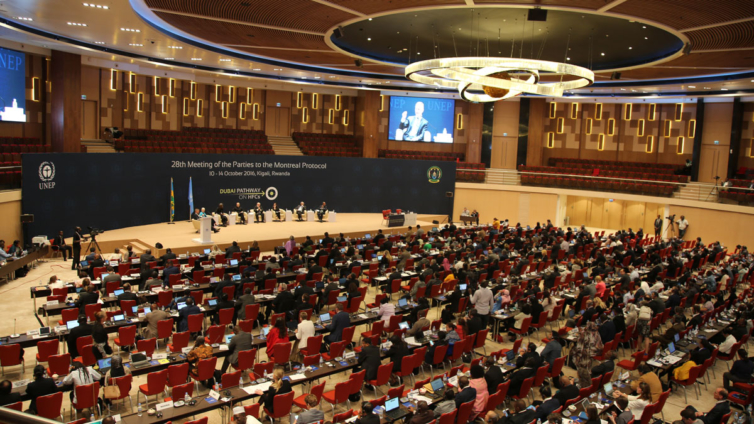
The Montreal Protocol, the first pact adopted by every UN member state, regulates nearly 100 man-made chemicals known as ozone-depleting substances (ODSs).
While the primary goal was to protect the ozone layer, ODSs are also significant greenhouse gases; therefore the agreement has delayed global warming.
According to the new study, the impacts of this include delaying the first ice-free Arctic summer (now expected for the middle of this century) by up to 15 years, depending on future emissions.
When scientists speak of an ice-free Arctic, they are referring to the disappearance of sea ice, which is generated by the freezing of seawater.
The ice-free Arctic is typically characterised as having less than one million square kilometres of sea ice.
According to researchers from UC Santa Cruz, Columbia University, and the University of Exeter, every 1,000 tonnes of ODS emissions avoided preserves almost seven square kilometres of Arctic sea ice.
“While ODSs aren’t as abundant as other greenhouse gases such as carbon dioxide, they can have a real impact on global warming,” said Dr Mark England, Royal Commission for the Exhibition of 1851 senior research fellow at the University of Exeter.
“ODSs have particularly powerful effects in the Arctic, and they played a major role in driving Arctic climate change in the second half of the 20th Century.
“While stopping these effects was not the primary goal of the Montreal Protocol, it has been a fantastic by-product.”
According to Dr England, opponents of the protocol projected a variety of bad repercussions, most of which did not occur, and instead, there are numerous documented cases of unforeseen climate advantages.
Professor Lorenzo Polvani, from Columbia University, said: “The first ice-free Arctic summer – meaning the Arctic Ocean practically free of sea ice – will be a major milestone in the process of climate change.
“Our findings clearly demonstrate that the Montreal Protocol has been a very powerful climate protection treaty, and has done much more than healing the ozone hole over the South Pole.
“Its effects are being felt all over the world, especially in the Arctic.”
The research published in the journal Proceedings of the National Academy of Sciences is titled "The Montreal Protocol is delaying the occurrence of the first ice-free Arctic summer," employed new climate model simulations, and found that ozone layer protection played no effect in reducing the loss of Arctic sea ice — all of the benefits are related to the role of ODSs as greenhouse gases.
ODSs which include chlorofluorocarbons, also known as CFCs are compounds that were produced in the last century for industrial use as refrigerants and propellants.
The Montreal Protocol, which has now been signed by all 198 UN members, restricted these substances in order to safeguard the ozone layer, which protects humans and the environment from hazardous levels of UV radiation.
The effort has been successful, with atmospheric ODS concentrations dropping since the mid-1990s and signs that the ozone layer is beginning to mend.
However, research has shown a modest increase in ODS concentrations from 2010 to 20; hence, Dr England advises caution.
The study was supported by the National Science Foundation in the United States.
Latest Stories
-
Ghana Development Awards 2026 set to celebrate excellence in nation-building and economic recovery
21 minutes -
IMANI opens applications for 12th SYPALA summer seminar
34 minutes -
Khamenei’s wife dies after suffering injuries in air strike – Iranian media
51 minutes -
Modernising customs operations: Leveraging advanced technology to combat fraud and inefficiencies
52 minutes -
Accra Professional Ladies Open returns after three-year hiatus to mark International Women’s Day
54 minutes -
Savannah police command lauds Yagbonwura and others for sustaining current peace
54 minutes -
SONA crafted to set up President Mahama – Economist
1 hour -
Gov’t losing focus over cedi appreciation – Economist
1 hour -
March 6 declared statutory public holiday for Independence Day
1 hour -
GCB Bank PLC reaffirms commitment to Ghana–China trade at Chinese New Year climax in Accra
1 hour -
Elikplim Akurugu cuts sod for construction of 5.2km Narhman-Musuku road
1 hour -
Woman, 25, convicted over acid attack that killed boyfriend
1 hour -
Bars close and hundreds lose jobs as US firm buys Brewdog in £33m deal
2 hours -
Barker-Vormawor vows to challenge GH₵5.1m Kan Dapaah defamation judgment
2 hours -
Court slaps Barker-Vormawor with GH₵5m in favour of Kan Dapaah for defamation
2 hours