

Audio By Carbonatix
Consumer advocacy group CUTS International is demanding urgent government intervention to ensure that Ghanaians fully benefit from recent reductions in fuel prices.
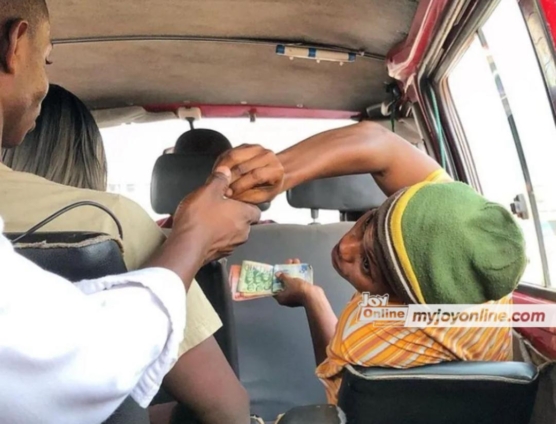
The organisation says the refusal of some commercial drivers to comply with the 15% fare reduction announced by the Ghana Private Road Transport Union (GPRTU) is exploitative and must be punished.
“Fuel prices have dropped significantly, and GPRTU has taken the commendable step of recommending lorry fare reductions by 15%,” said Appiah Kusi Adomako, West Africa Regional Director of CUTS.
“It is only fair that passengers, many of whom are struggling with the high cost of living, should see the benefits of this reduction reflected in their daily transport costs.”
Although the directive from GPRTU took effect on Saturday, 24 May 2025, many drivers and unions have refused to implement it, citing unrelated operational costs. CUTS has condemned the resistance, saying it is a betrayal of public trust.
“Transport fares are one of the biggest daily expenditures for millions of Ghanaians. Any attempt to suppress a legitimate fare reduction due to falling fuel prices is simply unacceptable,” Mr. Adomako said.
CUTS International is proposing a three-pronged approach to restore discipline in the transport system and protect passengers.
First, it wants the government to empower Metropolitan, Municipal, and District Assemblies (MMDAs) to deregister and ban drivers who refuse to adjust fares.
“MMDAs already have the mandate under local government laws to register and license commercial vehicles. Government should empower them to revoke the registration of drivers who refuse to comply with the new fare regime,” Adomako stated.
He also suggested the issuance of visible compliance stickers for drivers who obey the new pricing directive.
“This will allow the police and regulators to easily identify and sanction those who continue to exploit commuters.”
As an emergency measure, CUTS is calling on the government to authorise public universities to deploy their idle campus buses along affected routes.
“This would create a buffer for commuters and put economic pressure on defiant operators to reverse course,” Mr Adomako noted.
Beyond short-term responses, CUTS is urging long-term investment in Ghana’s public transport infrastructure.
“Globally, cities like London, New York, Seoul, and Berlin have strong public transport because their governments invest in it. Ghana must do the same,” he argued.
He called for the retooling of Ayalolo and Metro Mass Transit (MMT), alongside the construction of dedicated bus lanes, to improve service reliability.
“A strong state-run transport system can introduce healthy competition, improve service quality, and prevent arbitrary fare hikes.”
Mr. Adomako added that while Ghana operates a liberalised transport market, that does not mean the government is powerless.
“Just like the National Petroleum Authority (NPA) uses a pricing formula to manage fuel prices, we need a rational framework for transport fares during fuel price changes.”
“We need consumer-focused transport reforms that promote affordability, fairness, and safety,” he concluded. “Now is the time for action.”
Latest Stories
-
Kaneshie footbridge rehabilitation to take up to 9 months — AMA
2 minutes -
AMA confirms trading will be banned on Kaneshie footbridge after rehabilitation
12 minutes -
IMANI flags procurement concerns in state insurance placements
17 minutes -
Mahama’s push for visa-free Africa reflects Nkrumah’s Pan-African vision – Rashid Tanko-Computer
41 minutes -
Redefining sweetness: Why our celebrations must heal, not harm
42 minutes -
IMANI urges Mahama to reaffirm his 2014 directive on competitive state insurance placements
43 minutes -
Maiden Katon Praise comes off at Accra Sports Stadium on April 17
55 minutes -
Families flock to Luv FM Easter party at Rattray park in Kumasi
1 hour -
Rural health worker laments overwhelming burden at CHPS compounds
2 hours -
Katon Meet to stream Accra stadium Katon Praise Concert worldwide
2 hours -
Gov’t considers exploring local raw materials to stabilise production costs of sachet water prices
2 hours -
Mahama in Paris: Turning Diplomacy into Delivery
2 hours -
Middle East crisis shows Ghana needs to diversify energy sources – Energy expert
3 hours -
Government of Ghana Internal Revenue Generation cannot fund Big Push in Four Years
3 hours -
EPCG Moderator urges leaders to serve with courage and humility in Easter message
3 hours