

Audio By Carbonatix
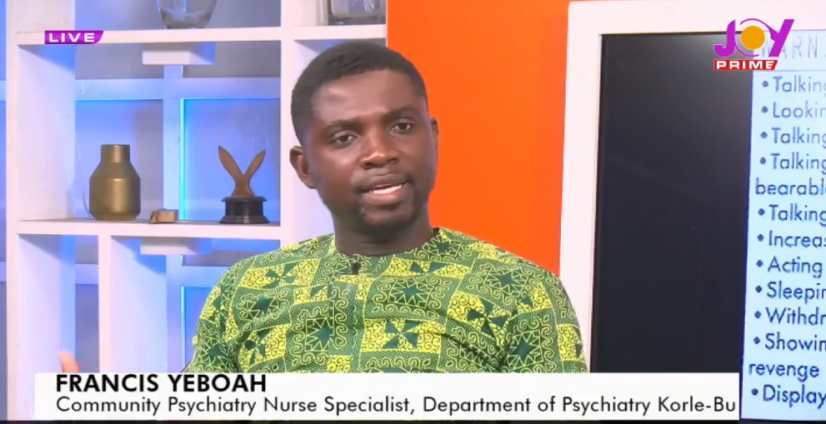
A community psychiatry nurse specialist at Korle-Bu Teaching Hospital, Francis Yeboah says people who commit suicide are been selfish.
He said some of the victims always want to satisfy their personal interests instead of considering their family’s legacy.
According to the psychiatrist, most people who decide to engage in suicide fail to consider the aftermath and consequences of the act towards their family.
He made these statements while discussing "Suicidal Patterns and Prevention: The Dynamics and Complications."
"The issue is that there are a lot of dreadful things that happen when you die. When one person commits suicide, it puts about 200 people in an uncomfortable state because, with victims that commit suicide, you realise that the whole family now has this feeling of guilt and shame," he said.
He urged people with suicidal thoughts to consider the wellbeing and legacy of their families after the act adding that it is capable of completely draining an entire family.
He believed dying is not just a solution, but rather leaves untouched issues that can remain with the family for several years.
Also contributing to the conversation, Dr. Abigail Harding, a psychiatrist at the Department of Psychiatry at Korle-Bu Teaching Hospital, indicated that some individuals commit suicide to ease financial challenges but end up destroying their families.
"I had a young man who is of university age, and he thought that by ending it all, he wouldn’t be a burden to his family because they wouldn’t have to pay fees for him to attend school... So he thought ending it all would stop the argument within his family and create peace," she narrated.
She further revealed that the families of suicide victims are at higher risk of also committing suicide after the loss of their loved ones.
This, she said, may be due to mental or behavioural conditions, as it could possibly be a genetic problem.
However, Dr Harding has appealed to societies and authorities to intensify the creation of awareness about stigmatisation so as to inform and educate people on the effects of the act.
Although the outcome of life is unpredictable, people are encouraged to have properly planned goals in a manner that will avoid such thoughts as "nobody knows tomorrow."
People are also encouraged to be open with some of their personal emotions that may be threats to their livelihood to create an avenue for support from society.
In the meantime, here are some warning signs of suicide one must watch out for: talking about wanting to die; increasing use of alcohol or drugs; sleeping too little or too much; talking about feeling hopeless, among others.
Latest Stories
-
President Mahama to attend One Health Summit in France, hold bilateral talks with Macron
11 minutes -
Mahama endorses ADB at Kwahu Business Summit
2 hours -
Every gram will be tracked – Gold Board unveils traceability push to deal with illegally-mined gold
2 hours -
Analysis: Why the Bank of Ghana sold half its gold reserves
2 hours -
Buy wrong gold, face prosecution – Gold Board CEO cracks down on rogue dealers
2 hours -
Africa pushes integrated health agenda ahead of One Health Summit in Lyon
2 hours -
We own the strategy, its not head office decision – GCB MD positions bank as engine of Ghana’s economy
3 hours -
No more waiting for head office – GCB boss pushes Ghana-first banking
3 hours -
Mahama lauds Julius Debrah for shaping Kwahu Business Forum
3 hours -
Why actors beg in difficulty – Patience Ozokwor on Nollywood financial struggles
3 hours -
Any man who apologises to woman deserves to suffer – Brymo
4 hours -
Nigerian artistes no longer put effort into making music – Omah Lay claims
4 hours -
‘I’m now skeptical about going into politics’ – Davido
4 hours -
Nigeria’s Seplat Energy resumes operations as oil workers halt strike action
4 hours -
Nigeria launches manhunt after abductions by bandits in northwest Zamfara
4 hours