

Audio By Carbonatix
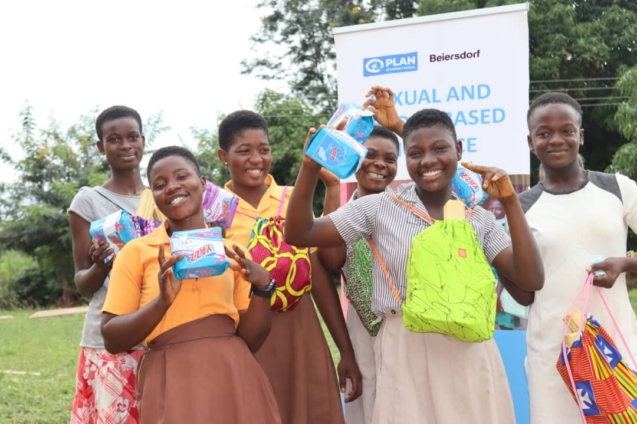
In a significant step towards ending menstrual poverty and promoting gender equality, Plan International Ghana has commended the Government of Ghana for its unprecedented budgetary allocation of GH₵292.4 million in the 2025 financial year to provide free sanitary pads to schoolgirls across the country.
The initiative, which fulfils a key 2024 manifesto promise by President John Dramani Mahama, will benefit female students in both primary and secondary schools, and is set to become a cornerstone policy in ensuring equitable access to education for girls.
Menstrual poverty remains a major barrier to the health, dignity, and educational progress of girls, particularly in rural and underserved communities. Many girls are forced to rely on unsafe and unhygienic alternatives—such as rags, newspapers, or leaves—due to an inability to afford sanitary products. This often results in health complications, increased absenteeism, and in severe cases, heightened vulnerability to abuse.
A Timely and Transformative Initiative
Speaking on the initiative, Mr Constant Tchona, Country Director of Plan International Ghana, described the allocation as a bold and transformative measure that will significantly reduce school absenteeism and improve menstrual health management among girls.
“We recognise the profound impact this initiative will have on the lives of girls, especially those in underserved rural communities. By ensuring access to free sanitary pads, the government is addressing a key driver of inequality and creating an enabling environment for girls to stay in school, focus on their education, and achieve their full potential,” he said.
Plan International’s Role in Fighting Menstrual Poverty
Over the years, Plan International Ghana has remained at the forefront of efforts to combat menstrual poverty. Through key projects and partnerships—such as SHE Leads, the Lead Fund, Be Smart, Learn and Stay Protected, and the Integrated Package for Sustainable Community Development (IPADEV)—the organisation has directly supported thousands of vulnerable adolescent girls.
Some of its major achievements include:
- Advocating for the removal of taxes on sanitary pads
- Distributing disposable sanitary pads to over 100,000 adolescent girls
- Leading advocacy for the development of certification standards for reusable sanitary products
- Training women and girls in the production of reusable sanitary products
- Distributing reusable sanitary pads to over 50,000 girls
- Promoting menstrual health education to reduce school absenteeism
- Engaging boys and men as allies in menstrual health advocacy
- Supporting visually impaired girls to demand improved sanitary facilities
- Introducing Pad Banks at institutions such as Wa Methodist School for the Blind and Dr Hilla Limann Technical University
- Conducting nationwide campaigns to challenge menstrual stigma
- Constructing over 100 girl-friendly latrines in schools
- Providing water facilities in schools and communities to enhance menstrual hygiene
- Supporting alumni-led ‘No Pad Tax’ campaigns, including a 1,000-signature petition to the Ministry of Gender, stakeholder dialogues, and policy advocacy
Call for Effective Implementation and Sustainability
While applauding the government’s bold step, Plan International Ghana also emphasised the importance of effective implementation, particularly in hard-to-reach areas where access continues to pose a challenge. The organisation urged the government to ensure:
- Equitable distribution of sanitary pads across all regions
- Continued investment in menstrual health education
- Adequate sanitation and water facilities in schools
Ongoing Advocacy and Policy Momentum
The recent budget allocation aligns with several advocacy milestones that Plan International and other partners have championed, including:
- The implementation of zero-rated VAT on locally produced sanitary pads
- Waivers on import duties for raw materials used in local production
- The public condemnation of taxes on sanitary products by the Speaker of Parliament, Rt Hon Alban Bagbin
- A private member’s bill introduced by MP Francis-Xavier Sosu to remove the 15% VAT on menstrual hygiene products
These complementary efforts demonstrate a broader commitment to sustainable policy reform and the safeguarding of girls’ rights in Ghana.
A United Front for Gender Equality
Mr Tchona reaffirmed Plan International Ghana’s commitment to working with government institutions, civil society, and communities to achieve menstrual equity.
“Together, we can create a future where every girl in Ghana can thrive, free from the barriers of menstrual poverty. Once again, we commend the Government of Ghana for this bold and transformative initiative, which will undoubtedly have a lasting impact on the lives of girls across the country.”
Latest Stories
-
DWM honours Nana Konadu Agyeman-Rawlings as it renews pledge for gender equality
11 minutes -
See the areas that will be affected by ECG’s planned maintenance on Tuesday, March 10, 2026
28 minutes -
CID recovers over 100 tonnes of stolen ECG cables in Tema raid
31 minutes -
Police identify fifth suspect in killing of Liberian national at Sakumono
37 minutes -
Pastor arrested in Cape Coast for child sexual abuse and production of indecent materials
38 minutes -
Dr Agnes Naa Momo Lartey to address the 70th Session of the Commission on the Status of Women
44 minutes -
Osei Assibey Antwi faces 21 counts as state files amended charge sheet
47 minutes -
Gender Ministry marks 2026 IWD with renewed call for equality
50 minutes -
IWD: Media must be deliberate in ending stereotypes about women – Joy Brands Projects Coordinator
52 minutes -
Awutu Senya East MP urges gov’t to boost malaria vaccination funding amid global cuts
59 minutes -
Petrine Addae launches ‘Single and Being – Trust the Faithful God’
60 minutes -
McDan donates GH¢200,000 to Volta Youth Development Fund, hails region as Ghana’s human skill hub
1 hour -
Nana Osowa Abena Korama-I aka Mrs Juliana Ackom
1 hour -
Invest in Ghana’s garment industry for job creation – Expert urges gov’t
1 hour -
Anny Osabutey: What is Daddy Lumba’s crime
1 hour