

Audio By Carbonatix
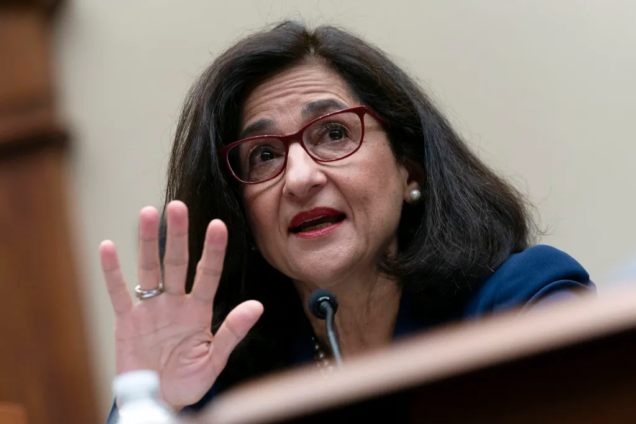
Columbia University President Minouche Shafik resigned effective immediately, the head of the prestigious New York university announced in a message to the university community on Wednesday.
Columbia’s upper Manhattan campus was at the center of a protest movement connected to the Israel-Hamas war that swept college campuses nationwide with thousands arrested and end-of-year graduation ceremonies disrupted. In her statement, she acknowledged those protests factored into her decision.
“This period has taken a considerable toll on my family, as it has for others in the community,” Shafik wrote. “Over the summer, I have been able to reflect and have decided that my moving on at this point would best enable Columbia to traverse the challenges ahead.”
In addition to the protests, the school in July removed three deans, who have since resigned, after officials said they exchanged disparaging texts during a campus discussion about Jewish life and antisemitism.
Shafik said in a July 8 letter to the school community that the messages were unprofessional and “disturbingly touched on ancient antisemitic tropes.”
Shafik said in her letter that she will return to the United Kingdom to lead an effort by the foreign secretary’s office reviewing the government’s approach to international development and how to improve capability.
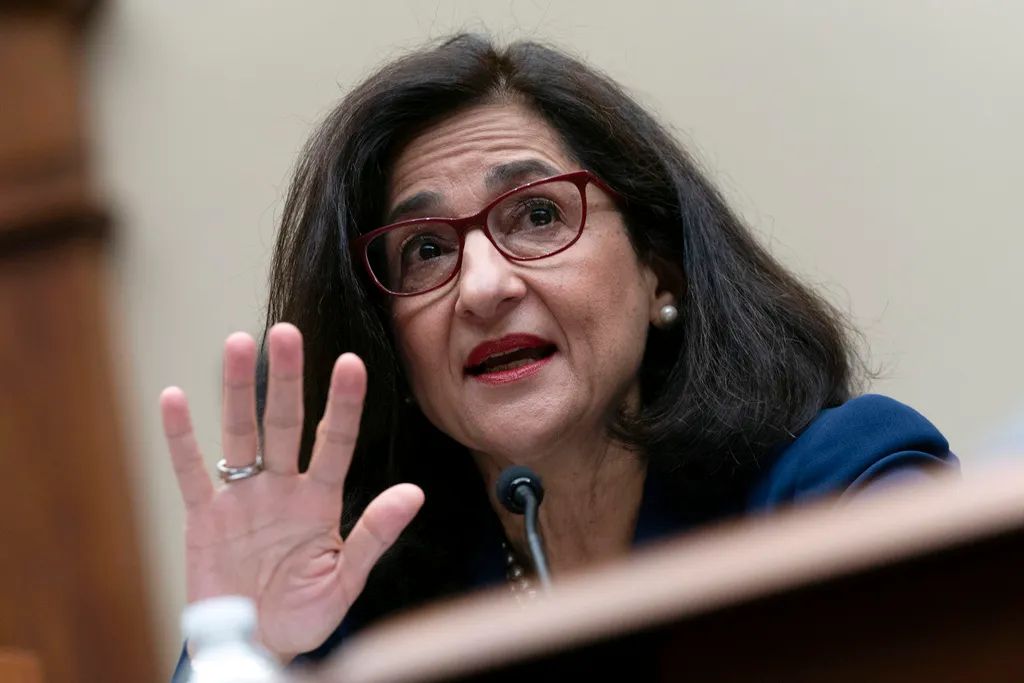
“I am very pleased and appreciative that this will afford me the opportunity to return to work on fighting global poverty and promoting sustainable development, areas of lifelong interest to me,” she wrote. “It also enables me to return to the House of Lords to reengage with the important legislative agenda put forth by the new UK government.”
Shafik was named president of the university last year and was the first woman to take on the role, and she was one of several women newly appointed to take the reins at Ivy League institutions.
She had previously led the London School of Economics and before that worked at the World Bank, where she rose through the ranks to become the bank’s youngest-ever vice president.
Shafik also worked at the United Kingdom’s Department for International Development, followed by stints at the International Monetary Fund and the Bank of England.
She earned her master’s degree at the London School of Economics and earned a doctorate at Oxford University.
At the time of Shafik’s appointment, Columbia Board of Trustees chair Jonathan Lavine described her as a leader who deeply understood “the academy and the world beyond it.”
“What set Minouche apart as a candidate,” Lavine had said in a statement, “is her unshakable confidence in the vital role institutions of higher education can and must play in solving the world’s most complex problems.”
Latest Stories
-
Africa must look inward: Reframing resilience in a shifting global econy
5 minutes -
7 dead, 2 missing after boat capsizes on Volta Lake
15 minutes -
Miss Diaspora Ghana 2026 launched to deepen diaspora ties and drive development
22 minutes -
US warns citizens to reconsider Nigeria travel on safety grounds
47 minutes -
Ivan Toney questions refereeing in Saudi Pro League title race after Al-Ahli draw
48 minutes -
Angola appoint Aliou Cissé as new head coach
60 minutes -
Virtual Security Africa showcases digital security vision at Kwahu Business Forum
1 hour -
EBID strengthens regional integration role amid global economic uncertainty
2 hours -
Two assault rifles, ammunition retrieved in Police probe of Tamale gang attack
2 hours -
EBID records strong financial growth with $722m disbursements in 2025 – President, Dr George Donkor
2 hours -
EBID to mobilise $2.69bn under new 2026–2030 growth strategy – Dr George Donkor
2 hours -
An open letter to telcos, regulators and security agencies on mobile money fraud in Ghana
2 hours -
Mobile Money Merchants are driving fraud
2 hours -
Alban Bagbin declines minority’s motion to investigate sale of gold reserves at BoG
2 hours -
NACOC leadership tours drug testing centres in Accra
2 hours