


Audio By Carbonatix
Tune into any television show in China and it's likely that you'll be met with a picture-perfect celebrity.
But musical act Produce Pandas, said to be the country's first ever "plus-size" boyband, are part of a new wave of celebrities viewed by audiences as more relatable.
It comes as celebrities in China are being criticised for being "image-obsessed", and the government has announced a crackdown on effeminate male stars.
The Produce Pandas, who debuted in July last year, sing upbeat songs about being confident and true to oneself. "Don't hold back. If you're chubbier, you're more eye-catching," they sing in one of their hits Stand Up.
Band member Ding tells the BBC: "We can't say we represent different people, we just hope that our attitude can give out good vibes.
"One time, we got a letter from a girl who was not very confident. She was a plumper girl and had some setbacks and she saw how our band works, it made her brighten up and more confident.
"I feel we can bring everyone joy and positive energy, and this is what we want to bring to everyone."
Some fans are now revelling in the idea of having celebrities that look just like them, after years of seeing thin and clean-cut male stars known colloquially as "little fresh meat".
"I feel that I am fat, ugly and uncomfortable when around many people… You have given me a lot of self-confidence, allowing me to have a new understanding of myself and dare to chase what I like," one fan of the group wrote on Chinese social media site Weibo.
'She will not cater to anyone's joy'
Besides Produce Pandas, plus-size comedian and filmmaker Jia Ling has also recently gained recognition.
Her 2021 film Hi, Mom turned her into the highest grossing female filmmaker in the world, beating Wonder Woman director Patty Jenkins. Ms Jia wrote and starred in the film, which was based on the relationship she had with her mother.
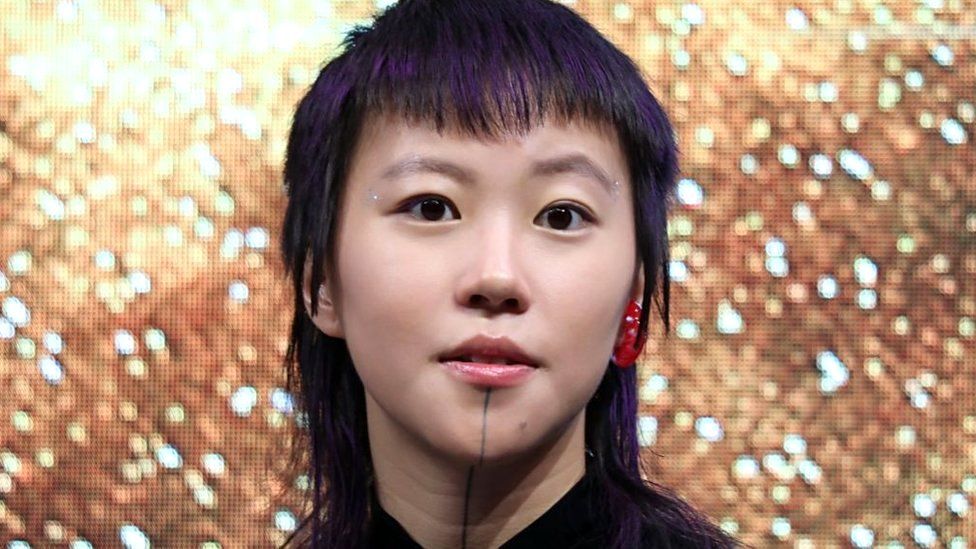
Meanwhile, singer-actress Dou Jintong, also known as Leah Dou, has gained popularity for her alternative and "edgy" look.
Unlike many Chinese, she dropped out of school during her teenage years to couch-surf around Los Angeles, has embraced an androgynous style during her career, and even has a face tattoo. These days she can be seen promoting cosmetics, presenting an image that is a far cry from the typical female Chinese model on billboards.
"She has been exploring and pioneering, doing whatever she wants to do," one Weibo fan wrote. "She will not cater to anyone's joy," they added.
Talent shows have also capitalised on this growing appetite. Sisters Who Make Waves, a show featuring female celebrities older than 30, was incredibly popular with Chinese audiences last year. It saw celebrities compete to make it to the final, where they formed a five-member female singing group.
"I am very happy that China has started to promote the beauty of 'old girls'," one user wrote on review site Douban.
Manya Koetse, a China social media specialist, tells the BBC that given the "enormous" size of the Chinese entertainment industry, "there is definitely an interest for more relatable celebrities".
She says this started with virtual influencer Papi Jiang in 2016, who became a viral hit and was one of the first women to become famous "without being covered in makeup, and she was very straightforward in speaking out her opinion and talking in a funny way about social issues".
The weight of expectations
But Ms Koetse notes that there are also growing expectations on what a celebrity should be. "The moment they do not adhere to what is expected of them, the consequences can be big," she says.
Papi Jiang, for instance, has had videos taken offline after using words and images deemed vulgar or "not responsible".
In 2019, Roy Wang, a member of the TF Boys, China's ultimate "fresh meat idol" group, got into trouble after he was caught smoking in a Beijing restaurant, flouting anti-smoking rules. It was a far cry from his patriotic, squeaky clean image and he was forced to apologise to his 73 million fans on Weibo.
"It really tarnished his image of being this good, talented, perfect boy," Ms Koetse adds.
This crackdown on celebrity culture has only intensified recently.
Last month, the government published guidelines saying they would ban broadcasts by "vulgar internet celebrities" and "feminine-looking men" because they do not portray the values the country wants to promote.
It is part of a tightening of rules over what China's broadcasting regulator described as "unhealthy content" in programmes. Authorities pledged to promote what it defined as more masculine images of men and criticised male celebrities who use lots of make up.
"How relatable can you be when you have to tick so many boxes and really mind what you say and what you do?" Ms Koetse says.
Latest Stories
-
Ghana–China Forum explores zero-tariff trade opportunities
4 seconds -
What is wrong with us?: A quiet truth we can no longer ignore
13 minutes -
What is wrong with us? : When sirens become symbols of power rather than protection and emergencies
32 minutes -
Businesses scramble to get noticed by AI search
54 minutes -
From perk to performance: Why employee wellness must be a core business strategy
1 hour -
Bank of Ghana’s $1.3bn profit from gold sale could help narrow 2025 losses
1 hour -
Odau Twafohene Baffour Osei Afrifa appointed Regent of Akyem Chia
1 hour -
We are focused on engineering low interest rate regime – BoG Governor assures
1 hour -
How Sporting hero Gyokeres could end European run
1 hour -
The attack on Ghanaian traders in Burkina Faso and the blame game: Why Hybrid Security Governance Holds the Key (II)
1 hour -
Bayern face waiting game on ‘very special’ Kane
2 hours -
The Problem with Nutrition Advice on Social Media – Lessons from a study among University Students
2 hours -
Arteta calls for perspective as Arsenal look to avoid slump
2 hours -
Kasoa Old Market traders given final eviction notice ahead of redevelopment
2 hours -
GH¢15 sachet water price is a ceiling, not fixed – Producers clarify
2 hours