

Audio By Carbonatix
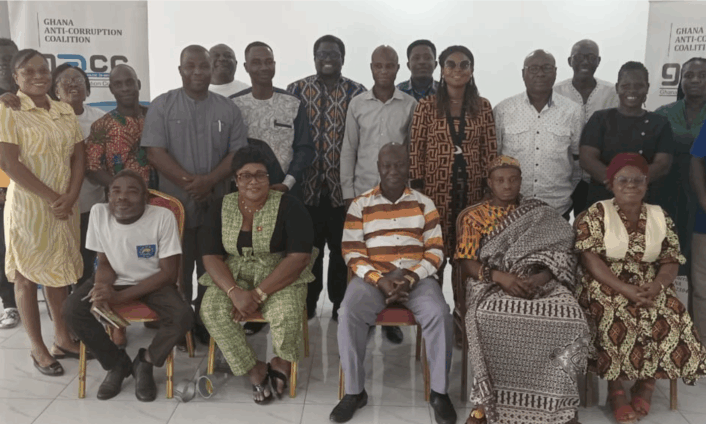
The Ghana Anti-Corruption Coalition (GACC) and its partners, including the Africa Centre for Energy Policy (ACEP) and Citizens Groups such as the Local Accountability Network (LANet), have concluded an advocacy and dissemination engagement with stakeholders at the district level in Ho.
GACC, through its ‘From Disclosure to Impact’ initiative, has mobilised local civil society organisations in the Volta Region to monitor projects funded from the extractive sector and advocate for the equitable, transparent, and accountable use of public resources.
The exercise, undertaken by LANet Ho Chapter and other partners, was part of efforts to verify published extractive-sector data and assess whether funds disbursed for development projects were delivering the intended impact at the community level.
The monitoring, which involved site visits to selected project locations, interviews with key stakeholders, including Presiding Members, Assembly Members, Planning Officers, and community beneficiaries, and photographic documentation of the project, progress and conditions.
Member organisations of the Ho LANet included the Africa Disability Institute (ADI), WomenNow Ghana, Global Action for Women Empowerment, YMCA Volta Regional Council, the National Commission on Civic Education (NCCE), JoyNews, WODAO, Zibo Mobisquad, Rural Needs Foundation (RUNEF) and the Alale Youth Association.
Projects funded through the Oil and Gas Annual Budget Funding Amount (ABFA) and monitored were drawn from the Akatsi North District and the Ho Municipality.
In Akatsi North, the team assessed the construction of 15 culverts across the Volta Region, four of which were in the district, the Ave Afiadenyigba–Gborxoxome–Korve Feeder Road, and the construction of the Ave-Dakpa Central Market.
In the Ho Municipality, monitored projects included the Community-based Health Planning Systems (CHPS) Compound at Klefe Demetey, the upgrading of roads in the CK and Fiave areas, the construction of the Ho Tarso Concrete Drains, and the Ho Leprosarium Flood Control Programme.
Findings from the monitoring revealed mixed results. While some projects were completed and improved residents' access and mobility, others showed significant shortcomings, including visible structural defects, a lack of accessibility features for persons with disabilities, the absence of project signboards, limited stakeholder involvement in design and implementation, and unresolved technical design issues.
For instance, the Ave-Dakpa Central Market was found to be completed but with noticeable defects, while market women managing the facility called for renovation and improved accessibility.
The Ave Afiadenyigba–Gborxoxome–Korve Feeder Road improved transportation for residents, although the absence of a project signpost made it difficult to trace the contractor.
In Ho, beneficiaries of the Tarso Concrete Drains project expressed dissatisfaction, citing the lack of safe access to homes, while the Leprosarium Flood Control Project was identified as having a potential design flaw that could undermine its effectiveness during heavy rainfall.
The monitoring team also identified several challenges, including difficulty accessing project details and contractor information, insufficient funding to visit all selected sites, and reluctance among some officials to share information because the exercise coincided with the 2024 general election period.
Despite the challenges, the team recorded successes, including the completion of the Ave-Dakpa Central Market, the upgrading of roads in the CK and Fiave areas, and progress on the Ho Tarso Concrete Drains.
Mr Solomon Nankah, the Monitoring and Evaluation Officer of GACC, said the project monitoring focused on project identification; location verification; stakeholder engagement; implementation and structural integrity; impact and sustainability; and Gender Equality and Social Inclusion (GESI).
He said the exercise focuses on deepening accountability and ensuring the use of state funds delivers value for money.
Ms Suzzy Sogbaka, the Focal Person for LANet, Ho Chapter, said the outcome is to address corruption and non-compliance issues identified in extractives-sector reports (oil and gas), with timelines for the monitoring exercise as follows: Phase One: June 2022 – August 2023; and Phase Two: March 2024 – March 2025.
She said LANet Chapter encountered monitoring challenges: “Limiting access to information, reducing accountability, delaying the process, and hindering cooperation from local officials.”
Mr Mohammed Avona Akape, the Chief Director of Volta Regional Coordinating Council (VRCC) had debunked the assertion that projects at certain stages were being awarded from national level without recourse to the VRCC and clarified that incidents in this category are rather few.
He said that in most instances, the VRCC was copied on project award documentation, clarifying that, though not the project award authority, they are always responsible for monitoring and evaluation.
“Ghana Highway Authority, Feeder roads, the Ghana Education Trust Fund (GETFUND) project awards were usually copied by the VRCC,” saying institutions like the LANet and partners usually missed, which offices to track these projects.
Participants recommended stronger collaboration between civil society and local authorities, greater community involvement in project design and contractor selection, and improved official recognition for monitoring teams through introduction letters or identification materials.
They noted that citizen-led monitoring remained a critical tool for strengthening transparency and accountability, and for ensuring that extractive-sector revenues translate into tangible development outcomes for communities.
Latest Stories
-
Edmond Boateng takes up secretary role at Honorary Consular Corps of Ghana
3 hours -
Gambia appoints British barrister to prosecute gruesome Jammeh-era crimes
3 hours -
Girl group Flo on entering into their ‘bombastic, confident, strong’ era
3 hours -
Germany suspends military approval for long stays abroad for men under 45
4 hours -
Liverpool face uphill Champions League task after PSG thrashing in Paris
4 hours -
‘Ketamine Queen’ sentenced to 15 years in Matthew Perry overdose death
4 hours -
Nigeria begins mass trial of 500 terrorism suspects
4 hours -
Atletico Madrid stun 10-man Barcelona to seize Champions League semi-final advantage
4 hours -
Black Stars coach to be announced by next week – Sports Minister
5 hours -
Chiefs, queen mothers and principal elders of Odau group denounce ‘rebellious Etweresohene’, pledges allegiance to Okyenhene
5 hours -
KNUST library dress code sparks online backlash over strict rules
5 hours -
Cultural Diplomacy in Action: Ghanaian youth leaders present symbolic smock to U.S. Chargé d’Affaires
5 hours -
Ghana Card payment activation under review – NIA breaks silence on financial integration
5 hours -
Ofori-Atta’s ICE release on bail positive; he poses no risk – Amanda Clinton
5 hours -
Ken Ofori-Atta’s passport seized after bail, set to reappear in US Court on April 27
5 hours