

Audio By Carbonatix
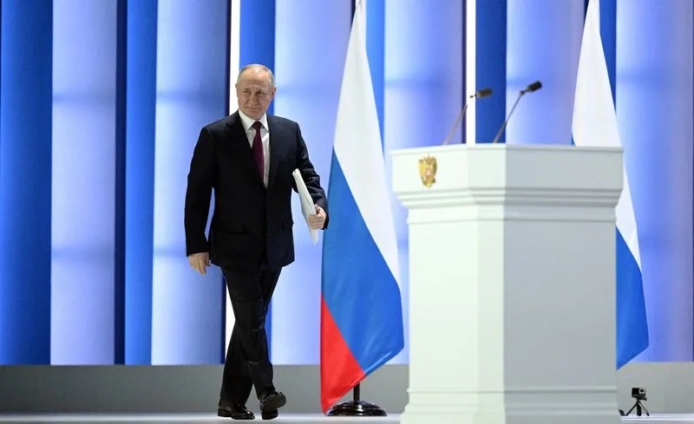
President Vladimir Putin revoked on Tuesday a 2012 decree that in part underpinned Moldova's sovereignty in resolving the future of the Transdniestria region - a Moscow-backed separatist region which borders Ukraine and where Russia keeps troops.
The decree, which included a Moldova component, outlined Russia's foreign policy 11 years ago which assumed Moscow's closer relations with the European Union and the United States.
The order revoking the 2012 document was published on the Kremlin's website and states that the decision was taken to "ensure the national interests of Russia in connection with the profound changes taking place in international relations".
It is part of a series of anti-Western moves announced by Putin on Tuesday.
Alexandru Flenchea, Moldovan chairman of the joint control commission in the security zone around Transdniestria, said the cancellation did not mean that Putin was abandoning the notion of Moldovan sovereignty.
"The decree is a policy document that implements the concept of Russia's foreign policy," Flenchea told Publika-TV. "Moldova and Russia have a basic political agreement that provides for mutual respect for the territorial integrity of our countries."
The Kremlin has said that Russia's relations with Moldova, which last week approved a new pro-Western prime minister that vowed to pursue a drive to join the EU, were very tense. It accused Moldova of pursuing an anti-Russian agenda.
Wedged between Romania and Ukraine, Moldova, one of Europe's poorest nations, has been led since 2020 by President Maia Sandu with strong U.S. and European Union backing. U.S. President Joe Biden met her in Poland on Tuesday affirming his support.
The 2012 decree committed Russia to seeking ways to resolve the separatist issue "based on respect for the sovereignty, territorial integrity and neutral status of the Republic of Moldova in determining the special status of Transdniestria".
The Russian-speakers of Transdniestria seceded from Moldova in 1990, one year before the dissolution of the Soviet Union, amid fears that Moldova would merge with Romania, whose language and culture it broadly shares.
A brief war pitted newly independent Moldova against the separatists in 1992. But there has been virtually no violence in the past 30 years, with Russian "peacekeepers" still posted in the tiny sliver of land, which has no international recognition.
Moldova's foreign ministry said it would "carefully study" the document.
Latest Stories
-
MTN Ashanti-Fest music concert set to hit Kumasi on Saturday
17 minutes -
Authorities probe discovery of dead fish at Tema shipyard
19 minutes -
Minority welcomes fuel tax cuts, demands accountability for GH¢1 levy
29 minutes -
It remains a priority — Sam George on Anti-LGBTQ bill
35 minutes -
Police arrest Nigerian national seen in viral videos wearing police uniforms
37 minutes -
Free golf training empowers underprivileged girls in Accra
53 minutes -
Why SIGA’s reset is not a market sin, but a national necessity
56 minutes -
SIGA Directive: Beyond the theatre of institutional displacement
59 minutes -
Boso Odweegyi Festival 2026 launched with call for unity, cultural preservation
59 minutes -
YEA clears majority of beneficiary arrears, assures completion of outstanding payments
2 hours -
AfCFTA key to building globally competitive African businesses – Zambia envoy urges Ghanaian CEOs
2 hours -
Albert Kobina Mensah, soil pollution and remediation: Risk assessment, phytoremediation, revegetation
2 hours -
GIFEC supports national rollout of One Million Coders Programme with laptop presentation
2 hours -
Old Tafo MP rolls out street lights project to boost security and night-time economy
2 hours -
Telecel Ghana CEO urges urgent education reform and stronger industry-academia partnership at UEW Public Lecture
2 hours