


Audio By Carbonatix
The assassination of Qasem Soleimani has plunged Iran and the United States into their most serious confrontation since the hostage crisis in 1979.President Donald Trump's decision to kill Soleimani removes one of the most obdurate and effective enemies of the US, and delivers a blow to the heart of the Islamic republic of Iran. It is also a dangerous escalation in a region that was already tense and full of violence.The killing at Baghdad airport has increased tensions sharply, creating fears of a slide into an all-out war. That is no certainty. Neither the Americans nor the Iranians want one. But the crisis brought on by the killing of Soleimani - and a senior Iraqi ally - amplifies the chances of a bloody miscalculation.Iran has sworn vengeance. That threat has to be taken seriously. Soleimani was at the core of the regime, and a talisman for Iran's hardliners. They will want to get even, perhaps more than that.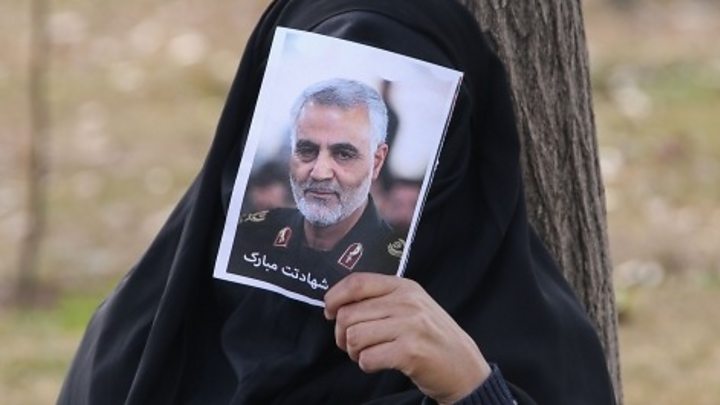 Media caption: Thousands took to the streets of Kerman to mourn Gen Soleimani, a popular figure in IranAn act of war to answer that of the US - for example attacking US ships in the Gulf - would risk provoking a devastating response. Iran's oil refineries are on the coast and would be easy targets for the vast firepower the US has in and around the Gulf.When Iran retaliates, it is likely to follow Soleimani's own indirect tactics: so-called asymmetric warfare, spurning an attack through the front door for one through a side window.Soleimani cultivated a range of well-armed militias, which give Iran options short of a head-to-head confrontation with the Americans which it would only lose.The Americans will now be looking at their most vulnerable deployments in the Middle East. One is the small force in Syria.
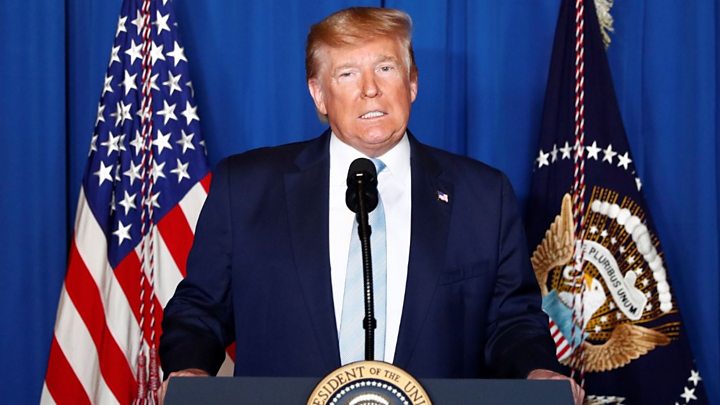 Media caption: Trump - We took action to stop, not start a warBut it is not at all clear whether the assassination fits into a coherent US strategy, and such an assumption could be dangerous and wrong.Soleimani was a colossal figure inside Iran. He was its strategic mastermind. Perhaps he left a plan of steps to take if he were killed.This assassination at the start of a new year and a new decade might turn into another Middle Eastern milestone, touching off another sequence of bloody events.To begin with, the Iranian regime must now be planning its answer to his death, to show that the position Soleimani spent so long creating outside its borders in the Middle East can be defended.
Proxy forces
Despite arms embargoes, Iran has developed a modern arsenal of rockets and missiles. But if it wanted to use them against US forces as part of a reprisal, Iran would risk making matters worse.Media caption: Thousands took to the streets of Kerman to mourn Gen Soleimani, a popular figure in IranAn act of war to answer that of the US - for example attacking US ships in the Gulf - would risk provoking a devastating response. Iran's oil refineries are on the coast and would be easy targets for the vast firepower the US has in and around the Gulf.When Iran retaliates, it is likely to follow Soleimani's own indirect tactics: so-called asymmetric warfare, spurning an attack through the front door for one through a side window.Soleimani cultivated a range of well-armed militias, which give Iran options short of a head-to-head confrontation with the Americans which it would only lose.The Americans will now be looking at their most vulnerable deployments in the Middle East. One is the small force in Syria.Calculated risk
A big question is why the Americans chose now to kill Soleimani.He had been a thorn in their sides since at least the US invasion of Iraq in 2003. He made sure Iraqi Shias raised, trained and equipped militias which became effective and ruthless fighters against the US and its allies.The Americans and their allies in Israel and the West have tracked Soleimani closely for years. It's likely that he has been in their sights before.The fact that this time the Americans pulled the trigger suggests that President Trump believes the reward is worth the risk, that the Iranian regime has been so weakened by isolation, economic sanctions and recent demonstrations that it will rage but not offer a serious strategic threat.Media caption: Trump - We took action to stop, not start a warBut it is not at all clear whether the assassination fits into a coherent US strategy, and such an assumption could be dangerous and wrong.Soleimani was a colossal figure inside Iran. He was its strategic mastermind. Perhaps he left a plan of steps to take if he were killed.This assassination at the start of a new year and a new decade might turn into another Middle Eastern milestone, touching off another sequence of bloody events.To begin with, the Iranian regime must now be planning its answer to his death, to show that the position Soleimani spent so long creating outside its borders in the Middle East can be defended.DISCLAIMER: The Views, Comments, Opinions, Contributions and Statements made by Readers and Contributors on this platform do not necessarily represent the views or policy of Multimedia Group Limited.
Tags:
DISCLAIMER: The Views, Comments, Opinions, Contributions and Statements made by Readers and Contributors on this platform do not necessarily represent the views or policy of Multimedia Group Limited.
Latest Stories
-
Authorities probe discovery of dead fish at Tema shipyard
1 minute -
Minority welcomes fuel tax cuts, demands accountability for GH¢1 levy
11 minutes -
It remains a priority — Sam George on Anti-LGBTQ bill
16 minutes -
Police arrest Nigerian national seen in viral videos wearing police uniforms
18 minutes -
Free golf training empowers underprivileged girls in Accra
35 minutes -
Why SIGA’s reset is not a market sin, but a national necessity
38 minutes -
SIGA Directive: Beyond the theatre of institutional displacement
41 minutes -
Boso Odweegyi Festival 2026 launched with call for unity, cultural preservation
41 minutes -
YEA clears majority of beneficiary arrears, assures completion of outstanding payments
1 hour -
AfCFTA key to building globally competitive African businesses – Zambia envoy urges Ghanaian CEOs
2 hours -
Albert Kobina Mensah, soil pollution and remediation: Risk assessment, phytoremediation, revegetation
2 hours -
GIFEC supports national rollout of One Million Coders Programme with laptop presentation
2 hours -
Old Tafo MP rolls out street lights project to boost security and night-time economy
2 hours -
Telecel Ghana CEO urges urgent education reform and stronger industry-academia partnership at UEW Public Lecture
2 hours -
Nigerian army general and several soldiers killed in assault on military base in northeast
2 hours