

Audio By Carbonatix
A Pan African Scholar, Professor Patrick Loch Otieno Lumumba, has called on African Nations to urgently rethink and decolonise their education systems because genuine transformation hinges on the return to indigenous knowledge, values and innovation.
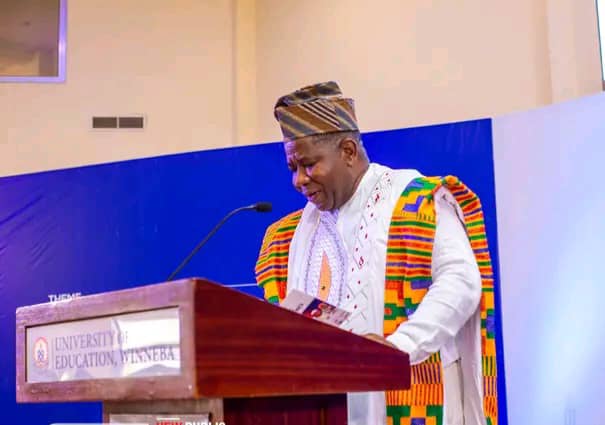
Prof Lumumba made the call at the University of Education, Winneba’s 2025 Public Lecture Series on the theme: "Empowering minds, shaping futures for 21st century education" at Winneba.
The flagship Intellectual platform brought scholars, policymakers, practitioners, higher education administrators, other stakeholders and the general public together to engage in critical conversations on issues of national and global importance.
Prof Lumumba stated that the prospects and challenges of 21st-century education and its lessons for Ghana resonated strongly with UEW’s vision of promoting critical thinking, research, and inclusive dialogue on national development.
He emphasised that true educational reform must begin with mental liberation.
He challenged Africans to decolonise their minds and reclaim their identity through transformative education.
Prof Lumumba was concerned that Africans still equate intelligence with fluency in speaking colonial languages, while disregarding native wisdom and languages.
“Our minds have been conditioned to believe that only John can go to heaven, not Kofi; we were told our languages, our systems, and our ways of knowing were inferior,” Prof Lumumba said.
He also criticised the continents' continued reliance on imported goods and services despite producing abundant raw materials.
Prof Lumumba said: “Africa consumes what it does not produce and produces what it does not consume,” he emphasised, mentioning areas that also needed reforms to include agriculture, sports, and medicine and further called on universities like UEW to lead in producing relevant knowledge that addressed Africa’s real challenges.
He echoed Ngũgĩ wa Thiong’o, a renowned African writer’s call for all Africans to decolonise the mind, warning that Africa’s future depended on rewriting schools’ curricula and restoring cultural self-esteem.
He underscored the philosophical foundation of African education reform in the historic speeches delivered by African leaders during the formation of the Organisation of African Unity in 1963.
Prof Lumumba hailed the efforts of Ghana’s first President, Osagyefo Dr Kwame Nkrumah, for his role in the establishment of tertiary education through the founding of the University of Ghana, Kwame Nkrumah University of Science and Technology, and the institute that birthed UEW.
"I challenge the audience, particularly young scholars and educators, to draw inspiration from this legacy and redefine Africa’s curriculum based on indigenous knowledge, innovation and self-confidence," he said.
With rich historical reflections, Prof Lumumba dismantled colonial narratives that portrayed Africa as intellectually barren before colonisation.
He highlighted the pre-colonial African civilisations like Timbuktu and Benin, which had evidence of the Continent’s ancient scholarly and technological prowess, adding, “Africa had a golden age, and we must never romanticise the past, but reclaim it to shape our future.”
Prof Lumumba stated that true educational reform must begin with mental liberation and further address scars of colonialism, referencing Dr Kwame Nkrumah’s caution on neo-colonialism as “the last and most dangerous stage of imperialism.”
He further hailed his efforts for institutionalising tertiary education through the founding of the University of Ghana, Kwame Nkrumah University of Science and Technology, and the Institute that birthed UEW."
He urged the students and faculty to aspire to the new African citizens Dr Nkrumah dreamed of, with imagination, passion, and spirit of innovation to transform Africa and further urged the audience, particularly young scholars and educators to draw inspiration from this legacy and redefine Africa’s curriculum based on indigenous knowledge, innovation and self-confidence.
Prof Lumumba urged the UEW and other African universities to work to eliminate outdated paradigms and develop contextually relevant models that reflect Africa’s realities and aspirations and further called on the academic community to admit past shortcomings.
They should also embrace the responsibility of shaping a new generation of Africans equipped, not only with certificates but imagination, innovation, and purpose.
Prof Lumumba critiqued Africa’s continued reliance on colonial legal, educational, and administrative systems, describing them as a form of mental imprisonment and urged UEW and other African universities to challenge outdated paradigms and develop contextually relevant models that reflect Africa’s realities and aspirations.
Leadership Expert, Dr Samuel Koranteng-Pipim, advocated for mind empowerment for Ghana’s future, while UNESCO Ghana Representative, Mr Edmond Moukala, also championed a bold rethink of Africa’s education for a better future.
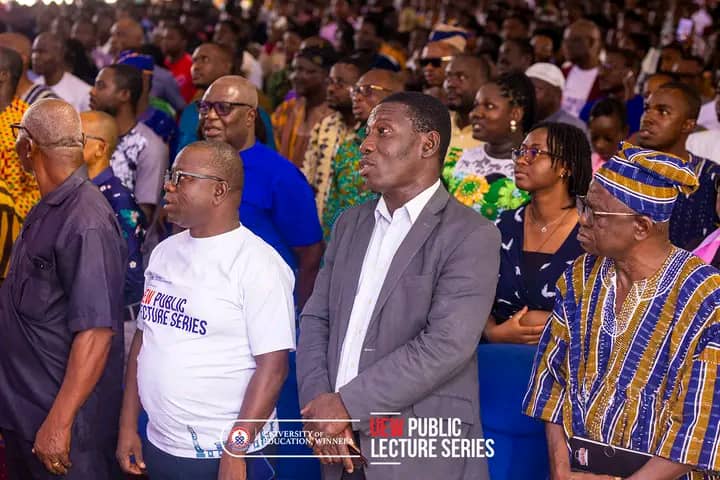
With a standing ovation, the audience at UEW responded by endorsing the speeches, not just as historical moments but as a clarion call for the university to rise boldly in its mission to educate for liberation and transformation.
Latest Stories
-
Afenyo-Markin demands Interior Minister brief Parliament over security recruitment expansion
2 hours -
Felicia Boadu inspires gratitude with new song ‘Aseda’
2 hours -
Conflict of interest and the President’s use of a private jet: A constitutional perspective
2 hours -
Otto Addo names Black Stars squad for Austria and Germany friendlies
2 hours -
Rev. Stephen Wengam urges leaders to embrace ‘servant leadership’ to transform national institutions
2 hours -
Ghana Development Awards spotlight need for intentional socio-economic transformation
2 hours -
The Private Jet Debate: When generosity becomes an alleged “Scandal”
2 hours -
IGP Cyber Vetting arrests 20-year-old woman for false publication on social media
2 hours -
Overall government debt in sub-Saharan Africa stabilises but at high level – IMF
3 hours -
We will file an appeal against Freddie Blay’s remand – Lawyer
3 hours -
Tema crash: Safety record of microlight aircraft ‘very poor’ – Aviation expert
3 hours -
Only 5% of CHPS compound in Ghana are well tooled – Agotime Ziope MP
3 hours -
PwC Ghana , UGBS call on women to embrace collaboration and take up leadership roles
3 hours -
‘My mother cried out one last time’: Palestinian boy, 12, describes how Israeli forces killed his family in car
3 hours -
National Seed System Reset Programme launched at University of Ghana to boost 24-hour economy
3 hours