

Audio By Carbonatix
Associate Professor at the University of Ghana, Professor Elsie Effah Kaufmann, has called on the Ghana Education Service (GES) to look for ways to reward those who go the extra mile to promote STEM education.
She said the narrative about STEM was changing and individuals and organisations doing their best to promote it needed to be encouraged and rewarded.
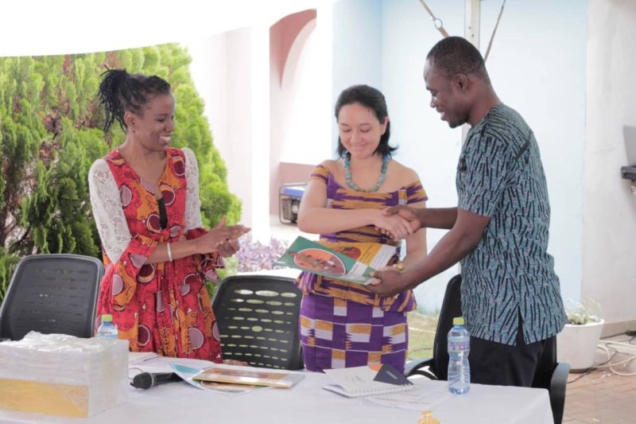
Prof Kaufmann said this in an interview with GNA on the sidelines of the launch of the Practical Education Network's (PEN) Resource Centre and Science Resource Manual for Basic School Teachers.
The Centre will enable schools and other education stakeholders to learn STEM subjects practically and experience what the hands-on STEM approach means in reality.
It is equipped with hands-on STEM activities made from local materials.
The Manuals contained tested science activities for teachers to follow in order to make learning impactful, meaningful, and enjoyable for all leaders.
It provides step-by-step procedures for activities that bring every single science topic in the curriculum to life.
Prof Kaufmann urged stakeholders in education to endeavour to include practical steps to teach other subjects for easy learning not only for STEM.
She said previously STEM education had been a means to an end but " l am happy to note that there are changes in the promotion of these subjects in the country."
The Associate Professor said as a country, there was the need for critical mass if people, educators, believe in the narrative and were willing to put in the effort to change society.
She commended the management of PEN for their continuous support in promoting the teaching and learning of STEM subjects right from the basic education level Dr Heather Beem, the Founder, and CEO of PEN, said the activities had been carefully illustrated to make them easier to replicate through their visual appeal.
She said the manual had been prepared in alignment with the new national primary school science curriculum (2019) and will support teachers to deliver a hands-on teaching approach in classrooms across the country.
The Founder said PEN donated the first 1400 copies of its recently approved National Council for Curriculum and Assessment, (NaCCA) science teacher resource manuals for upper and lower primary schools to the Science Education Unit of the Ghana Education Service.
She said PEN would continue to train STEM teachers to employ hands-on pedagogical, leveraging locally available materials for the practice experience.
"PEN teachers equip their students with technical skills to solve the continent’s pressing challenges," she added.
Mr Emmanuel Omang Ocquaye, National Integrated Science Coordinator, Science Education Unit of GES, commended the management of PEN for their contributions to the development of STEM education in the country.
Latest Stories
-
IMANI demands review of SIGA directive steering SOEs toward SIC placements
2 minutes -
Climate change and pollution threaten livelihoods of White Volta fishermen
10 minutes -
First Atlantic Bank targets regional growth and digital expansion in 2026 outlook
13 minutes -
Bond market: Turnover surges 559.42% to GH¢2.49bn
17 minutes -
Dagomba line residents begin rebuilding after Easter Monday inferno
17 minutes -
ECG substation upgrade exercise: parts of Accra to experience power outages
21 minutes -
IMANI petitions Mahama over alleged procurement breaches in state insurance placements
26 minutes -
First Atlantic Bank posts strong 2025 results as profit surges 30.5%
29 minutes -
Maguire signs contract extension with Man United
31 minutes -
The WTO is debating trade: The world runs on investment
58 minutes -
Minority questions gov’t purchase of fuel-powered buses, pushes for electric alternative
1 hour -
GFA Executive Council to decide on new Black Stars coach ahead of 2026 World Cup
1 hour -
One injured as fire destroys 14-bedroom house at Kwame Danso
1 hour -
GACL struggling despite recording profit, levy needed for expansion – Agalga
1 hour -
Kwahu Business Forum: Ghana Sports Fund calls for stronger corporate backing for sports dev’t
1 hour