

Audio By Carbonatix
Fuel prices may rise again soon, but what if higher prices don’t actually reduce petrol consumption in Ghana?
Discussions about rising global crude oil prices are once again dominating energy market conversations, raising concerns about higher petrol prices and increased transport costs across Ghana.
Yet the relationship between oil prices and petrol consumption may not be as straightforward as many assume. Conventional economic theory suggests that when fuel prices rise, consumers should reduce consumption. However, recent research analyzing Ghana’s petrol market reveals a more complex pattern of behavior.
The study finds that crude oil prices exhibit a positive relationship with petrol consumption, indicating that higher prices do not necessarily suppress demand as standard models predict.
This pattern reflects several structural characteristics of Ghana’s economy.
First, alleged BDC's stockpiling increases the potential for increased purchases(demand) vis a vis consumption as consumers often engage in anticipatory or hoarding behavior when price increases are expected.
Second, global crude oil price increases do not necessarily reduce petrol consumption in Ghana in the short run. Petrol is an essential input for transport, logistics, and small business operations, meaning substitution possibilities are limited. As a result, consumption may remain stable or even increase due to inventory adjustments and expectations of further price hikes
These findings also carry an important methodological implication that Traditional symmetric demand models, which assume that price increases and decreases produce equal but opposite responses in consumption, appear to misrepresent the dynamics of Ghana’s petrol market.
When asymmetric price behavior such as the Rock-and-Feathers effect interacts with structural demand constraints, consumption responses become more complex than standard theory predicts.
Using monthly national data from 2016 to 2024 and applying a nonlinear econometric approach, the study examined how crude oil prices, exchange rates, inflation, and domestic fuel taxes affect petrol consumption.
The findings show that petrol consumption in Ghana responds asymmetrically to price changes. In practical terms, this means that price increases and price decreases do not affect consumption in the same way.
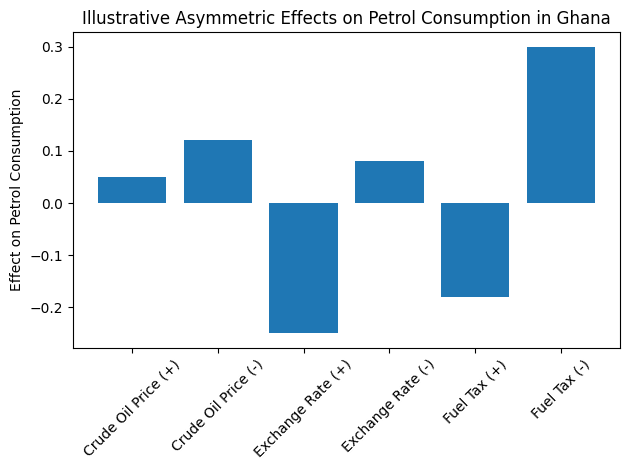
The research also highlights the importance of exchange rate movements. Because Ghana imports most of its refined petroleum products, a depreciation of the cedi significantly increases the local cost of fuel and tends to reduce consumption.
Perhaps the most influential factor identified in the study is domestic fuel taxation. Changes in taxes, levies and margins have a stronger effect on petrol consumption than movements in global crude oil prices. In particular, reductions in fuel taxes tend to stimulate consumption much more strongly than tax increases suppress it.
These findings suggest that policymakers seeking to manage fuel demand, inflation, and fiscal stability should pay close attention to domestic fuel pricing structures rather than focusing solely on international oil price movements.
As global oil markets face renewed volatility, understanding how Ghanaian consumers and businesses respond to fuel price changes will become increasingly important for economic planning and energy policy
Understanding the behavioral responses behind fuel consumption is critical for managing energy affordability, fiscal stability, and economic resilience.
The next time fuel prices rise in Ghana, the assumption that “higher prices reduce consumption” may need to be reconsidered.
In reality, the dynamics of petrol demand are shaped by behavioral responses, policy decisions, and exchange rate pressures, not just global crude oil prices. Understanding these asymmetries could be the difference between reacting to fuel price shocks and actually managing them.
Latest Stories
-
Uganda confirms 2027 AFCON dates
4 minutes -
40 convicted in Northern Region crime crackdown
4 minutes -
‘We’re days away from parts of the world experiencing actual shortages:’ Eric Nuttall on energy
14 minutes -
‘I’m Obroni in every country’ – Coco Blasian on music, survival and making Accra home
15 minutes -
IMANI wants NIC to probe possible conflicts of interest in reinsurance arrangements
27 minutes -
First Atlantic Bank strengthens balance sheet as net interest income surges 67%
31 minutes -
Choplife Gaming donates to Korle Bu Radiotherapy unit for Women’s Week 2026
32 minutes -
Would President Mahama have reduced cocoa prices if this were an election year ? – Annoh Dompreh asks
35 minutes -
Passion, not survival, should drive career choice – Dr Kofi Annan
36 minutes -
Climate change, pollution and overfishing push White Volta fishermen to the brink
36 minutes -
IMANI demands review of SIGA directive steering SOEs toward SIC placements
41 minutes -
Climate change and pollution threaten livelihoods of White Volta fishermen
49 minutes -
First Atlantic Bank targets regional growth and digital expansion in 2026
52 minutes -
Bond market: Turnover surges 559.42% to GH¢2.49bn
56 minutes -
Dagomba line residents begin rebuilding after Easter Monday inferno
57 minutes