

Audio By Carbonatix
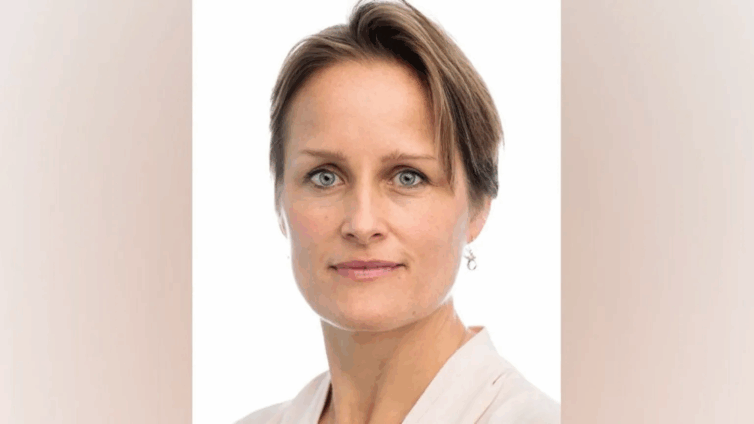
The new chief of MI6, Blaise Metreweli, will warn of "the acute threat posed by Russia" when she makes her first public speech later.
She will highlight so-called hybrid warfare, which includes incidents such as cyber attacks and drones suspected of being launched near critical infrastructure by Russian proxies.
Ms Metreweli will describe this as "an acute threat posed by an aggressive, expansionist and revisionist Russia".
Referring to the war in Ukraine, she will insist that Britain will be keeping up the pressure on President Vladimir Putin on Ukraine's behalf.
Ms Metreweli, who took over as head of the Secret Intelligence Service in the autumn, is the first woman to head Britain's overseas spy agency. She took over from Sir Richard Moore on 1 October.
Monday's speech will point to the recent sanctioning of Russian entities accused of conducting information warfare, as well as two China-based companies sanctioned for their "indiscriminate cyber activities against the UK and its allies".
Western sanctions have certainly damaged Russia's economy, driving its exports eastwards towards China and India. But they have singularly failed to change President Putin's determination to wage war on Ukraine until it gives in to his demands for territory and, ultimately, loyalty to Moscow.
It is also clear from Ms Metreweli's speech that a special area of interest for the new spy chief is technology.
Having joined MI6 in 1999, she has arrived at the top job via Q Branch. Named after the fictional MI6 division in Ian Fleming's spy books, this is the real-life, in-house, top-secret part of the Secret Intelligence Service that designs the sorts of gadgets and gizmos that enable agents to communicate with their handlers, without being detected and caught.
In her speech later, she is expected to call on all her intelligence officers to master technology, "not just in our labs, but in the field, in our tradecraft.. We must be as comfortable with lines of [computer] code as we are with human sources, as fluent in Python as we are in multiple languages".
Python, a programming language, may surprise some as an example to pick, since it has been around for more than three decades. But her point will not be lost on the men and women who have chosen to work in the shadowy world of espionage.
In an age where data is key, where spies can no longer rely on false identities when biometric scanning can unmask them in seconds at borders and checkpoints, MI6 needs to prove that it can still be relevant.
Elsewhere, the Chief of the Defence Staff, Sir Richard Knighton, will on Monday call for a "whole of society approach" to building national resilience, in the face of growing threats and uncertainty.
In a speech to the Royal United Services Institute in London, Sir Richard is expected to say that defence and resilience need to be a higher priority for everyone, not just those in the military.
It is the latest in a string of warnings that the UK needs to be more ready than it is now to meet a growing volume of threats.
Sir Richard is expected to say that the situation is more dangerous than he has known during his entire career.
Russia has made it clear that it wishes to challenge, limit, divide and ultimately destroy Nato, he will say.
Britain's response needs to be about more than simply strengthening the armed forces. Deterrence, he will say, involves harnessing the UK's power, from its universities to industry, the rail network and the NHS.
"A new era for defence doesn't just mean our military and government stepping up - as we are - it means our whole nation stepping up," he will say.
Addressing a skills gap highlighted in a recent report by the Royal Academy of Engineering, Sir Richard will talk about the need to work with industry and young people and will announce £50m for new defence technical excellence colleges.
In recent weeks, both France and Germany have outlined plans for voluntary national service.
Last year, the then-Conservative government set out its own compulsory proposals, which Labour dismissed as a gimmick.
But the debate about how Britain as a whole should respond to an increasingly uncertain world is gathering pace.
Latest Stories
-
Every neurodivergent child deserves to thrive – AWARE 2026 walk set for North Legon
1 minute -
Ghana-Russia Centre, ATF donate to Princess Marie Louise Children’s Hospital
5 minutes -
NPP increases polling station coverage per election committee from 10 to 25
9 minutes -
Ghana card cannot be used for financial transactions – NIA debunks false reports
10 minutes -
Successful conviction secured for illegal fish processing operation in Watford
15 minutes -
Bowen: Ceasefire means respite for civilians, but it might not last long
16 minutes -
Ofori-Atta not yet formally notified of any charges – Frank Davies
16 minutes -
Asanko Gold supports road rehabilitation to ease transport challenges in Amansie West
28 minutes -
Serial killer pleads guilty to eight murders in case that haunted Long Island, New York
31 minutes -
NPP used Bosomtwe road as ‘election machine’ but failed to dedicate funds for its completion – Dr Amoakohene
37 minutes -
CSOs warns of contraceptive crisis as $500k UNFPA supplies stall at port
43 minutes -
Africa’s youth bulge a ‘defining moment’ that requires urgent action – NYA CEO Osman Ayariga
50 minutes -
No looming power crisis; Ghana’s electricity supply remains stable – Energy Ministry PRO insists
1 hour -
Mahama should reset his stance on LGBTQ -Clinton Baffour
1 hour -
Rising sachet water costs should spark a bigger conversation on plastic waste
1 hour