

Audio By Carbonatix
Sanitation remains a major issue in Ghana, with waste management, poor water quality, and inadequate hygiene posing significant risks to public health, the environment, and economic productivity.
According to the Ghana Statistical Service, nearly 23% of households lack adequate sanitation facilities, leading to the spread of diseases such as cholera and diarrhea.
The challenges are widespread, from urban centers like Accra, which generates over 3,000 tonnes of waste daily, to rural communities struggling with access to clean water. AI offers innovative solutions that can revolutionize how sanitation is managed in Ghana, providing a data-driven approach to tackle these issues effectively.
One of the critical areas where AI can make a significant impact is waste management. The traditional approach to waste collection in Ghana is often inefficient, with trucks following fixed routes regardless of the actual need.
AI-powered waste bins equipped with sensors can monitor fill levels, optimizing collection schedules and reducing operational costs. For example, smart waste systems implemented in cities like Copenhagen have shown a 50% reduction in waste collection costs. Applying a similar approach in Accra or Kumasi could not only streamline waste management but also significantly reduce the environmental impact of uncollected waste.
Furthermore, AI can revolutionize waste sorting processes through automation. AI-powered robots can identify and separate different materials faster and more accurately than human workers, boosting recycling rates and minimizing the volume of waste ending up in landfills.
In China, AI-driven recycling facilities have achieved up to 95% accuracy in sorting recyclable materials, setting a precedent for what could be accomplished in Ghana. By investing in such technologies, local governments can enhance waste management systems, turning waste into a resource and reducing environmental pollution.
Water quality is another pressing concern that AI can address effectively. In many parts of Ghana, water sources are contaminated due to industrial activities, poor sanitation, and agricultural runoff. AI-driven sensors can monitor water quality in real-time, detecting contaminants such as heavy metals, pathogens, and harmful chemicals. For instance, Cape Coast and Sekondi-Takoradi could benefit from AI sensors placed in rivers and water treatment plants to ensure that water reaching households is safe for consumption. In South Africa, similar AI-powered systems have been used to monitor water quality, helping communities avoid waterborne diseases.
Beyond monitoring, AI can also predict water contamination events by analyzing weather patterns, industrial discharge, and other risk factors. This predictive capability allows authorities to take proactive measures, such as issuing warnings or adjusting treatment processes, to prevent potential outbreaks. Implementing these systems in areas prone to water quality issues, like the Odaw River basin, could drastically reduce the health risks associated with unsafe water.
AI’s impact on overall hygiene improvement can also be transformative. In Ghana, basic hygiene practices like regular handwashing are often overlooked, contributing to the spread of infectious diseases. AI can power digital platforms and chatbots to promote hygiene education tailored to individual communities.
For example, AI-driven public awareness campaigns in India have successfully increased hygiene compliance by delivering personalized messages through mobile phones and social media. A similar strategy in Ghana, using local languages and culturally relevant messaging, could enhance public understanding and adoption of good hygiene practices.
Robotics and automation also have a role to play in sanitation. AI-driven robots can be deployed to clean public spaces, empty public toilets, and disinfect areas with high foot traffic, such as markets and transport hubs.
In Japan, sanitation robots have been effectively used in airports to maintain cleanliness, providing a model for Ghanaian cities like Accra and Tema, where managing public hygiene is a daily challenge. These technologies not only improve sanitation but also free up human resources for other critical tasks.
However, implementing AI solutions in Ghana is not without challenges. The cost of deploying AI technologies, coupled with the need for reliable digital infrastructure, poses a significant barrier. Many rural areas still lack basic internet connectivity and power supply, making it difficult to roll out AI-driven sanitation projects universally.
Moreover, ethical considerations around data privacy and equitable access to technology must be addressed to ensure that AI benefits all communities fairly. To overcome these barriers, it is essential for the government, private sector, and international partners to collaborate, investing in infrastructure and creating policies that support the sustainable adoption of AI in sanitation.
The potential of AI to transform sanitation in Ghana is immense, but it requires a collective effort. Policymakers must prioritize AI-driven sanitation initiatives, providing funding, regulatory support, and public-private partnership opportunities.
NGOs and companies can play a crucial role in piloting AI technologies, demonstrating their effectiveness, and scaling successful models. Citizens, too, must be engaged and educated about the benefits of AI in improving sanitation, ensuring community buy-in and participation.
In conclusion, AI offers a powerful tool to address Ghana’s sanitation challenges, making waste management, water quality, and hygiene more efficient and effective. The time to act is now.
By embracing AI and fostering collaboration across all sectors, Ghana can achieve a cleaner, healthier environment for all. Let us seize this opportunity to harness technology, drive change, and build a future where every Ghanaian has access to clean streets, safe water, and proper sanitation facilities.
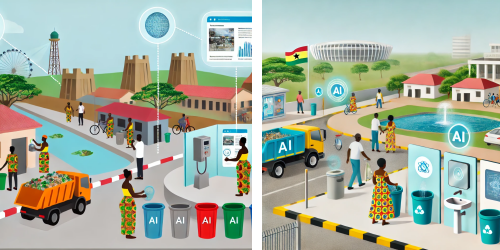
Here's the illustration depicting the impact of AI on sanitation in Ghana, highlighting AI-driven waste management, water quality monitoring, and hygiene practices in a modern urban setting. This visual can effectively complement the article, showcasing the blend of traditional Ghanaian architecture with innovative AI technology.
-
The Author, James Faraday Odoom Ocran, is the Head of HRMD, Ghana Education Service (GES) Gomoa East in the Central Region. He's an AI Africa Trainer.
Email: ocranodoomfaraday@gmail.com
Latest Stories
-
Today’s Front pages : Friday, April 10, 2026
5 minutes -
‘We don’t have time’ – Fianoo calls for Schäfer to lead Black Stars temporarily
49 minutes -
CAF will not favour any country – President Motsepe
54 minutes -
Otto Addo was appointed through the backdoor – Kudjoe Fianoo slams GFA
54 minutes -
UG Corporate Football League back from the Easter break
58 minutes -
CGI orders motorbike training at tactical school in Kyebi
2 hours -
Sachet water producers in Berekum defy gov’t directives, increase prices
2 hours -
Critical commodities stuck at port, CSOs warn of family planning crisis
2 hours -
Gender Ministry mourns victims of Volta Lake boat tragedy, deploys support for affected families
2 hours -
MPs undergo training on human trafficking and gender dimensions
2 hours -
Don’t expect instant relief – COMAC CEO warns fuel price drops will be gradual
2 hours -
GIS to unveil comprehensive plans to enhance officers’ welfare and infrastructure
2 hours -
Right move, wrong timing? – COMAC CEO questions govt’s delay on fuel price relief
2 hours -
IMF urges Central Banks to keep inflation in check
3 hours -
NRSA stands firm on Toyota Voxy ban despite transport operators’ opposition
3 hours