

Audio By Carbonatix
Ahmed Ibrahim, the Minister for Local Government, Chieftaincy and Religious Affairs (MLGCRA) has raised alarm over an impending sanitation crisis in the eastern part of Accra, following reports that the Kpone Landfill could be exhausted within a month.
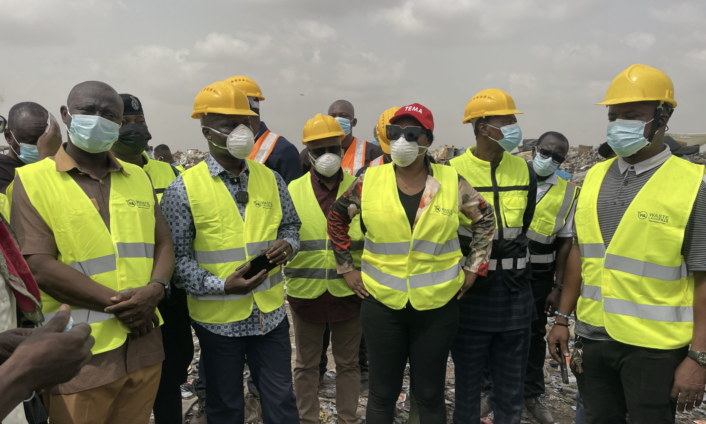
Speaking during an inspection visit to the site with city authorities and the ministry officials, the Minister said the visit was prompted by information received at the ministry indicating that the landfill, which was the only dumping site serving the eastern corridor of the Greater Accra Region, was nearing full capacity.
“If critical steps are not taken, the 10 metropolitan, municipal and district assemblies in the eastern part of Accra will have nowhere to dump hospital, domestic and industrial waste,” he added.
Mr Ibrahim stressed that it was necessary to verify the situation firsthand before briefing the President and the Finance Minister, warning that failure to act swiftly could plunge the capital into a sanitation emergency.
He described the situation as a “sanitation time bomb,” especially in the dry season, when waste accumulation could pose serious public health risks.
The Minister noted that transporting waste from eastern Accra to distant locations such as Nsawam or the western parts of the capital, would not be a sustainable solution, as it would significantly increase operational costs and logistical challenges for assemblies.
He referenced a private-sector-led integrated waste management treatment plant under development at Agomeda, stating that if such interventions had progressed as expected, the region would not be facing the current threat.
“We are behind time, developing a properly engineered landfill site takes not less than six months. So clearly, we are racing against time,” he stressed.
Following the State of the Nation Address on Friday, the Minister announced plans to summon the Greater Accra Regional Minister and all Metropolitan, Municipal and District Chief Executives (MMDCEs) in the 29 assemblies across the region.
Each assembly would be required to present a detailed report on its sanitation and landfill waste management situation.
The Minister said the compiled reports, would form the basis of a comprehensive Cabinet memorandum to be presented to the President and the 19 Cabinet Ministers for decisive action.
During the tour, the Minister observed ongoing works by the contractor at the landfill and was briefed on interim measures being implemented to manage the situation, emphasising that interim steps alone would not be sufficient.
He called on technical experts and stakeholders to “think beyond the box” and explore strategies that could potentially extend the landfill’s lifespan from one month to two or three months while long-term solutions were pursued.
Ms Bertha Essel an Engineer and the Head of Waste Management Department, Tema Metropolitan Assembly (TMA), revealed mounting operational and environmental challenges at the municipality’s landfill site, warning that the facility had exceeded its designed capacity and could no longer sustainably serve the growing waste demands of the enclave.
She said the current landfill site was originally acquired by TMA in 1996, however, operations were later moved to a World Bank-supported engineered landfill constructed.
“We moved to the engineered landfill and operated it for about 10 years. It was designed to last between 15 and 25 years,” she added.
Ms Essel said the facility’s lifespan was significantly shortened after it became the primary disposal site for seven Assemblies in the Greater Accra Region, following the closure of the Insumia landfill.
She said due to these difficulties, authorities directed that the engineered landfill be capped in 2019, with support from the Ministry of Sanitation and Water Resources.
“As an emergency measure, TMA reopened the old landfill site, which had previously been covered but not fully exhausted,” she stressed.
She said the situation had reached a critical stage, such that the landfill’s designed airspace height of 16 metres had been exceeded, with waste now reaching heights of 24 metres and beyond.
This has led to several operational challenges, including irregular access roads to the top of the landfill, vehicles struggling to discharge waste, and frequent leachate overflows.
Ms Essel said the old site was not originally designed with protective lining systems such as geomembrane mats and leachate pipes, causing waste liquids to flow uncontrolled.
She said the facility currently received between 600 and 800 tonnes of waste daily volumes, which was excessive for the limited remaining space.
Given the pressure, the Assembly proposed that some of the assemblies using the facility identified alternative dumping sites, to reduce the burden.
Latest Stories
-
MTN Ashanti-Fest music concert set to hit Kumasi on Saturday
13 minutes -
Authorities probe discovery of dead fish at Tema shipyard
15 minutes -
Minority welcomes fuel tax cuts, demands accountability for GH¢1 levy
25 minutes -
It remains a priority — Sam George on Anti-LGBTQ bill
31 minutes -
Police arrest Nigerian national seen in viral videos wearing police uniforms
33 minutes -
Free golf training empowers underprivileged girls in Accra
49 minutes -
Why SIGA’s reset is not a market sin, but a national necessity
52 minutes -
SIGA Directive: Beyond the theatre of institutional displacement
55 minutes -
Boso Odweegyi Festival 2026 launched with call for unity, cultural preservation
55 minutes -
YEA clears majority of beneficiary arrears, assures completion of outstanding payments
2 hours -
AfCFTA key to building globally competitive African businesses – Zambia envoy urges Ghanaian CEOs
2 hours -
Albert Kobina Mensah, soil pollution and remediation: Risk assessment, phytoremediation, revegetation
2 hours -
GIFEC supports national rollout of One Million Coders Programme with laptop presentation
2 hours -
Old Tafo MP rolls out street lights project to boost security and night-time economy
2 hours -
Telecel Ghana CEO urges urgent education reform and stronger industry-academia partnership at UEW Public Lecture
2 hours