

Audio By Carbonatix
As farmers succumb to changing weather patterns and low precipitation, scientists are making a case for the adoption of intercropping to adapt to the changing climatic conditions.
The sudden atmospheric changes are adversely impacting soil fertility with consequent effects on farm yields and imminent threats to the country’s food security.
Climate-smart agricultural practice – where cereal plants are cultivated with nitrogen-fixing crops like pigeon pea – does not only improve soil health and crop yields but also provides resilience against extreme weather events.

In the last farming season, Ghana witnessed yet another unprecedented long dry spell, destroying nearly a million acre of land.
Thousands of farmers in eight regions of the country lost their source of livelihood as they watched their hard labour bear no fruit.
This year seems no different. The rains came in late, and some farmers are already counting their losses.
Farmers in Ejura, one of Ghana’s food baskets, are reeling under the impacts of climate change.

“About 3 weeks now, the rains have failed us. It doesn’t rain heavily on the farms. Last year, we couldn’t harvest enough. We were hoping it would improve, but it’s still the same,” Akua Dowaa worriedly said.
But they may soon find relief.
At the CSIR-Crops Research Institute’s (CRI) outstation in the locality, farmers growing on large vast of land have gathered to find solutions to their troubles.
Scientists from the research institute are exposing them to a climate-smart farming practice of intercropping cereals and legumes.
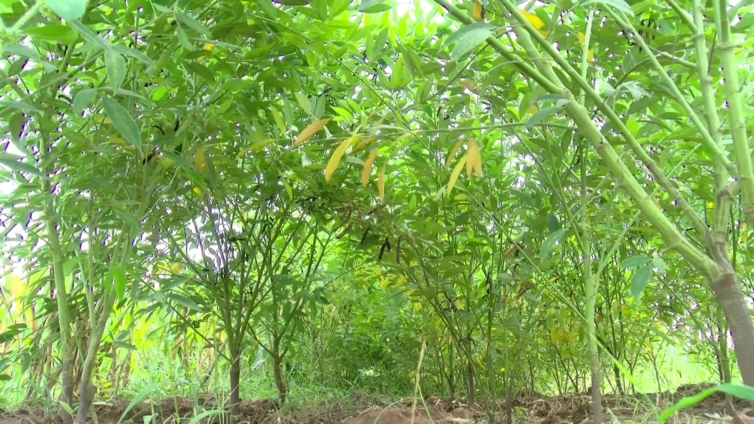
On a parcel of land, maize – a major staple grown by the farmers here – have been cultivated together with a leguminous shrub- Pigeon pea.

This sustainable farming practice enhances resilience to climate variability, improves resource use efficiency, and reduces greenhouse gas emissions.
“When the pigeon pea grows, it provides shade, preventing the little moisture in the ground from escaping. It is also able to absorb carbon from the atmosphere and fix it in the soil, reducing greenhouse gas emissions,” An agronomist at the CRI, Dr. Eric Owusu Danquah, highlighted.

On the demonstration field, the alley of maize crops grown together with pigeon pea was protected against rainstorms, securing the roots of the maize firmly in the ground. Conversely, the ones grown solely stood diagonally, other than their usual upright rise.
Ataa Akosua adopted the technique on her farm. Her maize grew beautifully even though the rains were erratic.
“If it had rained regularly, I would have harvested large sacks of maize this year. But even with the little rains, my farm looks greener,” She noted while recalling a poor harvest in the previous crop season.
The rains aren’t the only troubles confronting farmers and bringing about lower yields. The declining soil quality is a major challenge to Ghana’s agriculture sector.
Research reveals Ghana’s soils have turned acidic owing to the misapplication of synthetic fertilizers. But biochar, an activated charcoal produced from farm waste like rice husks and other biomass.
Dr. Felix Frimpong explains the importance of the charred biomass to soil health.

“The carbon from the bioactivated charcoal is key for plant growth and soil health. The microorganisms utilized the element for their growth and crucial activities to the soil. Biochar is also able to fix other nutrients like potassium, phosphorus and nitrogen,” he noted.
The farming practice is part of innovations adopted under the Diversification pathways in Africa through bio-based and circular agricultural innovations (DIVAGRI) project.
Under the project, farmers are introduced to climate-smart agricultural practices to improve their livelihoods and sustain food security.

“We showcase the farmers what they can do to diversify their farming, and not only grow a single crop or rear animals but harness the waste from their farms to increase their income streams and live sustainably,” Project lead, Ing. Dr. Shadrack Kwadwo Amponsah, said.
The farmers introduced to these climate-smart practices anticipate a full adoption on the national level to boost productivity and enhance Ghana’s food security.
Latest Stories
-
Berekum Chelsea edge Aduana FC in Bono derby to boost survival hopes
3 hours -
‘They can’t control the team’ – Ernest Thompson doubts local coaches for Black Stars role
3 hours -
Ghana-born midfielder Seidu realises ‘dream’ with Atlético Madrid debut
4 hours -
GPL 2025/26: Bubakari strikes late to hand All Blacks vital win over Dreams FC
4 hours -
Fatal crash on Kintampo–Tamale highway claims four lives
4 hours -
2025–26 FA Cup Semifinal Draw: Chelsea, Man City Learn Wembley Opponents
4 hours -
GPL 25/26: Gold Stars back on top after beating Nations FC
5 hours -
GPL 2025/26: Heart of Lions roar back with victory over Vision FC in Kpando
5 hours -
Solomon Agbasi: Hearts keeper in stable condition after concussion
5 hours -
GPL 2025/26: Late Salim Adams penalty earns Medeama draw at Bechem
6 hours -
Hearts pip Young Apostles 1-0 to end 5-game winless run
6 hours -
Boakye Agyarko marks Easter Sunday with a call for Godly leadership ahead of nationwide campaign tour
7 hours -
Pepsi withdraws as UK festival sponsor after Kanye West backlash
7 hours -
Pope Leo calls for global leaders to choose peace in his first Easter Mass
7 hours -
Kpando MP highlights progress on road projects
7 hours