

Audio By Carbonatix
According to estimates, around 52% of Ghana's population is made up of women, and the Ghana Statistical Service (GSS) reports that 7 million women and girls menstruate in Ghana.
However, many adolescent girls and women who menstruate lack access to period products and other hygiene supplies, which has a direct impact on their ability to fully participate in society.
Founder of the Kyereh Foundation, Eunice Agyapomaa Kyereh, says some girls in Elavanyo, in the Ada East district, in the Greater Accra Region of Ghana, are unable to attend school and fully participate in activities due to their periods and the intolerable cost of menstrual products, while other women and girls have turned to other unhygienic means to supplement the cost of the products.
Portia Ziemson, a student from Dampuo D/A Junior High School in the Upper West area, also recounted her story by relating how she uses toilet rolls since she lacks the money to buy menstrual pads, staining her outfit and causing embarrassment at school.
Additionally, a survey conducted during the #EndPeriodPoverty Twitter discussion revealed that some women and girls use baby diapers rather than sanitary pads, which has a negative impact on their general health and wellness. When taxes are scraped off period goods, I think these unpleasant incidents can be averted.
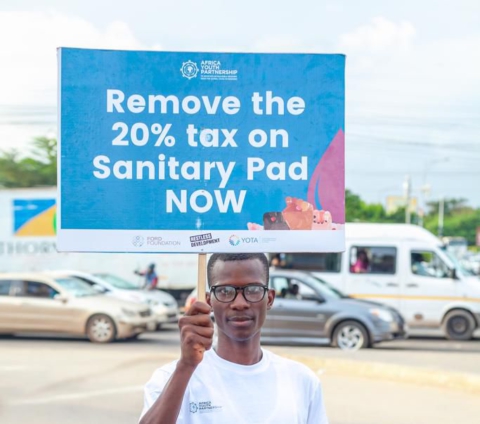
One of the crucial issues I have encountered as an advocate for adolescent girls and young people is the luxury tax on menstrual products in Ghana. I am especially enthusiastic about the Ghana Youth Task Team on the Africa Youth Partnership initiative, which is petitioning the Ghanaian government to abolish the 20% import tax and the additional 12.5% VAT on the price of menstrual products.
The campaign's objectives include urging Ghana's government to abolish tariffs on menstruation products, raising public awareness of the value of good menstrual hygiene, and addressing the problem of period poverty among teenagers living in underprivileged areas of Ghana.
Such initiatives will have an impact on the availability and accessibility of sanitary products to promote good health and well-being, which will help achieve Goal 3 of the Sustainable Development Goals, which is focused on good health and wellbeing, as well as Goal 5 of the SDGs, which is focused on gender equality at all levels.
Students won't skip class in order to ensure that SDG 4: Ensure inclusive and equitable quality education and promote lifelong learning opportunities for all is met.
To lower the high cost of the items, I believe that government and non-governmental organizations should work together to build and resource local firms that make menstruation products locally. In order to ensure sustainability in the battle against period poverty, the government may also eradicate period poverty by supplying equally distributed reusable menstruation products to students and adolescents.
In my opinion, removing the levy on sanitary napkins, empowering women, and providing affordable menstruation products will significantly improve Ghanaian women and girls' reproductive and general health.
Latest Stories
-
Prince Harry faces defamation lawsuit from charity he co-founded
1 minute -
South Korea deploys thermal cameras to track escaped zoo wolf
3 minutes -
Calls for royal meeting with Epstein survivors grow ahead of US visit
6 minutes -
Ibn Chambas advocates blend of technology and human values in education
8 minutes -
UMA improves healthcare access in Asutifi North with GH₵700k ‘Kim Taylor Legacy’ Walkway
12 minutes -
Scholarships Authority and Fanaka University offer sponsorship for procurement and supply chain studies
16 minutes -
Bisa Kdei drops new single ‘Go N Look’ featuring Medikal
22 minutes -
Benin facing rising terrorism in north as French military presence faces growing criticism
23 minutes -
UEW Public Lecture Series 2026: Education debate ‘about the soul of Ghana’s future’ — Dr Ibn Chambas
24 minutes -
EU fingerprint and photo travel rules come into force from today
51 minutes -
Anti-LGBTQ+ Bill: Ghanaians demand expedited passage, not dialogue – Ntim Fordjour to Mahama
59 minutes -
EU airline industry warns of fuel shortages if Strait of Hormuz stays closed
1 hour -
White House staff told not to place bets on prediction markets
1 hour -
Auctioneers petition Prez Mahama over ‘interference’ in public auctions
1 hour -
GEA, Mastercard Foundation drive market access for MSMEs at Kwahu Business Forum
1 hour