

Audio By Carbonatix
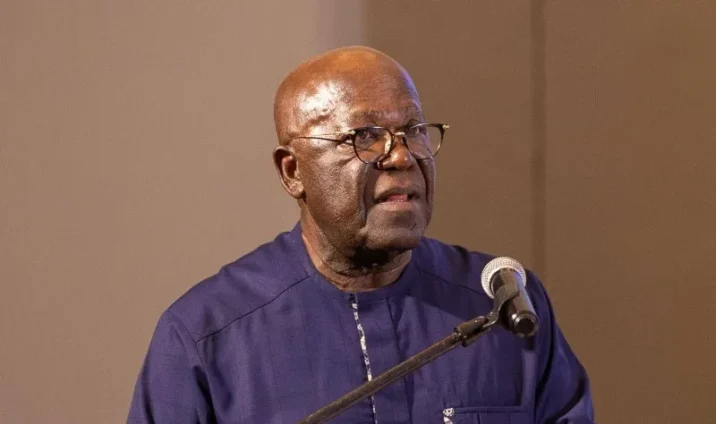
Renowned business leader Sir Sam Jonah has warned about what he describes as a "deeply corrosive” crisis threatening Ghana’s insurance industry, citing growing political interference, unethical practices, and systemic distortions in the sector.
Delivering a keynote address at the annual conference of the Insurance Brokers Association of Ghana in Accra on March 26, Sir Sam Jonah said the integrity of the industry is under serious threat, with practices that undermine professionalism, accountability, and public trust.
Drawing from decades of experience, including his role in building Met Insurance and later chairing the merged entity with Hollard, he said he had witnessed firsthand how the problem has evolved from isolated incidents into a deeply embedded system.
Political Influence Undermining Professional Standards
Sir Sam Jonah lamented what he described as an entrenched pattern of political and socio-economic interference in the conduct of insurance business in Ghana.
“There is a growing and deeply troubling pattern of political and socio-economic interference in the conduct of insurance business in Ghana,” he said. “What was once an occasional disruption has… become something more systemic. More embedded. More dangerous.”
According to him, contracts are increasingly being cancelled or reassigned based not on performance or merit, but on political directives and personal connections.
“Insurance portfolios, particularly those of state entities, are moved not through competitive tender or professional selection, but through personal access and political leverage,” he revealed.
He further disclosed that some brokers and insurers are compelled to take on risks they lack the capacity to manage, while premiums are artificially inflated without proper actuarial assessment.
“Premiums are loaded – fraudulently, without actuarial basis… purely as a vehicle for the extraction of money from institutions that ultimately belong to the Ghanaian public,” he stated.
Taxpayers Bearing the Cost
Sir Sam Jonah warned that the consequences of these practices are far-reaching, ultimately shifting the burden onto ordinary Ghanaians.
“When things go wrong… it is not the politically connected individuals who bear the cost. It is the taxpayer,” he said.
He described the situation as a betrayal of public trust, particularly where insurance is meant to protect state assets and public resources.
“That is a betrayal. And I say it plainly: it is a betrayal,” he stressed.
Ghana’s insurance sector, valued at billions of cedis in premiums annually, plays a critical role in risk management across sectors, including energy, infrastructure, transport, and finance. However, persistent governance challenges have slowed its growth and reduced confidence among investors and policyholders.
Threat to Industry Credibility
Beyond financial losses, Sir Sam Jonah warned that these practices are eroding confidence in the entire insurance system.
“It damages the institution of insurance itself. It erodes public trust. It undermines the case for compulsory insurance,” he said.
He cautioned that such an environment discourages professionalism and investment in technical expertise, as it creates the perception that connections matter more than competence.
“It signals — falsely and destructively — that competence is irrelevant and that access is everything,” he added.
Call for Reform and Accountability
While acknowledging the role of government and politically exposed persons in the economy, Sir Sam Jonah stressed that insurance placements, especially those involving public assets, must adhere strictly to professional standards.
“The placement of insurance… must be subject to professional standards, open competition, proper actuarial assessment, and the primacy of the policyholder's interest,” he said.
He called on the Insurance Brokers Association of Ghana to take decisive action in safeguarding the integrity of the profession.
“Membership of IBAG must carry meaningful obligations. The Code of Ethics must be enforced with seriousness of purpose,” he urged.
He insisted that members found culpable of unethical conduct must face the repercussions.
“Members who are found to have participated in… the corruption of professional standards must face consequences that are real and visible,” he said.
“Not because we wish to punish, but because a profession without consequences for misconduct is not a profession. It is merely an occupation.”
The conference brought together key stakeholders in Ghana’s insurance sector, including brokers, underwriters, regulators, and policymakers, at a time when the industry is seeking to deepen penetration and rebuild public confidence.
Latest Stories
-
Tamale: Alhaji Hussein Fuzak funds construction of 3-storey classroom block at Ambariya Islamic School
27 minutes -
Gender Ministry holds staff durbar, welcomes new Chief Director
27 minutes -
Anti-LGBTQ+: Mahama prioritises sentiments of development partners over Ghanaian values – Ntim Fordjour
32 minutes -
CPA intensifies crackdown on fake diapers across public hospitals
52 minutes -
Deputy Defence Minister urges failed GAF applicants to check medical disqualification reasons
56 minutes -
Video: President Mahama’s speech at One Health Summit
1 hour -
Constitution review must protect Ghanaians values, not advance LGBTQ agenda — Haruna Mohammed
1 hour -
Foreign Affairs Ministry advises Ghanaians to take recommended vaccinations before traveling to Senegal
2 hours -
If you have fixed the economy, why hide behind basic needs to delay Anti-LGBTQ+ Bill? – Ntim Fordjour to Mahama
2 hours -
NACOC Central Regional Command partners with NSRA on drug awareness campaign
2 hours -
Galaxy, DPS and Lycee Français shine at part 2 of 2026 Ghana International School Festival
2 hours -
Project C.U.R.E. donates vital medical supplies to support GMTF’s ‘Heal Ghana’ agenda
2 hours -
Engineers and Planners Ltd secures Damang Mining Lease after grueling $500m competitive tender
2 hours -
I never went to university – Tommy-Annan Forson
2 hours -
NACOC concludes four-day anti-drug operation in Eastern, Greater Accra regions
3 hours