

Audio By Carbonatix
The Department of Social Welfare under the Gender, Children and Social Protection Ministry have initiated a family tracing process to identify possible relations of the ten-year-old homeless boy who used to sleep at the underbridge of the Kwame Nkrumah Interchange.
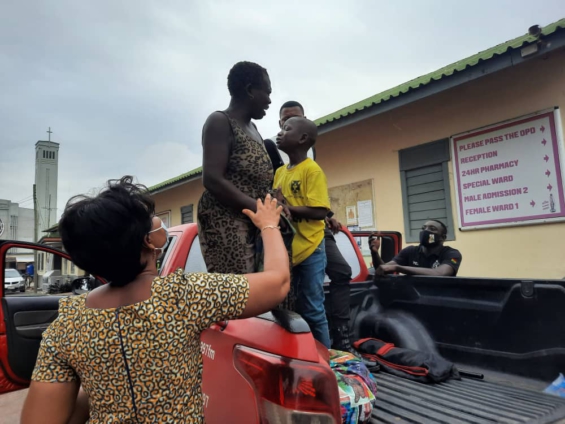
After a Joy News story that highlighted his plight, little Ebenezer was rescued with his mentally challenged mum on Friday [August 13] in a mission that lasted up to 10 hours.
“My father is dead, so I want to go to my village at Sampa [North]”, he said when rescuers met him around Avenor.
“I want you to take my mum to [the] hospital”, Ebenezer told Joy News journalists and Social Welfare officers.
He will only come with them if they took his mother along.
When asked if he’d like to be put in a home where he’d be given food, clothing, and other needs, he answered that “yes, but my mommy [must] know about it”.
But with his mum currently undergoing treatment for her condition and the boy in alternative care, the social welfare department says it has begun tracing possible family relations of the boy.
Head of Foster Care Services Unit at the Department of Social welfare, Samuel Anaglate, told Joy News, “we are working with our social welfare unit in the Bono Region to trace possible family members of this boy”.
He continued to say, “we will, however, need support for the boy. Because sometimes you’ll find a family member who is willing to take the boy but does not have the resources to take good care of him.”
Like Eben, hundreds of kids are roaming the streets of Accra in search of warmth and support from a society that is constantly failing them.
In 2017, the Gender Ministry launched a campaign to end streetism in Ghana.
The programme dubbed “#Operation Get off the Streets for a Better Life” aimed to identify persons on the streets, profiling and integrating them with their parents, caregivers, families, and community in five years.
It was also to ensure that target groups are completely cleared from the streets.
The target groups included Kayayei, hawkers, children who are beggars, adult beggars, and those contracted to push physically challenged persons.
The rest are persons with disabilities, mental health problems, families on the streets, displaced persons (international migrants), and ‘begging contractors’.
But four years after it was launched, the menace of streetism seems to have worsened, with various civil society groups calling for renewed efforts towards the agenda.
Latest Stories
-
Ghana to honour Christina Hammock Koch for historic Artemis II mission
16 minutes -
Supreme Court appointments require more than 15 years’ experience – Justice Adjei-Frimpong
32 minutes -
Fire destroys 3-bedroom house at Bogyawe
56 minutes -
Why the Supreme Court is a “policy court” – Justice Richard Adjei-Frimpong breaks it down
1 hour -
Playback: The Law discussed Supreme Court @150
2 hours -
MTN Momo staff walk to promote wellness and fitness
2 hours -
Assafuah: Sedina Attionu’s return from Nevada will test government’s commitment to accountability
3 hours -
How GRA’s Modified Taxation Scheme is boosting revenue compliance & SMEs competitiveness
3 hours -
Stonebwoy Can Do It: A call to unite behind 2026 BHIM Fest
3 hours -
World Shea Expo returns to Tamale for 2026 edition
3 hours -
Prioritise cocoa sector with better prices, timely payments-Annoh-Dompreh urges NDC
4 hours -
Lands and Mines Watch Ghana endorses Heath Goldfields’ mining capacity
4 hours -
Gbintiri residents protest alleged diversion of 24-hour market project
4 hours -
Justin Bieber headlines Coachella with nostalgia-fuelled set
4 hours -
Ukraine and Russia accuse each other of hundreds of ceasefire violations
4 hours