

Audio By Carbonatix
Some tertiary institutions have joined calls for using higher education to improve agriculture with the hope of addressing socio-economic challenges like post-harvest losses and unemployment.
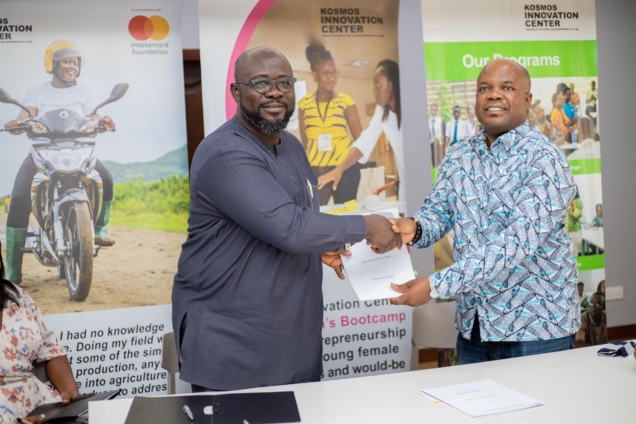
Speaking at the signing ceremony of a Memorandum of Understanding between Kosmos Innovation Centre and some six tertiary institutions to promote youth entrepreneurship in agriculture, heads of these tertiary intuitions outlined how the partnership will help revolutionise the relationship between academia and agriculture as well as its impact on socio-economic activities.
Acting Vice Chancellor of C.K Tedam University of Technology and Applied Science, Professor Samson Abah Abagele said “first, it would help us to address post-harvest losses. It is common knowledge that in the Northern part of Ghana, vegetables and perishable foods easily get rotten on the farms and so we are going to look at innovations that will increase the shelf life of these products. We’re also looking at solving youth unemployment and this project allows us to recruit community members”.
Principal of the Ejura Agriculture College, Bright Akoto stated that “the target is to train 50,000 youth this year, to gain skills and be employable. As a college, I believe that with this collaboration plus our competent tutors, we’re going to ensure that this target is achieved. We will not only rely on our students but also rope in young people in the community who are interested in agriculture”.
The partnership agreement was signed with Pro-Vice Chancellors, Registrars and Principals of the following universities and agricultural colleges respectively, namely CKT University of Technology and Applied Sciences; Akenten Appiah-Menka University of Skills Training and Entrepreneurial Development; Damongo Agricultural College; Kwadaso Agricultural College; Ejura Agricultural College and Ohawu Agricultural College. This brings the total number of tertiary institutions and colleges on the programme to 16.
Speaking at the MOU signing ceremony, Executive Director for KIC, Benjamin Gyan-Kesse emphasised KIC’s commitment to youth development, working in collaboration with its partners to provide practical business training for young agripreneurs along the entire agricultural value chain. “We are committed to empowering young men and women to drive innovation in agriculture towards the attainment of SDG Goals,” he said.
Under the partnership, students and young people within the communities where these educational institutions are located will receive training and capacity building on entrepreneurship. Some of the programmes that will be run within the 2-year agreement include the AgriTech Challenge Classic, AgriTech Challenge Pro, and Young AgriPreneur Forum. Through the AgriTech Challenge Classic and Pro programmes, students receive mentorship, training, and networking opportunities to start and grow their business.
Students who go through unto the business incubation stage receive funding support from KIC together with its partners to enable them scale -up their businesses and become investor ready.
Latest Stories
-
Easter gesture: Ablakwa settles medical bills for 85 North Tongu constituents
24 minutes -
Africa must harness its population strength—Titus-Glover
24 minutes -
Visa-free access doesn’t mean unlimited stay – Lom Ahlijah
27 minutes -
From Golgotha to Kwahu: The Easter Migration of the Faithful and the Faithless
2 hours -
How the Ghanaian onion traders’ standoff with Nigeria unfolded and threatened local supply
2 hours -
No compensation for demolished structures on 24-Hour Economy market lands — Gov’t to structure owners
2 hours -
Financial Institutions must back local enterprises to spur growth – Deputy Minority Whip
2 hours -
Photos: Gomoa Easter Carnival 2026 ends in a burst of colour and celebration
3 hours -
Gomoa Easter carnival ends in colour as fashion, music and celebrity appearances light up final night
3 hours -
Families pick Luv Fm Family Party to celebrate Easter Monday with music and more
3 hours -
IMANI flags procurement issues in Ghana Gas insurance switch
3 hours -
Kaneshie footbridge rehabilitation to take up to 9 months — AMA
4 hours -
AMA confirms trading will be banned on Kaneshie footbridge after rehabilitation
4 hours -
IMANI flags procurement concerns in state insurance placements
4 hours -
Mahama’s push for visa-free Africa reflects Nkrumah’s Pan-African vision – Rashid Tanko-Computer
4 hours