

Audio By Carbonatix
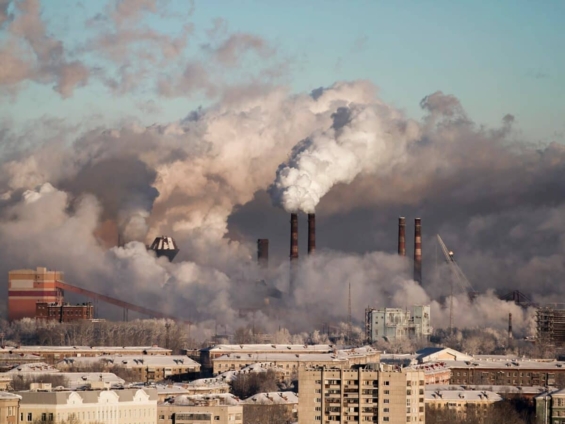
South Asia continues to face a severe air pollution crisis, according to the latest global report. Pakistan, Bangladesh, and India are among the most polluted countries in the world, with cities in these countries ranking among the 100 worst for air quality.
The report by Swiss-based air quality technology firm IQAir shows that Pakistan tops the list with an average PM2.5 of 67.3 μg/m³, followed by Bangladesh at 66.1 μg/m³, Tajikistan at 57.3 μg/m³, Chad at 53.6 μg/m³, and the Democratic Republic of Congo at 50.2 μg/m³. India is sixth, with its PM2.5 dropping slightly to below 50 μg/m³, still nearly 10 times higher than the World Health Organization’s safe limit of 5 μg/m³.
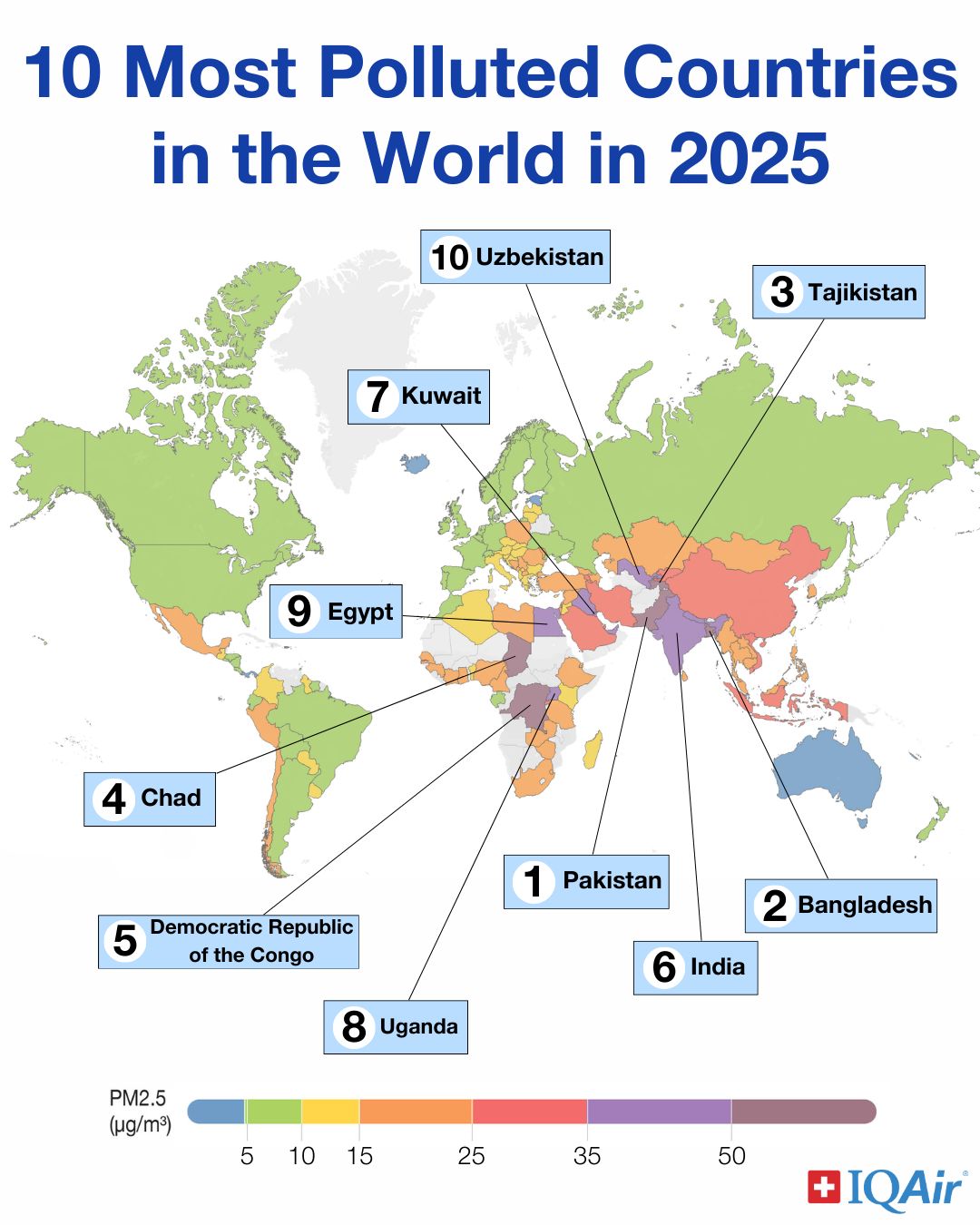
A total of 83 cities from India, Pakistan, Bangladesh, and Nepal rank among the 100 most polluted in the world. Within the top 20 most polluted places, nine cities are in India and eight in Pakistan, while three are in China.
The worst affected city is Loni, India, which borders Delhi and experiences chronic pollution from traffic, crop burning, and industrial activity. In 2025, Delhi recorded an average PM2.5 of 99.6 μg/m³—twenty times higher than the safe limit. This is despite an 8% reduction from previous years. Residents endured severe pollution during seasonal crop burning, traffic congestion, and stagnant winter air, with daily peaks reaching 460 μg/m³, forcing school closures and overwhelming hospitals with respiratory and heart cases.
PM2.5 refers to tiny air particles that are 2.5 micrometers or smaller, about 30 times thinner than a human hair. These particles can penetrate deep into the lungs and even enter the bloodstream, causing serious health problems such as asthma, heart disease, and lung damage. The unit μg/m³ (micrograms per cubic metre) measures how many of these particles are present in a given volume of air.
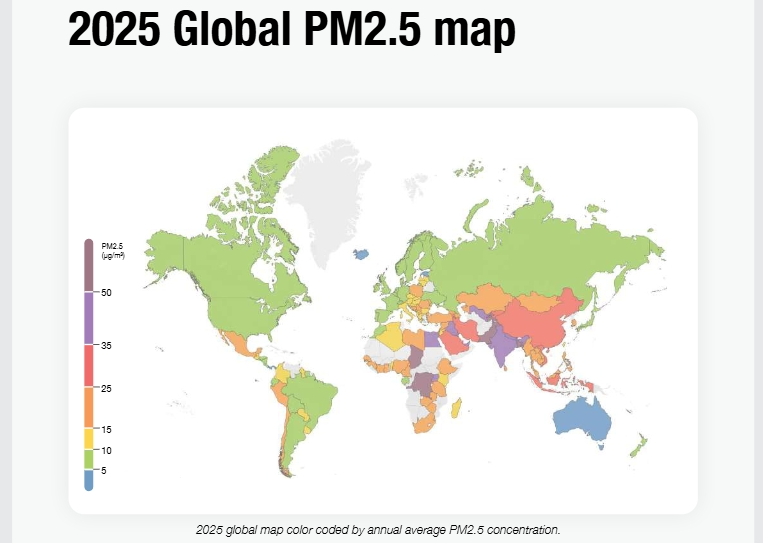
Globally, the burden of pollution remains heavily concentrated. Continuing a trend observed in previous years, the highest population-weighted national annual average PM2.5 levels are found largely across Africa and Central and South Asia. At the same time, there are signs of progress with 13 countries recorded annual average concentrations below 5 μg/m³, meeting the World Health Organization’s guideline for safe air, most of them located in Latin America, the Caribbean, and Oceania.
However, the report highlights a critical challenge behind the numbers taking unequal air quality monitoring in consideration. Africa and West Asia remain significantly underrepresented in monitoring infrastructure, despite hosting some of the world’s most polluted cities.
While Africa’s representation in the dataset has improved this year, with new data from countries and territories such as Guinea, Eswatini, Tanzania, Benin, Morocco, the Canary Islands, and Réunion, large gaps persist. In total, seven new countries were added to the report, driven largely by African entries, alongside a few additions from West Asia, Oceania, and Europe.
This data gap was further worsened in March 2025 when U.S. Embassy and Consulate monitoring stations, previously key sources of publicly accessible air quality data in many cities, stopped reporting, leaving several regions without reliable real-time information.
In response, community-led and independently operated monitoring stations have become increasingly important. These low-cost, low-maintenance sensors are helping to fill critical gaps, often providing the only real-time data available in underserved areas and offering a more detailed picture of air quality than government networks alone.
Some cities, however, are demonstrating how stronger monitoring systems can drive public awareness and action. In Bangkok, authorities have taken proactive steps to improve how air quality is tracked and communicated. Through a partnership with IQAir, the city has expanded access to reliable, real-time air quality data across districts, treating it not just as a technical function, but as a public resource.
Monitoring data in Bangkok is made openly accessible to enable residents to better understand local conditions and make informed daily decisions. A key feature of this approach is the involvement of schools, where monitoring devices installed on campuses help protect students while also supporting science and environmental education.
By giving students and teachers direct access to local air quality data, schools have become hubs of awareness and engagement, encouraging young people to take part in conversations about urban sustainability.
By combining city leadership, data transparency, and community participation, according to the report, Bangkok offers a model for how municipalities can strengthen environmental governance. Its collaboration with IQAir highlights how public–private partnerships can go beyond infrastructure to build more inclusive and participatory air quality monitoring systems.
Despite such progress, global air quality declined overall in 2025, with only a small share of cities meeting safe standards. Factors such as wildfire smoke, industrial emissions, and climate change continue to drive rising PM2.5 levels worldwide.
The report underscores the need for stronger international cooperation, not only to reduce emissions, but also to expand monitoring networks, since air pollution does not respect borders and its impacts are shared across regions.
Latest Stories
-
We can tackle multiple priorities – Sam George defends Anti-LGBTQ Bill push
10 minutes -
Statement: Ghana Chamber of Mines’ Response to Claims in Joe Jackson’s “Ananse Stories about the Economy of Ghana”
11 minutes -
GES opens 2026 teacher recruitment for licensed B.Ed graduates
14 minutes -
Ghana must value skilled trades, build resilient learners — Ibn Chambas
22 minutes -
Ghana must rethink education around relevance, resilience and responsibility — Ibn Chambas
25 minutes -
Prince Harry faces defamation lawsuit from charity he co-founded
27 minutes -
South Korea deploys thermal cameras to track escaped zoo wolf
28 minutes -
Calls for royal meeting with Epstein survivors grow ahead of US visit
32 minutes -
Ibn Chambas advocates blend of technology and human values in education
33 minutes -
UMA improves healthcare access in Asutifi North with GH₵700k ‘Kim Taylor Legacy’ Walkway
38 minutes -
Scholarships Authority and Fanaka University offer sponsorship for procurement and supply chain studies
41 minutes -
Bisa Kdei drops new single ‘Go N Look’ featuring Medikal
47 minutes -
Benin facing rising terrorism in north as French military presence faces growing criticism
48 minutes -
UEW Public Lecture Series 2026: Education debate ‘about the soul of Ghana’s future’ — Dr Ibn Chambas
49 minutes -
EU fingerprint and photo travel rules come into force from today
1 hour