

Audio By Carbonatix
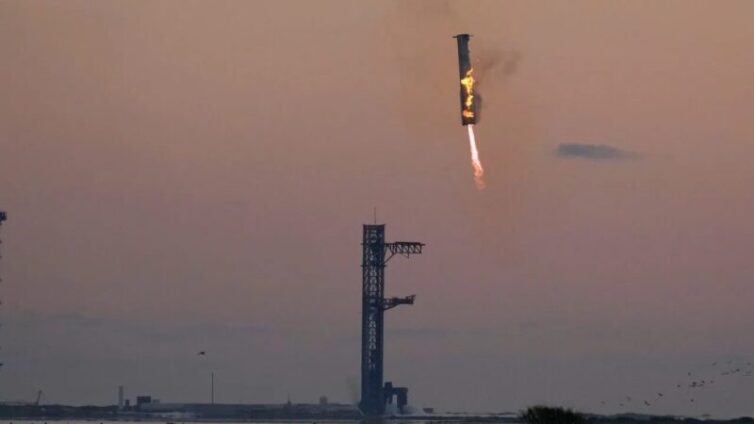
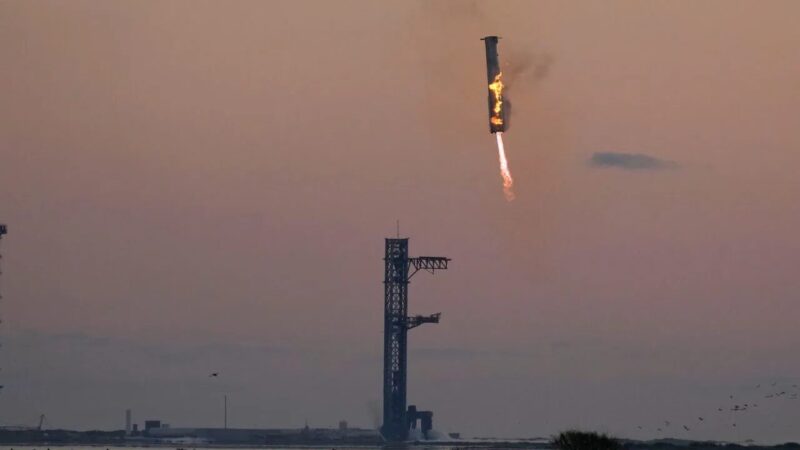
SpaceX in its fifth Starship test flight on Sunday returned the rocket's towering first-stage booster back to its Texas launch pad for the first time using giant mechanical arms, achieving another novel engineering feat in the company's push to build a reusable moon and Mars vehicle.
The rocket's first stage "Super Heavy" booster lifted off at 7:25 a.m. CT (1225 GMT) from SpaceX's Boca Chica, Texas launch facilities, sending the Starship second stage rocket toward space before separating at an altitude of roughly 70 km (40 miles) to begin its return to land - the most daring part of the test flight.
The Super Heavy booster re-lit three of its 33 Raptor engines to slow its speedy descent back to SpaceX's launch site, as it targeted the launch pad and tower it had blasted off from. The tower, taller than the Statue of Liberty at over 400 feet, is fitted with two large metal arms at the top.
With its engines roaring, the 233 foot (71 metres)-tall Super Heavy booster fell into the launch tower's enclosing arms, hooking itself in place by tiny, protruding bars under the four forward grid fins it had used to steer itself through the air.
"The tower has caught the rocket!!" CEO Elon Musk wrote on X after the catch attempt. SpaceX engineers watching the company's livestream roared in applause.
The novel catch-landing method marked the latest advance in SpaceX's test-to-failure development campaign for a fully reusable rocket designed to loft more cargo into orbit, ferry humans to the moon for NASA and eventually reach Mars - the ultimate destination envisioned by Musk.
Meanwhile, Starship, the rocket system's second stage or top half, cruised at roughly 17,000 miles per hour 89 miles up in space, heading for the Indian Ocean near Western Australia to demonstrate about 90 minutes into the flight a controlled splashdown.
As Starship reentered Earth's atmosphere horizontally, onboard cameras showed a smooth, pinkish-purple hue of superhot plasma blanketing the ship's Earth-facing side and its two steering flaps, intense hypersonic friction displayed in a glowing aura.
The ship's hot side is coated with 18,000 heat-shielding tiles that were improved since SpaceX's last test in June, when Starship completed its first full test flight to the Indian Ocean but suffered tile damage that made its reentry difficult.
Starship this time appeared more intact upon re-igniting one of its six Raptor engines to position itself upright for the simulated ocean landing.
The SpaceX live stream showed the rocket touching down in the nighttime waters far off Australia's coast, then toppling on its side, concluding its test mission.
A separate camera view from a vessel near the touchdown site then showed the ship exploding into a vast fireball, as SpaceX engineers could be heard on the live stream screaming in celebration. It was unclear whether the explosion was a controlled detonation or the result of a fuel leak.
Musk said the ship landed "precisely on target!"
Starship, first unveiled by Musk in 2017, has exploded several times in various stages of testing on past flights, but successfully completed a full flight in June for the first time.
The U.S. Federal Aviation Administration on Saturday approved SpaceX's launch license for the fifth test, following weeks of tension between the company and its regulator over the pace of launch approvals and fines related to SpaceX's workhorse rocket, the Falcon 9.
Latest Stories
-
Don’t force reconciliation during pregnancy – Counsellor Angie warns amid unresolved trauma
15 minutes -
Libya: Aliou Cisse leaves national team role after salary row
17 minutes -
NRSA declares commercial use of Toyota Voxy illegal
21 minutes -
Police hunt suspects after gunfire triggers chaos at Kotoku Onion Market
24 minutes -
Health Ministry partners private sector to boost public education on safe healthcare practices
35 minutes -
GhIE demands independent audit of GH¢110bn Big Push road programme
36 minutes -
Heavy rainstorm causes power outages in Ashanti Region – ECG
37 minutes -
Abuakwa MP supports constituents to mark Easter celebration
38 minutes -
CAF U-17 AFCON: Ghana handed tricky opponents in Group D
41 minutes -
Manhyia South MP decries unchecked commercialisation of residential areas, warns of extinction
41 minutes -
U-17 AFCON 2026: Ghana drawn in tough group as Black Starlets eye World Cup return
43 minutes -
NRSA recommends strict enforcement of laws banning right-hand drive imports
50 minutes -
‘Don’t belittle our intelligence’ – Methodist Bishop criticises Kwakye Ofosu over LGBTQ comment
50 minutes -
Ghana’s crude oil output declines for 6th consecutive year – PIAC
54 minutes -
$434m in oil revenue allocated to Big Push Programme — PIAC
54 minutes