

Audio By Carbonatix
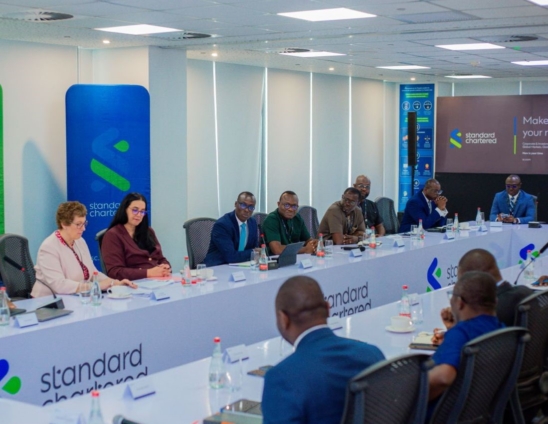
Standard Chartered Bank Ghana Plc hosted a Business roundtable in Accra to examine the evolution of Ghana’s capital markets, with discussions focusing on how digital assets are transitioning from retail-driven activity toward structured, bank-led infrastructure.
The meeting brought together regulators, infrastructure providers, pension fund trustees, real estate investment trusts managers and asset managers to assess how policy direction can translate into credible market development.
The session was also attended by Standard Chartered executives including Global Head of Financing and Securities Services, Margaret Harwood-Jones and the Africa Head of Financing and Securities Services Michelle Swanepoel. At the center of the discussion moderated by Jojo Bannerman, Head of Markets, Standard Chartered Bank Ghana PLC, was the view that digital assets are gradually moving into mainstream financial systems rather than operating on the margins.
Across Africa, digital asset growth has largely been fuelled by retail participation, particularly in markets such as Ghana, Kenya and Nigeria. Institutional adoption remains limited, but participants acknowledged that the next stage of market development will depend on regulated products, institutional-grade custody arrangements and integration with traditional banking structures.
Standard Chartered executives indicated that custody, the safekeeping and servicing of digital assets, is emerging as the critical foundation for institutional participation. Because digital assets represent investor funds in a different form, they require clear legal ownership frameworks, robust governance standards and secure infrastructure.
Allowing digital assets to evolve outside established financial systems was viewed as unsustainable, with integration seen as essential for long-term stability.
The bank outlined its own experience in the sector, noting that it began developing digital asset capabilities nearly eight years ago. Through dedicated ventures focused on custody, trading and tokenisation infrastructure, it built technological and operational frameworks before embedding them into its broader corporate and investment banking operations.
Initial launches were undertaken in jurisdictions with clear regulatory direction, including the United Arab Emirates, followed by tokenisation initiatives in Hong Kong involving money market fund structures.
Early engagement with regulators has shaped that approach. The bank positioned digital asset services within existing risk management and custody standards, emphasising regulatory alignment from the outset rather than pursuing isolated pilot projects.
Financial sector regulators at the meeting signalled that safeguards are being strengthened as the country’s virtual asset framework advances. The Securities and Exchange Commission (SEC), working in collaboration with the Cyber Security Authority, is developing guidelines that will introduce strict cybersecurity requirements as part of the licensing regime.
Operators will be required to meet defined security standards before approval and will be subject to ongoing monitoring and system testing to reduce vulnerabilities.
Authorities also addressed concerns about regulatory arbitrage. A coordinating committee comprising the SEC, the Bank of Ghana, the Financial Intelligence Centre and the Ministry of Finance has been established to align oversight across agencies.
The framework is structured around activity-based licensing with clear supervisory boundaries, while jointly regulated activities will be governed by coordinated guidelines to prevent gaps or overlaps.
The Ghana Stock Exchange underscored the importance of deeper institutional participation in building market depth. Structured engagement between regulators, exchanges and financial institutions was seen as necessary to convert policy frameworks into executable products that can attract long-term capital.
Industry participants noted that adoption challenges extend beyond regulation and infrastructure. Behavioural factors, including investor confidence and risk perception, were identified as key determinants of uptake. Market education and ecosystem-wide engagement were viewed as critical to broadening participation.
The discussions reflected a broader shift in tone within Ghana’s financial sector, with banks increasingly engaging in digital asset conversations. While the regulatory architecture continues to evolve, participants broadly aligned on the view that digital assets are likely to become a structural component of future banking and capital market activity.
In Ghana, the immediate task is to translate dialogue into operational systems that balance innovation with investor protection. The roundtable signalled that coordinated action among regulators, banks and market operators will determine how quickly digital assets move from retail experimentation to institutional integration.
Latest Stories
-
One dead, six maimed as bloody land feud tears Krachi Nchumuru apart
53 seconds -
Missing service member rescued by US forces after jet downed in Iran, Trump announces
23 minutes -
Gomoa Easter Carnival: Sarkodie, Kuami Eugene, Tinny, set festival ablaze as Day 3 ends on high note
48 minutes -
“Feels amazing” – Antoine Semenyo reveals after Manchester City dismantle Liverpool
1 hour -
Mahama calls for emergency cabinet meeting over rising fuel prices
2 hours -
Asante Gold reports US$345million loss for 2025
3 hours -
Gov’t making progress in clearing $1.7bn power debt – Mahama
4 hours -
Justice is the engine of growth – Chief Justice
4 hours -
Meet us halfway – Trade Minister tasks private sector with AfCFTA success
5 hours -
After more than 14 years at Atletico Madrid, what next for Simeone?
5 hours -
Conquering the World – Building on the foundations laid by Otto Addo
5 hours -
[Playback] Sarkodie, Kwami Eugene, Tinny, Keche and others thrill fans at Gomoa Easter Carnival
5 hours -
Gomoa Easter Carnival: Experts charge indigenes to own festival to ensure sustainability
7 hours -
Gomoa Easter Carnival: Edem Agbana and Joy Prime fans shower festival with huge endorsements
8 hours -
Gathering of Royals 2026: Empowering women, boosting tomato production
8 hours