


Audio By Carbonatix
Star Wars actor Mark Hamill has deleted his Facebook account, lambasting the company's political ads policy.In a tweet, the celebrity accused the firm's chief Mark Zuckerberg of having valued profit over truthfulness.It followed its decision to let politicians run adverts that contain lies on the social network.The firm has said that it does not believe decisions about which political ads run should be left to private companies. Facebook declined to comment in reaction to Mr Hamill's post but defended its policy in a post on Thursday."In the absence of regulation, Facebook and other companies are left to design their own policies," wrote Facebook's director of product management, Rob Leathern."We have based ours on the principle that people should be able to hear from those who wish to lead them, warts and all, and that what they say should be scrutinised and debated in public."Other US tech firms have, however, opted to be more restrictive about what they allow.One social media analyst said the controversy over the matter was unlikely to fade soon."Facebook is bucking the trend in the run-up to the US elections later this year," Alex Krasodomski-Jones, from the UK-based think tank Demos, told the BBC."The chorus of critical voices - from public figures and politicians - will grow louder as US presidential candidates ramp up their campaign spending."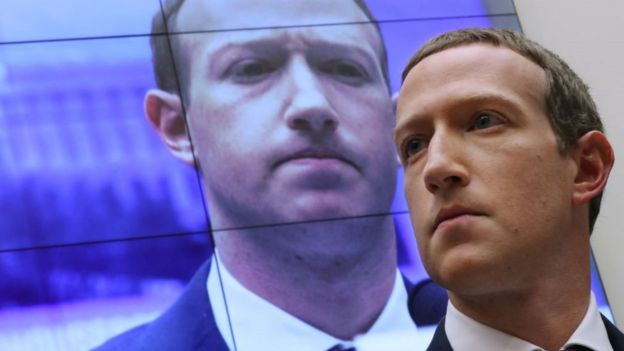 Facebook chief Mark Zuckerberg has said people should be allowed to form their own judgements about what politicians say in adsBy contrast, Twitter opted to ban all political adverts from its platform in October. The company's chief executive Jack Dorsey tweeted that he believed "political message reach should be earned, not bought".More recently, Google chose to limit the extent to which political adverts could be targeted via its tools.Under its revised rules, ads can be directed to users of a certain age, gender and rough location. But campaigns cannot match their own databases of prospective voters with those held by the search giant to make "micro-targeting" possible.In the absence of more defined government regulation, "steps by platforms to reduce risk to democratic and political processes should be welcomed", commented Mr Krasodomski-Jones.
Basic checks
Mr Hamill's criticism came days after Facebook's former security chief voiced his own disapproval about the social network's handling of the matter.Alex Stamos said he was "disappointed" that his ex-employer was not even policing whether politicians were deliberately misrepresenting what their rivals were saying.He suggested doing do would be both "non-partisan and helpful"."I would limit... fact-checking to claims about opponents," he explained."'Mexico will pay for the wall' is up to voters to judge, but a falsifiable claim like 'my opponent is going to be arrested' should be safer to judge."Facebook chief Mark Zuckerberg has said people should be allowed to form their own judgements about what politicians say in adsBy contrast, Twitter opted to ban all political adverts from its platform in October. The company's chief executive Jack Dorsey tweeted that he believed "political message reach should be earned, not bought".More recently, Google chose to limit the extent to which political adverts could be targeted via its tools.Under its revised rules, ads can be directed to users of a certain age, gender and rough location. But campaigns cannot match their own databases of prospective voters with those held by the search giant to make "micro-targeting" possible.In the absence of more defined government regulation, "steps by platforms to reduce risk to democratic and political processes should be welcomed", commented Mr Krasodomski-Jones.Wiped accounts
Facebook has faced greater scrutiny ever since the Cambridge Analytica scandal, during which it emerged that personal information about millions of the platforms' users had been harvested, with at least some of the data passed on to a political consultancy.Revelations that US-targeted disinformation campaigns had been run by Russian and Iranian groups subsequently caused further concern.Other high-profile figures who have previously deleted their accounts as a consequence include the singer Cher,- the comedian Will Ferrell
- the actor Jim Carrey
- Apple co-founder Steve Wozniak
DISCLAIMER: The Views, Comments, Opinions, Contributions and Statements made by Readers and Contributors on this platform do not necessarily represent the views or policy of Multimedia Group Limited.
DISCLAIMER: The Views, Comments, Opinions, Contributions and Statements made by Readers and Contributors on this platform do not necessarily represent the views or policy of Multimedia Group Limited.
Latest Stories
-
7 dead, 2 missing after boat capsizes on Volta Lake
5 minutes -
Miss Diaspora Ghana 2026 launched to deepen diaspora ties and drive development
12 minutes -
US warns citizens to reconsider Nigeria travel on safety grounds
37 minutes -
Ivan Toney questions refereeing in Saudi Pro League title race after Al-Ahli draw
38 minutes -
Angola appoint Aliou Cissé as new head coach
49 minutes -
Virtual Security Africa showcases digital security vision at Kwahu Business Forum
54 minutes -
EBID strengthens regional integration role amid global economic uncertainty
1 hour -
Two assault rifles, ammunition retrieved in Police probe of Tamale gang attack
1 hour -
EBID records strong financial growth with $722m disbursements in 2025 – President, Dr George Donkor
1 hour -
EBID to mobilise $2.69bn under new 2026–2030 growth strategy – Dr George Donkor
2 hours -
An open letter to telcos, regulators and security agencies on mobile money fraud in Ghana
2 hours -
Mobile Money Merchants are driving fraud
2 hours -
Alban Bagbin declines minority’s motion to investigate sale of gold reserves at BoG
2 hours -
NACOC leadership tours drug testing centres in Accra
2 hours -
OSP’s power to prosecute without AG’s authorisation unconstitutional – AG files at Supreme Court
2 hours