


Audio By Carbonatix
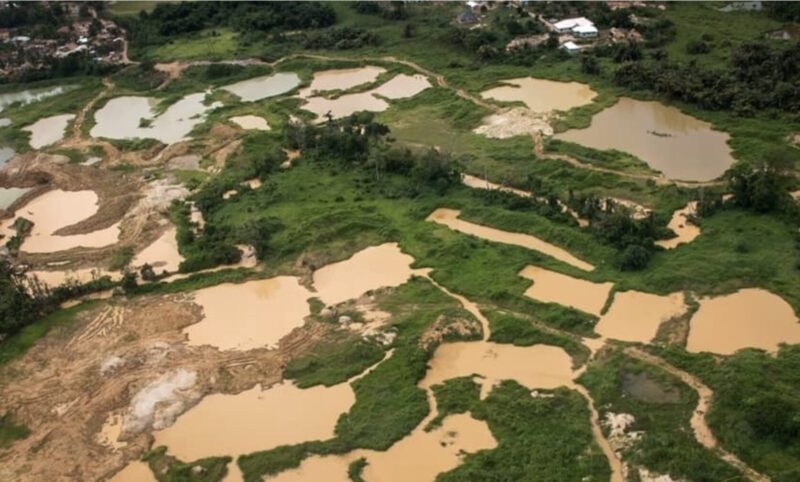
Food and Agric Minister Bryan Acheampong says declaring a state of emergency to combat illegal mining aka “galamsey,” would be ineffective without the active involvement of local communities.
In an interview on Joy News’ PM Express Business Edition the Minister highlighted the need for a national dialogue that engages all sectors of society to confront the crisis head-on.
Acheampong stressed that while government interventions have been launched, including deploying security forces, the challenge is beyond the scope of military or police actions.
“If we spread 34,000 soldiers across the country, they won’t even be able to stop galamsey in the Ashanti region alone. We need communal effort, not just central government enforcement,” he stated.
The Minister noted that while security personnel perform short-term acts of enforcement, illegal miners quickly return once the soldiers leave, which is why a community-led approach is essential.
Acheampong emphasised the critical role of community members in protecting their lands and resources.
He pointed out that those directly affected by the environmental devastation of galamsey, such as polluted rivers and destroyed farmlands, need to take the lead.
“You need a mindset change by the people in the community. When you fight the people who are destroying your land and polluting your waters, security personnel can back you up. But if you wait for central government to bring in soldiers or police, they don’t come and stay there,” he stated.
The Minister also argued that the responsibility for addressing galamsey does not rest solely with district authorities or political appointees.
He clarified that, apart from the District Chief Executive (DCE), most of those in local governance structures are part of the community and should play a vital role in stopping illegal mining activities.
“Are you saying the DCE is the only one looking on for all this to happen? Galamsey is happening in communities, not in the DCE’s house,” he asserted.
According to Acheampong, the fight against galamsey must move beyond Accra and into the affected communities themselves.
“We need a national dialogue on this matter. We need to agree on the role of the community, civil society, security forces, political parties, and the media. Only then can we swing into action.”
He concluded with a stern warning that without community involvement, the crisis would continue to escalate, putting Ghana’s food security, water supply, and environment at risk.
“What will a state of emergency do if you don’t have the community rising up to stop galamsey?” he asked, urging Ghanaians to take responsibility for safeguarding their own environments.
Latest Stories
-
AU’s 10-year reparations agenda is essential to address historic injustices – Spio-Garbrah
8 minutes -
Ghana can’t remain vulnerable to global economic disruptions— Dr Tutu-Boahene
22 minutes -
‘No nepotism’ – Former NSA Board Chairman demands world-class coach after Otto Addo exit
26 minutes -
Volta Region seen as top choice for luxury weekend breaks — V. L. K. Djokoto
35 minutes -
Halt small-scale mining for one year to fight galamsey – Hopeson Adorye
40 minutes -
President Mahama orders full probe into ‘Big Push’ procurement exposé
58 minutes -
Weija-Gbawe MP calls for commissioning of Weija paediatric hospital
1 hour -
Ghanaians dying in Russia–Ukraine war: The danger is real
1 hour -
Player ratings: Oppong earns high marks as Sibo and Adjetey draw low scores in Germany defeat
1 hour -
Pres. Mahama pledges action on 1.2m out-of-school children after School for Life raises concern
1 hour -
Suhum MP vows NPP will probe Gold-for-Reserves in 2029
2 hours -
Ghana to host Zimbabwe’s President Mnangagwa on three-day state visit
2 hours -
Ghana pushes for stronger West African blue economy partnership at Liberia fisheries investment conference
2 hours -
Ghana hosts high-level African climate strategy meeting ahead of COP31 and COP32
2 hours -
Today’s Front pages : Tuesday, March 31, 2026
2 hours