

Audio By Carbonatix
The blood-stained bodies of the four accused kidnappers were hung off construction cranes with heavy chains, one with a warning sign strung around his neck, "Abductors will be punished like this."
In the public spaces in the western Afghan city of Herat, the crowds squinted into the sun, peering up at the lifeless figures.
Adults took video and pictures with their cellphones, while small children climbed up on the edge of the fountain, directly underneath one of the bodies, to get a better view.
"People are really happy about this decision," one of the bystanders, Mohammed Mansour, told CNN. "Because people believe that by doing this, kidnapping can be removed from this province."
Under the previous government, corruption was rampant and crime rates were high.
Since ousting the US-backed administration and storming to power in August, the Taliban have gained favor with many for meting out swift, albeit brutal, justice under the group's strict interpretation of Sharia law.
In another incident, just after the group seized control of the city, two alleged criminals were paraded before a jeering crowd, their faces painted -- a punishment the Taliban favor for petty thieves.
A little over a month after most of the international community fled Afghanistan on evacuation flights, the lurid brutality in Herat harkens back to the Taliban's previous reign in the late 1990s, when grim public deterrents were commonplace.
But the Taliban are also savvy enough to know how the medieval displays appear to the rest of the world.
New booklet for police
In Ghazni, a strategic city on the Kabul-to-Kandahar highway, the much-feared religious police are back on the streets, but instead of doling out punishment, they are on a charm offensive, more intent on shaking hands and introducing themselves.
On a recent patrol through the market, they gathered the shopkeepers around to encourage them to follow sharia law.
"Treat your women according to Islamic law," one commander told a crowd of shopkeepers, "and make sure they cover themselves."
Nearby a man casually smoked a cigarette, a punishable offense under the previous regime, but on this day, the act was ignored by the police.
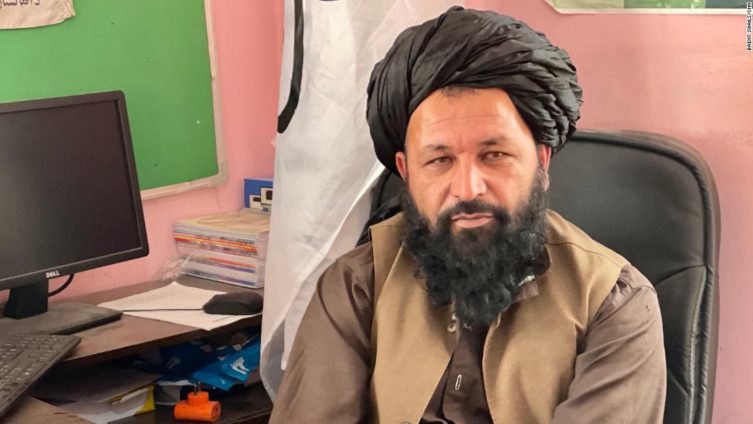
The Taliban have turned Ghazni's pink-walled Ministry of Women building into the new headquarters of the Ministry of the Propagation of Virtue and Prevention of Vice.
When a CNN team arrived, the men were still settling in, carrying a Taliban flag into the central office where director Mawlavi Abdullah Mohammad now sits.
He said their role is to encourage Afghan people to embrace Islamic rule and that there are strict rules on how they can do that.
"We [act] with accordance to Sharia law," said Mohammad.
"Firstly, we inform people about good deeds. We preach to them and deliver the message to them in a nice way; the second time we repeat to them, again; the third time we speak to them slightly harshly."
He carries a blue booklet, newly issued by the Taliban, which provides guidelines for the religious police on how to do their work.
"We abide by laws and rules. We give advice, but to grab someone's hand, to beat him up, to send them notice or to send them a warning letter, is against the Emirate's policy.
If anyone has done this, it is a self-assertive act," Mohammad said.
When asked about a recent edict in Helmand province that barber shops could be punished for shaving men's beards, he presented a document from the Taliban's leadership, condemning the decree.
But away from public view, not every Taliban fighter is following the new guidelines and abuses are common.
In a secure location in Kabul, Wahid shows the bruises across his backside, still visible days after he was attacked.
His name is changed for his protection. He said he was stopped by a group of Taliban fighters at a busy roundabout for wearing western-style clothing.
"I had photos on my mobile phone related to gays," Wahid said. The fighters searched his phone, found the pictures and found out he was gay.
Wahid said they started beating him, first with a whip and then with a stick.
"They had covered my mouth and also told me to not make noise and if I did they would beat me even more, so I had to bear the pain but not scream," he said.
Life for gay people was always difficult and dangerous in Kabul, said Wahid, and beatings from the Afghan police under the previous government were also common.
But he said that now he is too afraid to leave the house and worries he will end up dead.
"I am scared now to dress like before, because they told me if they catch me wearing those type of clothes again or if I have mobile phone with photos on it, they would kill me," he said.
But justice only cuts one way here and despite the Taliban's carefully cultivated new image, Wahid believes that the movement, born in conflict, is still brutal at its core.
"When they were beating me, they kept saying that I was a gay and that I should be killed," he said. "They had very scary faces. They were enjoying beating me."
Latest Stories
-
Why diaspora investors are using Accra real estate to hedge against global uncertainty in 2026
8 minutes -
GWL urges public support to stem water thefts
9 minutes -
Fire guts 2-storey apartment at Ashaley Botwe
10 minutes -
Come down and account, it’s a constitutional requirement – Martin Kpebu to Ofori-Atta
19 minutes -
The power of the private courtyard: How regalia is redefining resort-style living in Accra
31 minutes -
Beyond roads and bridges: Understanding the true role of your MP
32 minutes -
UK says Russia ran submarine operation over cables and pipelines
33 minutes -
NPRA recovers GH¢27m in 2025, 30% of defaulted pension contributions
36 minutes -
Power fluctuations slash Ashanti region water production by 959,000 cubic metres in March
41 minutes -
Beyond the festivities: Gomoa must turn visibility into development
49 minutes -
DVLA clarifies it is not responsible for Toyota Voxy commercial operations
51 minutes -
Calls for Ofori-Atta’s return a non-issue if trial proceeds in absentia – Pius Hadzide
54 minutes -
France names Ghana first beneficiary of newly established National Health Compact
59 minutes -
US Immigration, extradition outcomes likely to influence each other in Ofori-Atta case – Amanda Clinton
1 hour -
29-year-old woman rescued after hiding in drain to escape attackers
1 hour