


Audio By Carbonatix
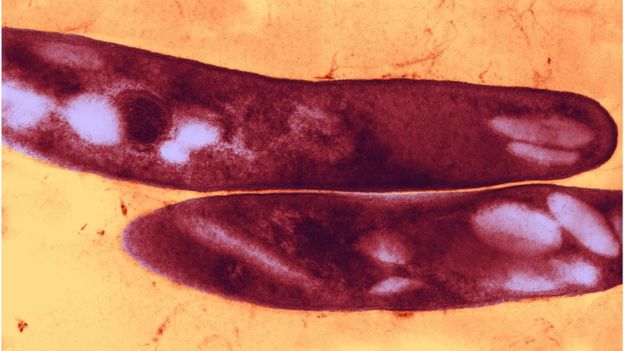
Tuberculosis now ranks alongside HIV as the world's most deadly infectious disease, the World Health Organization (WHO) says.
Each accounted for between 1.1 million and 1.2 million deaths in 2014.
The WHO said the tuberculosis figures were unacceptable for a disease that could be cured.
Medecins Sans Frontieres said the statistics were "disheartening" and warned the world was "losing ground" on tackling resistant forms of TB.
The WHO's Global Tuberculosis Report 2015 shows the huge strides that have been made in tackling TB, with the death rate being nearly halved since 1990.
And the number of infections has been falling by 1.5% a year since 2000.
Deaths from HIV/Aids have also been falling rapidly because of improved access to anti-retroviral drugs.
Dr Mario Raviglione, the WHO's tuberculosis director, told the BBC News website: "Tuberculosis and HIV are now competing to be the number one cause of death from infectious disease in the world.
"Tuberculosis now ranks alongside HIV."
Most new cases of TB are in China, India, Indonesia, Nigeria or Pakistan.
Deaths from HIV/Aids have been falling since the mid-2000s, and stand at 1.2 million a year.
Overall there were 1.5 million tuberculosis deaths in 2014.
But 400,000 of them are officially counted as Aids deaths as they were in HIV positive patients.
The WHO now considers TB and HIV to be effectively joint top killers.
WHO director-general Margaret Chan said there had been "tremendous impact" since 1990, but added that "if the world is to end this epidemic, it needs to scale up services and, critically, invest in research".
Dr Raviglione agreed, saying that if the international investment in TB matched that of HIV, then "we could have accelerated the decline in mortality".
Resistance
The report also highlights the dangers of tuberculosis becoming resistant to antibiotics.
About three in every 100 new cases of TB could not be treated with first choice antibiotics.
Dr Grania Brigden, from Medecins Sans Frontieres, said it was "yet another year of disheartening statistics" that should "serve as a wake-up call".
She added: "We're losing ground in the battle to control drug-resistant forms of TB, and without considerable corrective action, the vast majority of people with multi-drug resistant TB won't ever be diagnosed, put on treatment, or cured."
The World Health Organization will shift to its End TB Strategy next year, which aims to cut deaths by 90% by 2030.
Latest Stories
-
SSNIT increases stake in Societe Generale Ghana to 24.36%
7 minutes -
Africa cannot rely on government budgets alone to finance climate ambitions – Deputy Finance Minister
27 minutes -
COMAC gives Finance Ministry 14 days to suspend implementation of Section 136 of Customs Act
28 minutes -
WhatsApp introduces optional parental controls for teenagers
30 minutes -
Afoko could help Bawumia pursue ‘clean break’ ahead of 2028 – Dr Amakye-Boateng
32 minutes -
Global Capacity Hub conference connects Ghanaian businesses to technology, investment opportunities in London
39 minutes -
Overcharge passengers and face sanctions, GPRTU warns drivers
42 minutes -
Government seeks $165m to complete operational phase of Boankra Integrated Logistics Terminal
52 minutes -
‘Show us the evidence’ – Upper West teachers demand proof of arrears payments
58 minutes -
GH¢1 D-Levy suspension will offer relief to fuel consumers – COPEC
60 minutes -
Youth Olympic Games in Africa: policy, regulation, and perspectives on shaping youth lives
1 hour -
Contractors move to site for construction of 120-bed trauma hospital in Bole – Kwakye Ofosu
1 hour -
Poor institutional leadership hindering Ghana’s creative industry – Oscar Provencal
1 hour -
CSA demands faster sharing of cyber threat intelligence among financial institutions
2 hours -
CSA warns Ghanaians to verify money requests as AI makes online fraud harder to detect
2 hours