

Audio By Carbonatix
The Noguchi Memorial Institute for Medical Research (NMIR) says results reported by the Ghana Health Service (GHS), are from individual samples taken.
According to Head Virologist at the Research centre, Professor William Ampofo, this means that if GHS reports that some 68, 000 samples have been tested then it means 68,000 individuals have been tested.
The clarification follows concerns by people that government was reporting duplicated cases in its regular updates.
Many people have questioned the number of tests reported by President Akufo-Addo on Sunday, which he pegged at more than 68,000.
Arguing that Noguchi has a testing capacity of 1,200, a cross-section of Ghanaians believe it is unlikely that the institution had tested that many people within the time frame stated.
Presidential Advisor on Health, Dr. Anthony Nsiah-Asare, who spoke on Joy News’ PM Express show, explained that some individuals had several tests carried out on them to prove they were really cured of the virus, thus contributing to the high number of recorded tests.
"Out of the 68,591 tested cases … it includes duplicate tests because, as I said, when somebody is tested and is isolated and being treated, after 14 days you do a second test, the person can be positive.
“If he’s positive, he’s still counted as a test. So you don’t count the individual, you count the number of tests. This means that the number of patients will definitely be less than the number of tests,” he explained.
But Professor William Ampofo says this is untrue.
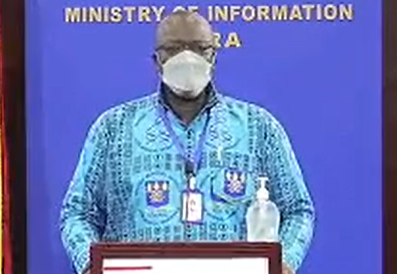
Speaking at a press briefing on Wednesday, April 22, Professor Ampofo said as of Tuesday, April 21, Noguchi had processed 76, 921 samples and tested 70, 921.
According to him, samples taken through retesting are placed in a different data base, making it impossible for them to be counted twice.

"Each respiratory sample is accompanied by a case investigation form. Our people refuse to accept a sample if it does not come with a case investigation form because, they need to understand where that particular individual came from.
"So each test results is based on a form. That's how come we are able to tell you that someone had traveled or some people don’t have a travel history. This information is not on the tube but on the form and that is where we get the data from.
"So every result that we get is from an individual. The 68,000, 70,000, 1,200 tests a day are individual data.
"Because we identify that our capacity is 1,200 a day, we decided to pull the samples. So yes, we actually run 1,200 samples a day but that is made up of 10,000 individuals. So when we break it down, we are able to record the individual results of those 10,000 individuals.
Latest Stories
-
‘We’ve become quite experienced in negativity’ – Liverpool’s Slot
4 hours -
Legendary manager Lucescu dies days after resigning
4 hours -
One dead as train travelling 99mph collides with lorry in France
4 hours -
Airlines cut flights and hike fares as fuel prices surge
4 hours -
Kane inspires Bayern to first-leg advantage over Real Madrid at Bernabéu
5 hours -
Wireless Festival cancelled after Kanye West blocked from coming to UK
5 hours -
Wa West MP commissions five boreholes for the benefit of his constituents
5 hours -
Havertz’s late strike hands Arsenal narrow first-leg advantage over Sporting
5 hours -
Damang mine award: Minority not against Ghanaian participation; we’re asking for fair process – Konadu
5 hours -
NPA to enforce stricter registration rules for petroleum tankers
6 hours -
Manhyia South MP laments decline in hospitality operations in his constituency
6 hours -
How a simple clean charcoal innovation could benefit Ghana’s climate future
6 hours -
NPA, COMAC launch Safety Week 2026 to promote risk management in petroleum sector
6 hours -
Stakeholder engagement resolves onion trade impasse
6 hours -
Gender Ministry holds staff durbar, welcomes new Chief Director
6 hours