

Audio By Carbonatix
As a young man, I sat at the feet of my grandparents, listening to the rhythmic cadence of their voices as they spoke of heroes. In those moments, I didn’t just hear names; I felt the presence of giants. I grew up believing these men were “superheroes,” men who stood up when the world expected them to kneel.
But as I grew older, I noticed a painful void. When I turned on the television or browsed global streaming platforms, the stories of my ancestors were either missing or told through distorted lenses—glorifying the wrong moments or softening the edges of our resistance. That silence is no longer acceptable.
1844 — Before 1957
Under immense military, political, and economic pressure, several coastal chiefs signed what became known as the Bond of 1844. Some signed under duress, uncertainty, or the hope of survival within a tightening colonial grip. Others believed compromise was the only available shield.
But among them, King Kaku Ackah I of Nzema refused.
He understood something simple but dangerous: freedom cannot be borrowed. Once sovereignty is diluted on paper, generations inherit the cost. For that refusal, he was isolated and removed—not because he was weak, but because defiance exposes systems.
He did not end colonial rule. But he refused to legitimize it. And sometimes, refusal itself is history’s first reply.
The 113-Year Reply
History does not forget—it waits.
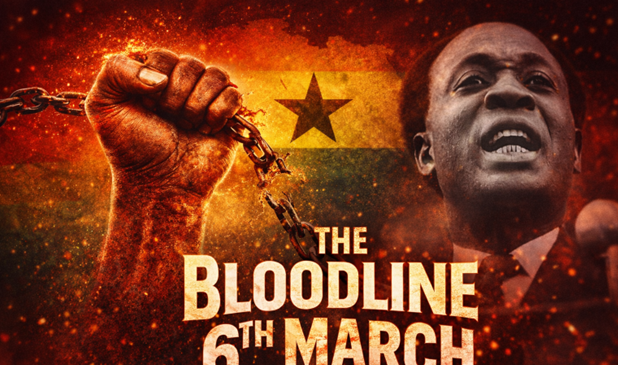
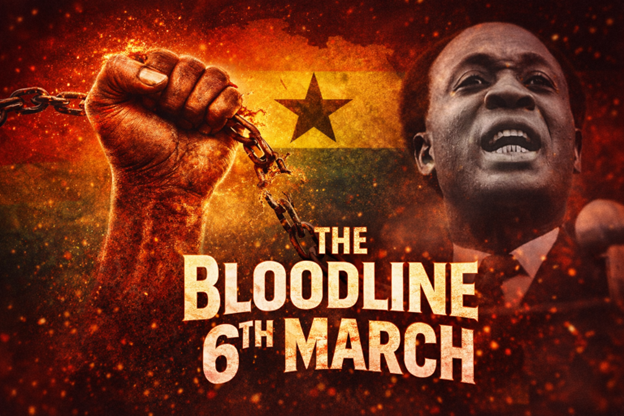
In 1957, when Kwame Nkrumah of Nkroful, a son of Nzema soil, declared Ghana independent, he was not only ending colonial rule. He was responding to unfinished resistance.
Whether by strategy or symbolism, choosing March 6 closed a historical loop that began in 1844. This was not a coincidence. It was continuity. A grandson finishing work began before his birth.
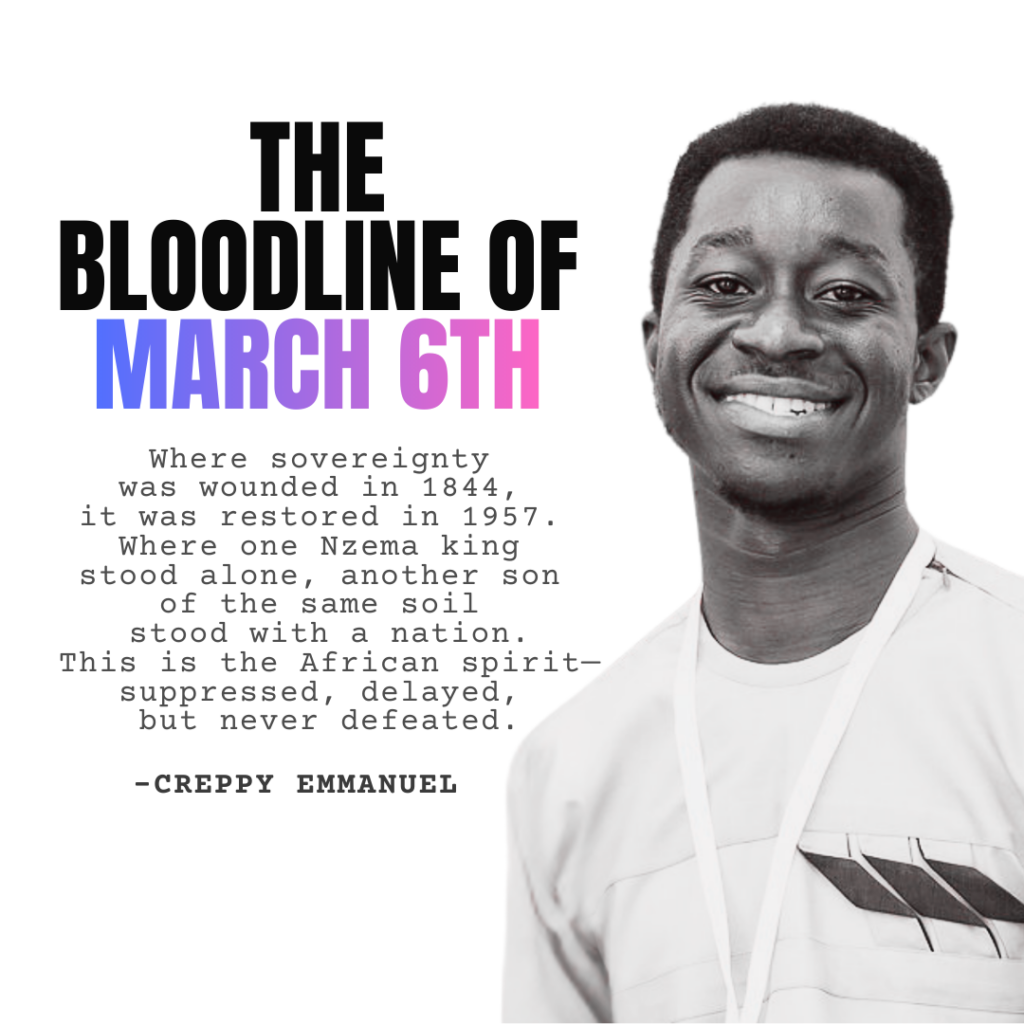
Where sovereignty was wounded in 1844, it was restored in 1957. Where one Nzema king stood alone, another son of the same soil stood with a nation.
But Nkrumah did not stand alone. The independence movement was a coalition of forces—educated elites, traditional rulers, market women, ex-servicemen, and youth across the Gold Coast. Figures like Eduardo Mondlane, though Mozambican, found solidarity in Accra's rising Pan-African energy; George Padmore from Trinidad helped shape Nkrumah's vision; J.B. Danquah and the Big Six, despite later political divergences, provided the intellectual and organizational architecture that made mass mobilization possible.
The United Gold Coast Convention (UGCC) and later the Convention People's Party (CPP) were vessels carrying the hopes of millions—not one man, not one lineage, but a people awakening to their collective power.
And yet, there is something that still moves me about that Nzema thread—that a king from that soil refused in 1844, and a son of that same soil declared freedom in 1957. It tells me that resistance, even when it seems to fail, plants seeds. The bloodline of March 6th is not just about who gave birth to whom. It is about who remembered. Who refused to let the story die.
This is the African spirit—suppressed, delayed, but never defeated.
A Call to the Creative Tribe: Let Us Ring the Bell
This is not a loud call. It is a listening one — a responsibility.
To writers, filmmakers, musicians, historians, archivists, and cultural workers: we cannot keep these stories locked in memory alone. We must return—to the towns, the elders, the soil—and record what is still alive before silence claims it.
And here is the good news: some of us have already started. I think of Akosua Adoma Owusu, whose films bend time and place until you feel our grandparents in the room again. I think of Makeba Boateng who speaks fashion, remembering the trailblazers who clothed the revolution.
I think of Manifest, whose lyrics carry the wisdom of elders into rhythms our young people actually dance to. I think of Nana-Ama Danquah and Kobena Brako (Ben Brako), who have spent years making sure our voices appear on pages that last. There are others—too many to name—, but their work tells me the lions are learning to write. The field is still wide, though. So many stories still sit at the edge of dying, waiting for someone to come sit with them.
Short films, archives, documentaries, books of memory, and living records must replace erasure. Oral history carried us far—but now, we must document.
As the old saying goes: “Until the lion learns how to write, every story will glorify the hunter.”
It is time for the lions to write—carefully, honestly, and together.
And writing, here, means more than ink on paper. It means building institutions—archives, film funds, cultural policy—that ensure the next generation inherits not silence, but song. It means placing King Kaku Ackah's refusal beside Nkrumah's declaration beside the filmmaker's lens beside the griot's memory not as artifacts, but as living tools for the liberation still ahead.
But one question remains, and it may define the next chapter:
Was March 6 the end of the battle—or only the moment Africa learned it could win?
Or, as Nkrumah himself warned, is the battle only truly won when Africa is totally liberated?
Perhaps the answer lies not in the past, but in what we—the creative tribe—choose to build with what the past has given us.
Latest Stories
-
‘We’ve become quite experienced in negativity’ – Liverpool’s Slot
3 hours -
Legendary manager Lucescu dies days after resigning
3 hours -
One dead as train travelling 99mph collides with lorry in France
3 hours -
Airlines cut flights and hike fares as fuel prices surge
3 hours -
Kane inspires Bayern to first-leg advantage over Real Madrid at Bernabéu
4 hours -
Wireless Festival cancelled after Kanye West blocked from coming to UK
4 hours -
Wa West MP commissions five boreholes for the benefit of his constituents
4 hours -
Havertz’s late strike hands Arsenal narrow first-leg advantage over Sporting
4 hours -
Damang mine award: Minority not against Ghanaian participation; we’re asking for fair process – Konadu
4 hours -
NPA to enforce stricter registration rules for petroleum tankers
5 hours -
Manhyia South MP laments decline in hospitality operations in his constituency
5 hours -
How a simple clean charcoal innovation could benefit Ghana’s climate future
5 hours -
NPA, COMAC launch Safety Week 2026 to promote risk management in petroleum sector
5 hours -
Stakeholder engagement resolves onion trade impasse
5 hours -
Gender Ministry holds staff durbar, welcomes new Chief Director
5 hours