

Audio By Carbonatix
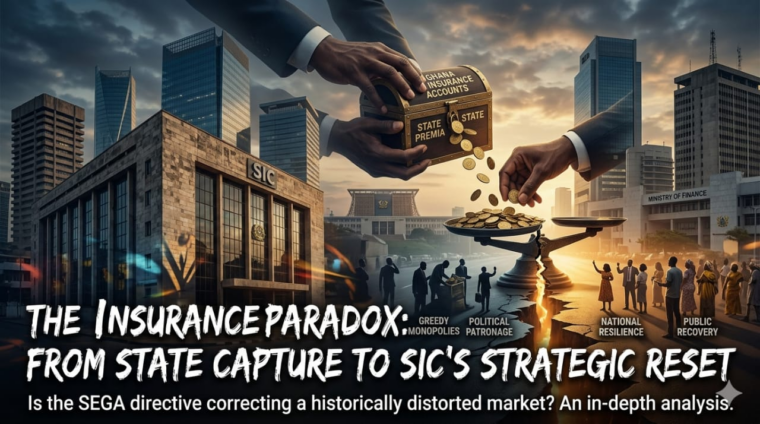
For far too long, the Ghanaian insurance industry has functioned less like a competitive marketplace and more like a banquet hall where the table is set by political patronage and the guest list is restricted to a greedy few.
What we are witnessing today, the shrill campaigns against “political influence” in the wake of the State Enterprise Governance Agency (SEGA) directives, is not a crusade for transparency.
It is the panicked roar of displaced beneficiaries who, having gorged themselves on state accounts through the same backdoors they now decry, find the locks finally being changed.
The history of Ghana Gas, established in 2014 under the John Mahama administration, serves as a masterclass in strategic institutional design. The Ghanaian Oil and Gas Pool was not a whim; it was a fortress built to safeguard national interests.
Yet, for nine years, we watched as the Ministry of Energy and the Energy Commission systematically dismantled this protection, pushing Ghana Gas downstream to strip it of its collective shield.
When the guard changed in 2017, the struggle that ensued between then-Energy Minister Boakye Agyarko and Finance Minister Ken Ofori-Atta was never about the soul of the nation.
It was a sordid duel over the spoils of electoral war. While one sought to anchor the entire account at Enterprise Insurance, the other manoeuvred to hand the mantle to GLICO. In this "dawn of change," the public interest was not even a footnote; it was the casualty.
The irony is as thick as it is distasteful. Today, those who captured Ghana Gas, VRA, GHAPOHA, and GRA through high-level religious, traditional, and political lobbying have suddenly discovered the "sanctity of competitive bidding."
Where was this devotion to merit when a staggering GHC 18,250,533.39 premium from the Bank of Ghana was handed to GLICO under this very government?
And, what "competitive process" involves reporting board members of public institutions to Archbishops to secure portfolios? This is the quintessence of greed: to occupy the house of monopoly by night and preach the gospel of the free market by day.
The current SEGA directive is not an administrative distortion; it is a Strategic Reset. We must reject the narrow, pedestrian mischaracterisation that frames this as a drift away from competition.
In reality, SEGA is performing a necessary market correction to reverse a structural imbalance where politically exposed private actors have hollowed out the State Insurance Company (SIC).
The pattern of this "Grand Larceny" was predictable. First, brokers were introduced into SIC-dominated placements. Slowly, these intermediaries redirected risks to aligned private interests until SIC, a strategic national anchor, was incrementally stripped of its most profitable assets.
To argue for "competitive neutrality" now is to demand that a man with bound feet compete in a sprint against those who stole his shoes.
The SIC is not an "ordinary" market participant. It is a sovereign pillar. When we allow its capacity to erode, we deny ourselves the technical expertise required for complex oil, gas, and infrastructure underwriting.
We become perpetual dependents on foreign reinsurance markets, exporting our capital and importing our vulnerability.
SEGA’s intervention aligns with the best traditions of developmental state economics by ensuring taxpayer-funded premiums recycle within the state ecosystem rather than being hoarded by a narrow clique, restoring SIC’s exposure to large-scale risks to strengthen the national balance sheet, and preventing a national institution from becoming a marginal ghost in its own sovereign territory.
It is a tragedy of our times that even SSNIT, a major shareholder in SIC, often looks elsewhere for its insurance needs.
This institutional betrayal, started by the likes of Dr. Kwabena Duffour and intensified by Boakye Agyarko and Ken Ofori-Atta under the previous regime to fatten political influence beneficiaries like Star Insurance, Enterprise Insurance and Glico at the expense of other industry players, must end.
We do not need a single, bloated monopoly, but we absolutely require a healthy, equitable market that fosters industrial giants rather than pampered cronies.
The noise we hear today is the sound of the "chief beneficiaries" losing their grip. If we are to talk about merit-based procurement, let us start by auditing how the current giants grew so fat on the state’s milk while the state’s own child, SIC, was left to starve.
Ghana does not belong to a cabal of influencers and their religious or political proxies. It belongs to the people.
The SEGA directive is a bold step toward ensuring that the insurance industry serves the Republic, not just the "Republic of Greed." It is time to choose: do we protect the ill-gotten gains of the few, or do we fortify the institutions that belong to us all?
The choice is not between competition and coordination; it is between national resilience and state capture. For SIC, and for Ghana, the reset is not just necessary, it is long overdue.
Latest Stories
-
Calls for royal meeting with Epstein survivors grow ahead of US visit
3 minutes -
Ibn Chambas advocates blend of technology and human values in education
5 minutes -
UMA improves healthcare access in Asutifi North with GH₵700k ‘Kim Taylor Legacy’ Walkway
10 minutes -
Scholarships Authority and Fanaka University offer sponsorship for procurement and supply chain studies
13 minutes -
Bisa Kdei drops new single ‘Go N Look’ featuring Medikal
19 minutes -
Benin facing rising terrorism in north as French military presence faces growing criticism
20 minutes -
UEW Public Lecture Series 2026: Education debate ‘about the soul of Ghana’s future’ — Dr Ibn Chambas
21 minutes -
EU fingerprint and photo travel rules come into force from today
48 minutes -
Anti-LGBTQ+ Bill: Ghanaians demand expedited passage, not dialogue – Ntim Fordjour to Mahama
56 minutes -
EU airline industry warns of fuel shortages if Strait of Hormuz stays closed
59 minutes -
White House staff told not to place bets on prediction markets
1 hour -
Auctioneers petition Prez Mahama over ‘interference’ in public auctions
1 hour -
GEA, Mastercard Foundation drive market access for MSMEs at Kwahu Business Forum
1 hour -
Education Ministry begins review of Ghana Library Authority law
1 hour -
Ghana U-15 girls clinch back-to-back CAF Schools titles
1 hour