

Audio By Carbonatix
The way people learn about food is changing, moving beyond lecture halls and health facilities into the everyday spaces of our phones, where a scroll, a swipe, or a short video can shape what we think and do about nutrition. Access to nutrition information has never been easier, but ease of access does not always guarantee that the information is reliable.
As nutrition and dietetic professionals, we are aware of this reality, and it is important to occasionally pause and take a closer look at what people are actually seeing, believing, and acting on. Last academic year, I supervised an undergraduate research project that explored this very issue, and the findings are worth paying attention to not only within academic circles, but for anyone trying to make informed decisions about what they eat and how it impacts their health.
In Ghana, like many parts of the world, social media has become a major source of health and nutrition information, especially among young adults; however, much of this information is often unverified, oversimplified, or sometimes completely inaccurate. Despite these limitations, people still act on it and this is what makes the situation particularly concerning.
What we Did
My student Gerald and I set out to answer a simple but important question: what is the quality of nutrition information university students are receiving on social media? To explore this, we conducted a cross-sectional online survey among 200 undergraduate students at the University of Ghana, asking them to share a nutrition message they had received, indicate its source, and state whether they acted or intended to act on it; central to this study is how we assessed the quality of that information.
The tool we used
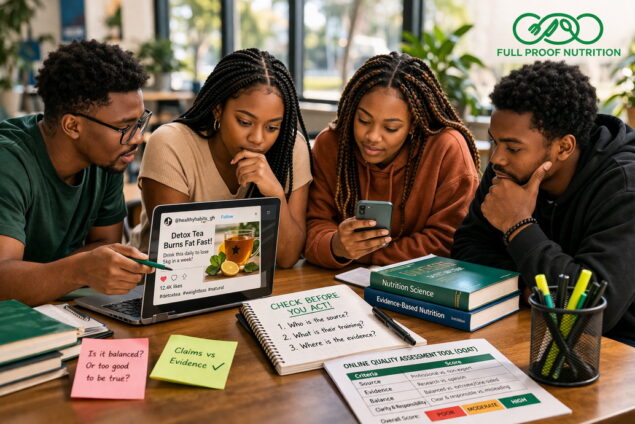
To evaluate the messages, we used the Online Quality Assessment Tool (OQAT), developed and validated by Ellis et al., which is particularly useful because, one of the biggest challenges with misinformation is that people often do not know how to judge what they are seeing; the OQAT helps to bridge that gap by prompting users to consider a few key questions:
- Who is the source? Is this coming from a professional with expertise in the field or just “someone online”?
- Is there evidence? Are the claims backed by research or based on opinions and personal stories only?
- Is it balanced? Does it present a fair view, or does it rely on extreme, one-sided claims such as “avoid this completely” or “this cures some disease” or in some instances “this cures every disease”?
- Is it clear and responsible? Or is it misleading, exaggerated, or fear-based?
Each message was then scored and classified as poor, moderate, or high quality. What makes this tool particularly valuable is that it is not limited to research use only. It also reflects the kind of critical thinking skills we need the general public to develop when engaging with nutrition information online.
What we found
Some of the findings were not surprising, but they were still important to sit with carefully.
- Social media is a major source of nutrition information: nearly 1 in 2 students (49%) reported receiving nutrition messages online, with TikTok emerging as the leading platform (35%), highlighting the dominance of short-form, fast-paced, and engaging content that is often unfiltered.
- People are not just watching, reading and listening, they are acting: this is where it becomes more concerning, as 57% of students reported that they acted on or intended to act on the information they received. This indicates that beyond passive exposure nutrition information on social media is something that is actively shaping food choices and health behaviours.
- A large proportion of online nutrition information is low quality: using the OQAT, 37% of messages were rated as poor quality, while only 31% were classified as high quality, suggesting that a significant portion of what students are exposed to (and may act on) is not reliable.
- Personal relevance drives action, not information quality: interestingly, factors such as age and gender did not influence whether students acted on the information, but BMI showed a significant association. This points to a deeper issue where individuals may be more inclined to act on nutrition messages that relate to personal concerns, particularly weight, which in turn increases their vulnerability to misinformation.
What this means
The findings of this study reflect a broader shift in how nutrition knowledge is being formed among Ghanaian youth and possibly older population groups. Information is gradually moving away from trained professionals and toward influencers, peers, and platform-driven algorithms, often without any meaningful quality control. Over time, when misinformation becomes familiar, it begins to shape everyday decisions such as what people eat, how they perceive their bodies, how they approach their health, and ultimately their risk of disease. This is not something we can afford to overlook.
So What Do We Need to Do?
First, educators, public health institutions, and media platforms need to take the lead in helping people question what they see, hear and read, because not every information that appears “credible” is grounded in evidence. This can be done by consistently promoting simple checks such as who is speaking, what their training is, and where the evidence comes from.
Second, nutrition and dietetic professionals and health practitioners must become more visible and intentional about their presence in public spaces, especially on social media, because when credible voices are absent, misinformation quickly fills the gap.
Third, those of us who generate and communicate evidence-based nutrition information - academics, clinicians, and health communicators - need to prioritise clarity and accessibility, recognising that misinformation often spreads because it is simple, visually appealing, and confidently delivered, and we must match that clarity without compromising accuracy.
Finally, policy makers, educational systems, and public health programmes need to treat digital nutrition literacy as essential, integrating it into curricula and community education, because the ability to evaluate online information is now a basic life skill, much like reading and understanding a food label.
I would like to take a moment to acknowledge my student, Gerald Quartey, for the thoughtfulness and effort that went into bringing this work to completion. Research like this requires patience, curiosity, and discipline, and he carried it through commendably. Well done! And on a lighter note, I will be patiently (but expectantly) awaiting the manuscript draft for publication.
Written by Dr. Laurene Boateng (PhD, RD)
Dr. Laurene Boateng is a Registered Dietitian and Senior Lecturer in the Department of Dietetics, University of Ghana. She is the founder and editor-in-chief of Full Proof Nutrition, a Nutrition Consultancy committed to providing reliable, evidence-based, and practical healthy eating advice through its website www.fullproofnutrition.com. Click here to join Full Proof Nutrition WhatsApp channel to receive more educative content. Send us a mail on fullproofnutrition@gmail.com. Grab a copy of my book on healthy eating – available now on Selar (Buy HEALTHY EATING MADE SIMPLE by Laurene Boateng on Selar) and Amazon (https://amzn.eu/d/6i9OeVb).
References
Ellis, C. H., Moore, J. B., Ho, P., & Evans, C. E. (2023). Development and validation of a quality assessment tool to assess online nutrition information. Digital Health, 9, 20552076231187249.
Quartey, G.N.K. (2025). Assessing the quality of nutrition and health information disseminated via social media among University of Ghana undergraduate students. Undergraduate dissertation, University of Ghana.
Latest Stories
-
‘We’ve become quite experienced in negativity’ – Liverpool’s Slot
58 seconds -
Legendary manager Lucescu dies days after resigning
22 minutes -
One dead as train travelling 99mph collides with lorry in France
31 minutes -
Airlines cut flights and hike fares as fuel prices surge
48 minutes -
Kane inspires Bayern to first-leg advantage over Real Madrid at Bernabéu
59 minutes -
Wireless Festival cancelled after Kanye West blocked from coming to UK
1 hour -
Wa West MP commissions five boreholes for the benefit of his constituents
1 hour -
Havertz’s late strike hands Arsenal narrow first-leg advantage over Sporting
1 hour -
Damang mine award: Minority not against Ghanaian participation; we’re asking for fair process – Konadu
2 hours -
NPA to enforce stricter registration rules for petroleum tankers
2 hours -
Manhyia South MP laments decline in hospitality operations in his constituency
2 hours -
How a simple clean charcoal innovation could benefit Ghana’s climate future
2 hours -
NPA, COMAC launch Safety Week 2026 to promote risk management in petroleum sector
2 hours -
Stakeholder engagement resolves onion trade impasse
2 hours -
Gender Ministry holds staff durbar, welcomes new Chief Director
3 hours