

Audio By Carbonatix
When Ghana’s Artificial Intelligence (AI) Strategy received cabinet approval in February 2026, it signalled the culmination of years of consultation and institutional leadership, with the Kwame Nkrumah University of Science and Technology, Kumasi (KNUST) at the centre of the national effort.
From early ethical debates in 2022 to high-level national consultations in 2025, KNUST’s Responsible AI Lab (RAIL) shaped the ideas, frameworks and stakeholder engagements that ultimately defined Ghana’s AI roadmap.
Laying the ethical foundation (2022)
The journey began in March 2022, when the Responsible Artificial Intelligence Lab (RAIL), a lab under the AI4D Multidisciplinary Labs project initiated by the International Development Research Centre (IDRC) convened experts in digital technology, data governance and policy to deliberate on the ethical foundations of AI in Ghana.
At the time, Professor Jerry John Kponyo, Principal Investigator and Scientific Director of RAIL, presented a sobering assessment of Ghana’s AI landscape. He cited gaps in data infrastructure, cybersecurity vulnerabilities, shortage of skilled personnel, high implementation costs and the absence of a clear national AI strategy.
He recommended the establishment of a National AI Advisory Expert Group, a formal strategy framework and an oversight implementation committee.
“We must be strategic as a nation and lead the Fourth Industrial Revolution in the sub-region,” he emphasised.
The workshop, which drew participants from government, civil society and international bodies including UNESCO and the UN Executive Office of the Secretary-General, framed AI not merely as a technological tool but as a governance and development issue rooted in Ghanaian values and societal norms.
From ethical debate to national blueprint (April 2025)
By April 2025, those early recommendations had evolved into a structured draft National AI Strategy, with KNUST’s RAIL leading its coordination in collaboration with the Ministry of Communication, Digital Technology and Innovations and the British High Commission.
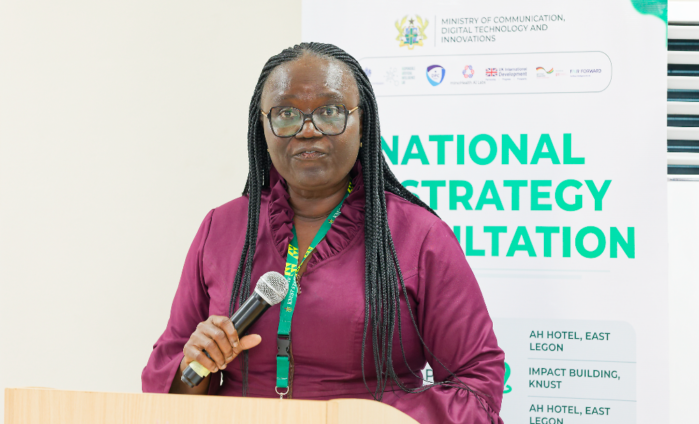
At a high-level consultation in East Legon, Prof. Kponyo presented the draft strategy anchored on eight key pillars designed to ensure ethical, inclusive and transformative AI adoption across healthcare, education, governance and agriculture.
“We consider this a sacred duty,” he stated. “KNUST is fully committed to engaging all stakeholders and ensuring the strategy is adopted on schedule.”
The Minister for Communication, Digital Technology and Innovations, Samuel Nartey George, declared AI a national development priority.
“Data alone isn’t enough, it’s the intelligence we apply that will revolutionise healthcare, smart cities, and financial inclusion,” he said, announcing the launch of the 1 Million Coders Programme to equip Ghanaian youth with future-ready skills.
International partners echoed their support. Keith McMahon, Deputy British High Commissioner to Ghana, said: “Globally, we are behind in AI adoption, but today’s discussions give me hope that Ghana recognises its transformative potential.”
Deepening academic ownership in Kumasi
On April 23, 2025, KNUST hosted the second national consultation in Kumasi, broadening engagement to academia and development partners.
The consultation moved beyond vision to implementation. Prof. Kponyo proposed an “AI-ready Ghana” programme, expanded AI education and training, stronger cloud partnerships and improved national data infrastructure. He also announced plans to establish a Responsible AI Office to oversee implementation and ensure ethical compliance.
KNUST Vice-Chancellor, Rita Akosua Dickson, underscored the university’s institutional commitment.
“This consultation brings together the brightest minds and critical stakeholders to chart a strategy that is all-inclusive, forward-thinking, responsible and grounded in Ghana’s unique developmental context,” she said.
She also announced an “AI in Education” Summer School scheduled for October 2025, aimed at building a competent AI workforce and strengthening national capacity.
Dr. Arnold Karvaapuo of the Data Protection Commission described the strategy as “a blueprint for Ghana’s digital future,” while Mr. Elikplim Sabblah of GIZ’s FAIR Forward initiative shared lessons from Rwanda and Kenya to inform Ghana’s approach.
Engaging the Judiciary
In late April 2025, RAIL led a third consultation focused on Ghana’s judiciary, recognising that AI governance required constitutional and legal clarity.
Representatives from the Ghana Bar Association cautioned against unregulated deployment, warning of risks including algorithmic bias, misinformation and threats to judicial integrity.
“AI must not be rolled out without regulation. We need constitutional fidelity, democratic oversight, and a commitment to investing in local datasets,” a Bar representative noted.
Discussions emphasised human oversight in high-risk AI decisions, the need for a Ghana AI Institute, a national data strategy, infrastructure investment and gender inclusion.
As Ghana embarks on implementing its AI roadmap, the road to approval tells a deeper story: that national digital transformation can be rooted in local expertise, institutional leadership and a commitment to responsible innovation.
In that story, KNUST helped design Ghana's AI future.
Latest Stories
-
Catholic Bishops say moral values must match economic priorities in Anti-LGBTQ+ debate
19 minutes -
IGP Yohuno urges merit and hard work ahead of Police Academy exams
31 minutes -
Queendalyn Yurglee releases debut album ‘Clouds of Glory’
1 hour -
UDS moves to clear MPhil student wrongly linked to robbery case
1 hour -
Vodza Regatta 2026: Prof Audrey Gadzekpo rallies investors for coastal tourism growth
1 hour -
Introduction of 100 new Metro Mass buses won’t affect transport unions – GPRTU
1 hour -
Deputy Transport Minister backs Yellow Line traffic initiative
2 hours -
MTN Ashanti-Fest music concert set to hit Kumasi on Saturday
2 hours -
Authorities probe discovery of dead fish at Tema shipyard
2 hours -
Minority welcomes fuel tax cuts, demands accountability for GH¢1 levy
2 hours -
It remains a priority — Sam George on Anti-LGBTQ bill
2 hours -
Police arrest Nigerian national seen in viral videos wearing police uniforms
2 hours -
Free golf training empowers underprivileged girls in Accra
2 hours -
Why SIGA’s reset is not a market sin, but a national necessity
3 hours -
SIGA Directive: Beyond the theatre of institutional displacement
3 hours