

Audio By Carbonatix
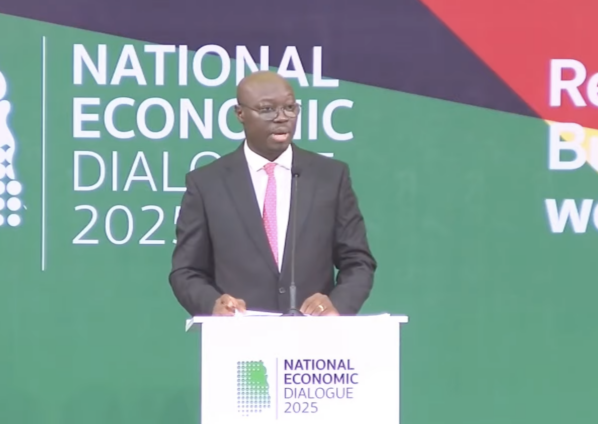
Finance Minister Dr Cassiel Ato Forson has emphasised the urgent need for institutional reforms to enhance productivity and accelerate Ghana’s economic transformation.
He warned that without comprehensive policy changes, Ghana may not achieve upper-middle-income status until after 2050.
Speaking at the National Economic Dialogue 2025, Dr Forson stressed that Ghana cannot afford to wait that long to attain economic progress.
“Without comprehensive reforms, unfortunately, Ghana will only achieve upper-middle-income status after the year 2050, and we cannot wait until then,” he said.
“There is an urgent need for comprehensive policies and institutional reforms that enhance productivity, improve the quality of infrastructure and services, and elevate human capital and workforce skills. These reforms have the potential to transform Ghana within a generation, tripling its per capita income by 2050,” he explained.
He highlighted the importance of reorienting fiscal policies to support economic growth and structural transformation. According to him, Ghana’s economic future depends on the level of reforms implemented.
“If nothing is done, Ghana will only become an upper-middle-income country by 2050. With moderate reforms, we can achieve this by 2042, but if we introduce ambitious reforms, Ghana can reach upper-middle-income status by 2038,” he explained. “We have no choice but to introduce measures to reset our economy.”
Dr Forson outlined a seven-chapter framework aimed at resetting the economy. He said the first focus will be on stabilising the economy and creating prosperity for all.
“We have no choice; we will have to introduce measures to reset our economy,” he said. “Chapter one is resetting the economy and creating prosperity for all. Chapter two is jobs for all, Chapter three is Ghana’s framework for industrial revitalisation, support, and transformation, which we call Ghana First.”
He added that another major focus will be infrastructure, human capital development, governance, and economic diplomacy.
“Chapter four will be powering growth through infrastructural development. Chapter five is investing in people for inclusive growth. Chapter six will be restoring good governance and combating corruption, and chapter seven will be deepening international relations and foreign policy so that Ghana can benefit from economic diplomacy,” he explained.
Latest Stories
-
President Mahama is not sincere with Ghanaians on LGBTQ bill matter – Hassan Tampuli
15 minutes -
Gov’t to establish Prison Industrial Hub to equip inmates with income-generating skills – Prison Service boss
34 minutes -
Alhassan Tampuli donates cement, roofing sheets to support storm victims in Gushegu
35 minutes -
Alhassan Tampuli appeals for urgent support for storm victims in Gushegu
37 minutes -
The hypocrisy must stop; pass Anti-LGBTQ+ Bill now – Alhassan Tampuli to Mahama
41 minutes -
Imprisonment should be rehabilitative, not punitive – Ghana Prisons boss at UNGA
1 hour -
Ga Adangbe traditional priests petition Mahama over McDan aviation licence revocation
1 hour -
Anti-LGBTQ Bill: NDC’s arrogance is worrying – Hassan Tampuli
1 hour -
Let’s give OSP time to mature, not to scrap it – Hassan Tampuli
1 hour -
Nigeria convicts 386 Islamist militants in mass trials
2 hours -
Djibouti president wins election with 97.8% of vote, state media says
2 hours -
We don’t have mandate to deduct tax from rent allowance of security services personnel – Interior Ministry clarifies
2 hours -
Ablakwa receives Presidential Special Envoy on Reparations to advance global agenda
2 hours -
Christina Koch becomes first woman to travel around the moon on Artemis II
2 hours -
Epstein survivors’ calls to meet King Charles and Queen harder to ignore as US visit approaches
2 hours