

Audio By Carbonatix
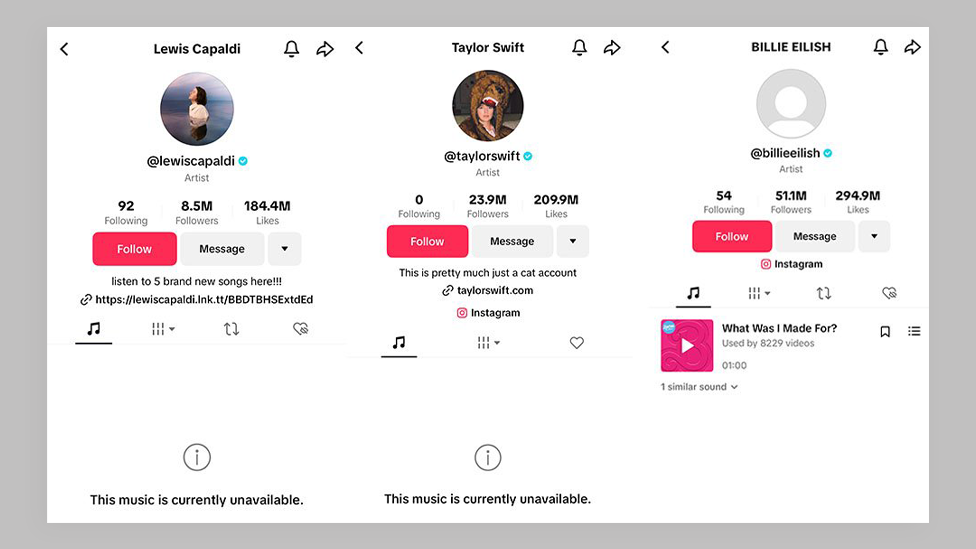
TikTok has removed music by stars including Taylor Swift, The Weeknd and Olivia Rodrigo from videos after a row with their record label, Universal Music Group (UMG).
A licensing agreement between TikTok and the label expired on Wednesday, and a new deal could not be reached.
UMG said TikTok wanted to pay a "fraction" of the rate other social media sites do for access to its songs.
TikTok accused UMG of presenting a "false narrative and rhetoric".
All videos which have UMG music on them will be muted and new videos will not be able to be made with those tracks.
Some artists such as Ariana Grande and Katy Perry have had most of their music disappear from their official pages, except a few songs which are on other labels.
Billie Eilish, another UMG artist, has had all but one of her songs taken down.
Her song What Was I Made For? was featured in the Barbie movie - whose soundtrack was published by Warner Music Group.
Sophie Ellis-Bextor's Murder on the Dancefloor, which became a viral hit after appearing in the film Saltburn, is also unavailable.
Unofficial, sped-up and slowed-down versions of tracks are still available to use.
TIKTOK
'Two colliding planets'
Noah Kahan, whose number one song Stick Season started as a viral TikTok clip, posted a video on his account saying he was unable to promote his new song on the platform.
"I can't stick it down your throats any more on this app," he said.
"I'll probably be OK, right? I'll land on my feet, right?"
Meanwhile Cody Fry, an artist signed to a record label owned by UMG, said in a TikTok video he felt "like a person standing between two colliding planets" - having seen reports about the licensing agreement expiring as one of his tracks was going viral in China.
The 33-year-old musician told the BBC he did not even have a TikTok account when his song, I Hear A Symphony, went viral on the platform in 2021, several years after it was first released.
He added that he thought TikTok should "value music more than it does currently" and he wished the two giants could have resolved differences without "leaving it to the expense of artists on the ground".
"I don't know much about the mechanics of these massive corporate negotiations," he said, "but I'd be remiss if I didn't express the frustration about how this was handled on behalf of myself, and I think Universal's artists, because to find out something like this on the news, it's pretty tough."
Major disagreement
Music companies and artists earn royalty payments when their songs are played on streaming and social media platforms.
On TikTok, they are used as backing music to the videos uploaded to the site.
But there has long been unease about how little the platforms pay, which in this case developed into a major and very public disagreement.
UMG and TikTok were in talks over a new deal, but were unable to agree one before the 31 January deadline.
In an open letter, published on 30 January, Universal claimed that "ultimately TikTok is trying to build a music-based business, without paying fair value for the music".
Universal said it was also concerned about getting artists fair compensation for AI-generated songs made to sound like real artists - such as one made to sound like Drake and The Weeknd which went viral.
"Content creators already compete on social media platforms with diluted or non-existing royalty pools," said Franklin Graves, an attorney and author of a newsletter focused on legal developments in the creator economy.
"By throwing an additional licensing payment for AI-generated music into the mix, it could potentially decrease any ad revenue share left after TikTok's cut and rights holders are paid," he added.
Universal also had issues with TikTok's content moderation, saying it failed to adequately deal with "the tidal wave of hate speech, bigotry, bullying and harassment on the platform".
TikTok responded: "It is sad and disappointing that Universal Music Group has put their own greed above the interests of their artists and songwriters.
"Despite Universal's false narrative and rhetoric, the fact is they have chosen to walk away from the powerful support of a platform with well over a billion users that serves as a free promotional and discovery vehicle for their talent," it added.
Universal's rival Warner Music agreed a licensing deal with TikTok in July 2023.
Latest Stories
-
$600m tomato imports undermining Ghana’s economy — Chamber of Agribusiness
34 minutes -
Rainstorm wreaks havoc: Faulty transformers, feeder failures leave parts of 3 regions without power
42 minutes -
CUTS International calls for urgent competition law amid sachet water price hikes
1 hour -
‘I never did this advert’, AI clones hijack Ghanaian identities for profit
2 hours -
25-year-old woman battles trauma after surviving deadly Nkwanta attack
2 hours -
Vice President honoured at Tortsogbeza as South Tongu leaders highlight development needs
2 hours -
Kwahu Business Forum 2026: Corporate citizenship, sustaining African businesses take centre stage with KGL as the case study
3 hours -
Trump seeks $152m to reopen notorious Alcatraz prison
6 hours -
Ex-Chelsea player Oscar retires with heart issue
6 hours -
CA Foundation drives constitutional literacy in Kpone Katamanso municipality
6 hours -
GPRTU to hold talks with Transport Ministry over rising fuel costs
6 hours -
CUTS International urges gov’t to halt sachet water price hike pending cost review
6 hours -
Chief Justice: Efficient Judiciary essential to reducing business costs
6 hours -
Bayern grabs 99th-minute winner to cap superb fightback
6 hours -
Ahmed Ibrahim urges Ghanaians to reflect Easter values in nation-building
6 hours