

Audio By Carbonatix
TikTok argued in court on Monday that a US law - which would see it banned unless it is sold by ByteDance - would have a “staggering” impact on the free speech of its US users.
The law was prompted by concerns that US users' data is vulnerable to exploitation by China's government.
TikTok and ByteDance have repeatedly denied links to the Chinese authorities.
The companies sued to block the legislation in early May, calling it unconstitutional and an effective ban on the speech of its 170 million US users.
A panel of three judges heard its arguments at an appeals court in Washington DC on Monday.
"This law imposes extraordinary speech prohibition based on indeterminate future risks," TikTok and ByteDance's lawyer Andrew Pincus told the court.
Concerns around China came up early, with Mr Pincus stating that the firm "is not owned" by the country.
"The owner of TikTok is ByteDance Limited, a Cayman Islands holding company,” he said.
But Judge Sri Srinivasan responded that the firm was "subject to Chinese control".
Mr Pincus said the US government does not allege any malfeasance has taken place - and the firm was being punished over the suggestion that there might be issues in the future.
But he was challenged on his argument that the law would be an unprecedented ban on a single speaker - and his claim that it would be "unfeasible" to divest the US arm of the firm.
Judge Ginsberg argued the law is "an absolute bar on the current arrangement of control" of the company, not the company itself.
He also said it targeted a group of companies controlled by a so-called foreign adversary, rather than TikTok alone.
Constitutional right
Jeffrey Fisher, representing creators concerned by the law, said it could impede their constitutional right to work with the editor and publisher of their choice – such as TikTok under its current ownership.
TikTok creator Tiffany Cianci, who is not among the creators involved in the lawsuit, was livestreaming outside the hearing to update viewers on proceedings.
She told the BBC that 65,000 people tuned into her TikTok Live.
"The American people care about this issue," she said. "They're tuning in because they're worried about losing something."
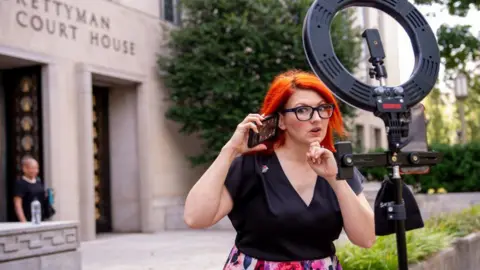
Ms Cianci added that the platform's use by politicians in the run-up to the 2024 presidential election felt "hypocritical" and made her doubt the security concerns at the heart of the controversial law.
"If it were dangerous, they wouldn't be there," she said.
Department of Justice lawyer Daniel Tenny argued against TikTok's defence that the code behind its platform is based in the United States.
"There’s really no dispute here that the recommendation engine is maintained, developed, and written by ByteDance rather than TikTok US," he said.
"It is not expression by Americans in America - it is expression by Chinese engineers in China."
Mr Fisher had claimed posts on the platform in the US were American speech that was "at most curated by a foreign company".
In addition to data concerns, officials and lawmakers have expressed alarm at the prospect of TikTok being used by the Chinese government to spread propaganda to Americans.
However, advocates of America's powerful free speech rights, enshrined in the First Amendment of the US Constitution, have said upholding the divest-or-ban law would be a gift to authoritarian regimes everywhere.
Xiangnong Wang, a staff attorney at Columbia University's Knight First Amendment Institute, said repressive regimes worldwide may use it to "justify new restrictions on their own citizens’ right to access information, ideas, and media from abroad."
'High stakes'
But according to James Lewis, of the Center for Strategic and International Studies in Washington, the law was drafted to withstand judicial scrutiny.
"The substance of the case against TikTok is very strong," Mr Lewis said.
"The key point is whether the court accepts that requiring divestiture does not regulate speech."
Mr Lewis added that the courts usually defer to the president on national security matters.
Regardless of how the appeals court rules, most experts agree the case could drag on for months, if not longer.
Gautam Hans, clinical professor of law at Cornell Law School, told the BBC he believes an appeal is likely either way.
The government's ability to legislate and regulate where national security is concerned is "paramount," he said.
"They cannot have that limited by the courts."
But the issues are also "existential" for TikTok, he added, with the company saying it cannot divest and would as such have no choice but to shut down.
Mike Proulx, vice president and research director at analysis firm Forrester, added the "high stakes" case would likely progress to the US' highest court, the Supreme Court.
Latest Stories
-
Foreign Affairs Ministry advises Ghanaians to take recommended vaccinations before traveling to Senegal
14 minutes -
NACOC Central Regional Command partners with NSRA on drug awareness campaign
38 minutes -
Galaxy, DPS and Lycee Français shine at part 2 of 2026 Ghana International School Festival
40 minutes -
Project C.U.R.E. donates vital medical supplies to support GMTF’s ‘Heal Ghana’ agenda
43 minutes -
Engineers and Planners Ltd secures Damang Mining Lease after grueling $500m competitive tender
46 minutes -
I never went to university – Tommy Annan Forson
56 minutes -
NACOC concludes four-day anti-drug operation in Eastern, Greater Accra regions
1 hour -
Cedi dips further as external shocks intensify; one dollar equals GH¢11.70 at forex bureaus
1 hour -
Sampa chieftaincy dispute: Sammordua dragged to court for contempt
2 hours -
Okyere Baafi calls for suspension of Publican AI system over ‘serious flaws’
2 hours -
VIP Transport defends fare increase over rising fuel and maintenance costs
2 hours -
LGBTQ+ issues not a priority for Ghanaians – Felix Kwakye Ofosu
2 hours -
Kwakye Ofosu rejects NPP Minority’s call for apology over anti-LGBTQ bill
2 hours -
Music giant Universal gets $64bn takeover offer
3 hours -
NPP criticism of anti-LGBTQ Bill ‘nothing more than political posturing’ — Kwakye Ofosu
3 hours