

Audio By Carbonatix
Warnings over the safety of OceanGate's Titan submersible were repeatedly dismissed by the CEO of the company, email exchanges with a leading deep sea exploration specialist show.
In messages seen by the BBC, Rob McCallum told OceanGate CEO Stockton Rush that he was potentially putting his clients at risk and urged him to stop using the sub until it had been certified by an independent agency.
Mr Rush responded that he was "tired of industry players who try to use a safety argument to stop innovation".
The tense exchange ended after OceanGate's lawyers threatened legal action, Mr McCallum said.
"I think you are potentially placing yourself and your clients in a dangerous dynamic," he wrote to the OceanGate boss in March 2018. "In your race to Titanic you are mirroring that famous catch cry: 'She is unsinkable'".
In the messages, Mr Rush, who was among five passengers who died when the Titan experienced what officials believe was a "catastrophic implosion" on Sunday, expresses frustration with the criticism of Titan's safety measures.
"We have heard the baseless cries of 'you are going to kill someone' way too often," he wrote. "I take this as a serious personal insult."
Mr McCallum told the BBC that he repeatedly urged the company to seek certification for the Titan before using it for commercial tours. The vessel was never certified or classed.
"Until a sub is classed, tested and proven it should not be used for commercial deep dive operations," he wrote in one email.
"I implore you to take every care in your testing and sea trials and to be very, very conservative," he added. "As much as I appreciate entrepreneurship and innovation, you are potentially putting an entire industry at risk."
In his response a few days later, Mr Rush defended his business and his credentials.
He said OceanGate's "engineering focused, innovative approach... flies in the face of the submersible orthodoxy, but that is the nature of innovation".
Throughout the exchange, Mr Rush defended his qualifications and questioned the existing framework around deep sea expeditions.
He said "industry players" were trying to stop "new entrants from entering their small existing market".
"I am well qualified to understand the risks and issues associated with subsea exploration in a new vehicle," he wrote.
Mr McCallum then responded in stark terms, writing: "It will be sea trials that determine whether the vehicle can handle what you intend to do with it so again; take care and keep safe."
"There is a lot more riding on this than Titan and the Titanic," he said.
Mr Rush founded OceanGate in 2009 and the company offered customers a chance to experience deep sea travel, including to the wreck of the Titanic, on board Titan for a price of $250,000 (£195,600).
The company has not commented on the email exchange.
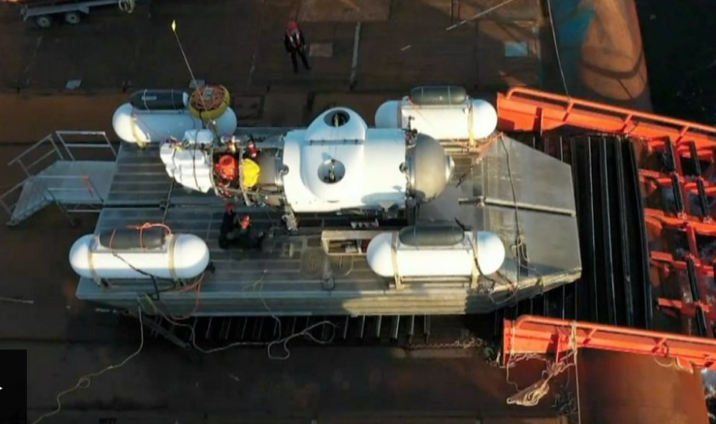
Experts have questioned the safety of Titan and how private sector deep-sea expeditions are regulated. Concerns have been raised over the Titan's experimental design and the carbon fibre material used to build it.
Mr McCallum was among more than three dozen industry leaders and experts who signed a 2018 letter to Mr Rush that warned OceanGate's approach could lead to "catastrophic" problems.
"The industry has been trying for several years to get Stockton Rush to halt his programme for two reasons," Mr McCallum, a specialist who runs his own ocean expedition company, told the BBC on Friday.
"One is that carbon fibre is not an acceptable material," he said. "The other is that this was the only submersible in the world doing commercial work that was unclassed. It was not certified by an independent agency."
Subs can be certified or "classed" by marine organisations - for example by the American Bureau of Shipping (ABS) or DNV (a global accreditation organisation based in Norway) or Lloyd's Register.
This essentially means that the vehicle must meet certain standards on aspects including stability, strength, safety and performance. But this process is not mandatory.
In a blog post in 2019, the company said the way it had been designed fell outside of the accepted system - but it "does not mean that OceanGate does not meet standards where they apply."
"Stockton fancied himself as somewhat of a maverick entrepreneur," Mr McCallum said. "He liked to think outside the box, didn't like to be penned in by rules. But there are rules - and then there are sound engineering principles and the laws of physics."
Mr McCallum maintains that nobody should have travelled in the Titan sub.
"If you steer away from sound engineering principles, which are all based on hard won experience, there is a price to pay, and it's a terrible price," he said. "So it should never be allowed to happen again. It shouldn't have been allowed to happen this time."
Latest Stories
-
Prudential Life settles GH¢100,000 medical bills under its PRUCares Valentine Experience Initiative
1 hour -
Wa West Picnic: Peter Lanchene Toobu champions peace, health and unity in landmark celebration
1 hour -
Dr Mensah Market flooded after downpour in Kumasi
2 hours -
Armed men reportedly storm Adjen Kotoku Onion Market amid tensions
3 hours -
Tecco Mensah writes: Why football fans must look beyond statistics
3 hours -
Police recover stolen Honda CR-V in Kumasi within 48 hours
4 hours -
Apetorku Gbodzi 2026 Festival opens in Dagbamete with development focus
4 hours -
President Mahama arrives in Lyon to co-chair One Health Summit
4 hours -
Beverly View Plus Hotel draws crowds amid coastal Easter rush in Volta
4 hours -
Maiden Zongo Festival held in Wa amid calls to tackle drug abuse among the youth
5 hours -
FDA warns of fake HIV test kits on Ghanaian market
5 hours -
Africa urged to build resilient health systems as donor support tightens
5 hours -
Easter gesture: Ablakwa settles medical bills for 85 North Tongu constituents
7 hours -
Africa must harness its population strength—Titus-Glover
7 hours -
Visa-free access doesn’t mean unlimited stay – Lom Ahlijah
7 hours