

Audio By Carbonatix
Donald Trump's politics have shifted considerably over his decades in the public sphere. But one thing he has been consistent on, since the 1980s, is his belief that tariffs are an effective means of boosting the US economy.
Now, he's staking his presidency on his being right.
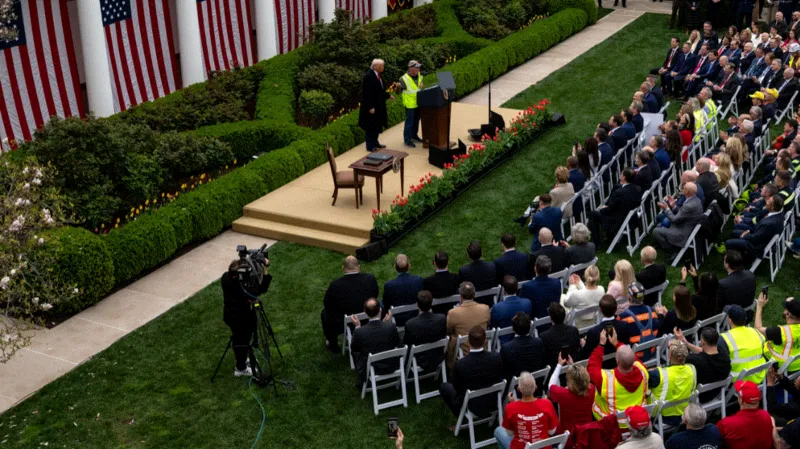
At his Rose Garden event at the White House, surrounded by friends, conservative politicians and cabinet secretaries, Trump announced sweeping new tariffs on a broad range of countries – allies, competitors and adversaries alike.
In a speech that was equal parts celebration and self-congratulation, regularly punctuated by applause from the crowd, the president recalled his longtime support of tariffs, as well as his early criticism of free trade agreements like Nafta and the World Trade Organization.
The president acknowledged that he will face pushback in the coming days from "globalists" and "special interests", but he urged Americans to trust his instincts.
"Never forget, every prediction our opponents made about trade for the last 30 years has been proven totally wrong," he said.
Now, in a second term in which he is surrounded by like-minded advisers and is the dominant force in a Republican Party that controls both chambers of Congress, Trump is in a position to turn his vision of a new America-focused trade policy into reality. These policies, he said, had made the United States into a wealthy nation more than a century ago and would again.
"For years, hard working American citizens were forced to sit on the sidelines as other nations got rich and powerful, much of it at our expense," he said. "With today's action, we are finally going to be able to make America great again - greater than ever before."
It is still an enormous risk for this president to take.
Economists of all stripes warn that these massive tariffs – 53% on China, 20% on the European Union and South Korea, with a 10% baseline on all nations – will be passed along to American consumers, raising prices and threatening a global recession.
Ken Roggoff, the former chief economist at the International Monetary Fund, predicted that the chances of the US, the world's largest economy, falling into recession had risen to 50% on the back of this announcement.
"He just dropped a nuclear bomb on the global trading system," Mr Roggoff told the BBC World Service, adding that the consequences for this level of taxes on imports into the US "is just mind-boggling".
Trump's move also risks escalating a trade war with other countries and alienating allies that America has otherwise tried to strengthen ties with. The US, for instance, sees Japan and South Korea as a bulwark against Chinese expansionist ambitions. But those three countries recently announced that they would work together to respond to America's trade policies.
If Trump is successful, however, he would fundamentally reshape a global economic order that America had originally helped to construct from the ashes of World War 2. He promises that this will rebuild American manufacturing, create new sources of revenue, and make America more self-reliant and insulated from the kind of global supply chain shocks that wreaked havoc on the US during the Covid pandemic.
It's a tall order – and one that many believe to be highly unrealistic. But for a president who seems fixated on cementing his legacy, whether through ending wars, renaming geographic locations, acquiring new territory or dismantling federal programmes and its workforce, this is the biggest, most consequential prize to be won.
It would be, he styled, America's "liberation day".
What appears clear, however, is that Wednesday's announcement, if he follows through, is almost certain to mark a historic change. The question is whether it will be a legacy of achievement or one of notoriety.
Trump's speech was triumphant - one that belied the potentially high costs his moves would impose on the American economy and on his own political standing.
But, he said, it was worth it - even if, at the very end of his remarks, a small shadow of presidential doubt may have peaked through the bravado.
"It's going to be a day that - hopefully - you're going to look back in years to come and you're going to say, you know, he was right."
Latest Stories
-
Tecco Mensah writes: Why football fans must look beyond statistics
21 minutes -
Police recover stolen Honda CR-V in Kumasi within 48 hours
57 minutes -
Apetorku Gbodzi 2026 Festival opens in Dagbamete with development focus
1 hour -
President Mahama arrives in Lyon to co-chair One Health Summit
1 hour -
Beverly View Plus Hotel draws crowds amid coastal Easter rush in Volta
1 hour -
Maiden Zongo Festival held in Wa amid calls to tackle drug abuse among the youth
2 hours -
FDA warns of fake HIV test kits on Ghanaian market
2 hours -
Africa urged to build resilient health systems as donor support tightens
2 hours -
Easter gesture: Ablakwa settles medical bills for 85 North Tongu constituents
4 hours -
Africa must harness its population strength—Titus-Glover
4 hours -
Visa-free access doesn’t mean unlimited stay – Lom Ahlijah
4 hours -
From Golgotha to Kwahu: The Easter Migration of the Faithful and the Faithless
5 hours -
How the Ghanaian onion traders’ standoff with Nigeria unfolded and threatened local supply
6 hours -
No compensation for demolished structures on 24-Hour Economy market lands — Gov’t to structure owners
6 hours -
Financial Institutions must back local enterprises to spur growth – Deputy Minority Whip
6 hours