

Audio By Carbonatix
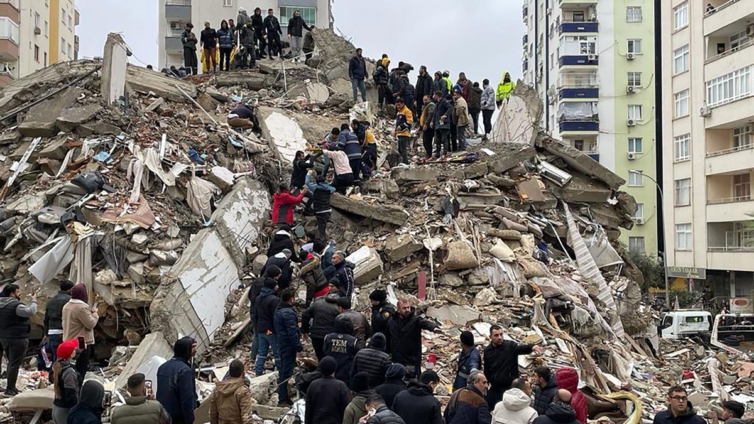
Rescuers are battling heavy rain and snow as they race against the clock to find survivors of a devastating earthquake in south-east Turkey.
More than 4,300 people were killed and 15,000 injured in Turkey and over the border in Syria when the quake struck in the early hours of Monday.
The World Health Organization has warned the toll may rise dramatically as rescuers find more victims.
As day breaks rescue teams are stepping up their search for survivors.
Many people in the disaster zone have been too scared to go back into buildings.
The 7.8 magnitude tremor struck at 04:17 (01:17 GMT) on Monday at a depth of 17.9km (11 miles) near the city of Gaziantep, according to the US Geological Survey.
Seismologists say it was one of the largest ever recorded in Turkey, where at least 2,921 people are now known to have died. Survivors say it took two minutes for the shaking to stop.
A later tremor had a magnitude of 7.5, and its epicentre was in the Elbistan district of Kahramanmaras province.
As dawn broke on Tuesday, traffic was at a standstill on the main highway to the Turkish city of Maras, close to the epicentre of the quake and believed to be one of the worst-affected areas.
Cars occasionally crawled forward, the wet road illuminated by glowing red brake lights.
Few rescuers have made it to this part of southern Turkey yet and everyone is trying to get there as fast as they can to assess the damage and give vital help.
One search and rescue team on their way to the city, their van loaded with specialist equipment and supplies, told the BBC they were eager to get there and start looking for survivors, but they had no idea how bad the devastation would be when they arrived.
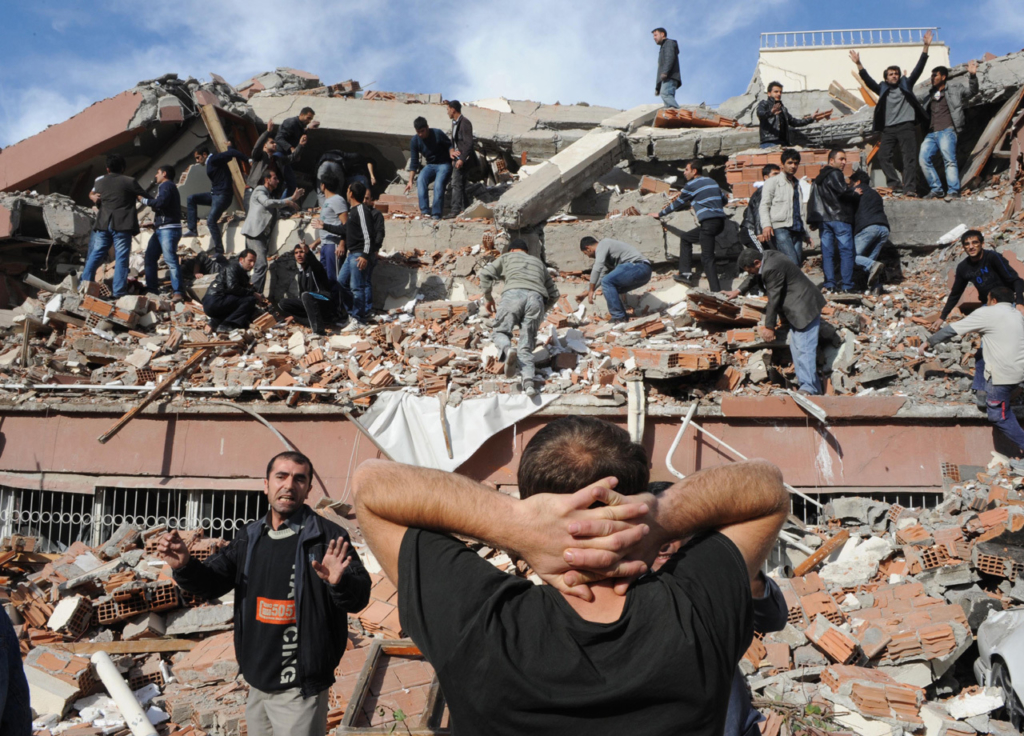
As aftershocks continue, rescuers in some areas have been digging through rubble with their bare hands looking for survivors.
In the Turkish city of Osmaniye, near the epicentre, pouring rain hampered rescuers as they searched through the rubble looking for any survivors.
The city was without power as the cold and rain set in.
One family camped on the street - despite the freezing temperatures - as they were scared of the aftershocks triggering another building to collapse.
Every time they felt an aftershock, the family moved closer into the middle of the street.
A hotel owner in the city told the BBC that of 14 guests staying that night only seven had been found.
Countries around the world are sending support to help the rescue efforts, including specialist teams, sniffer dogs and equipment.
But the earthquake has caused significant damage to three airports across Turkey, also creating challenges for aid deliveries.
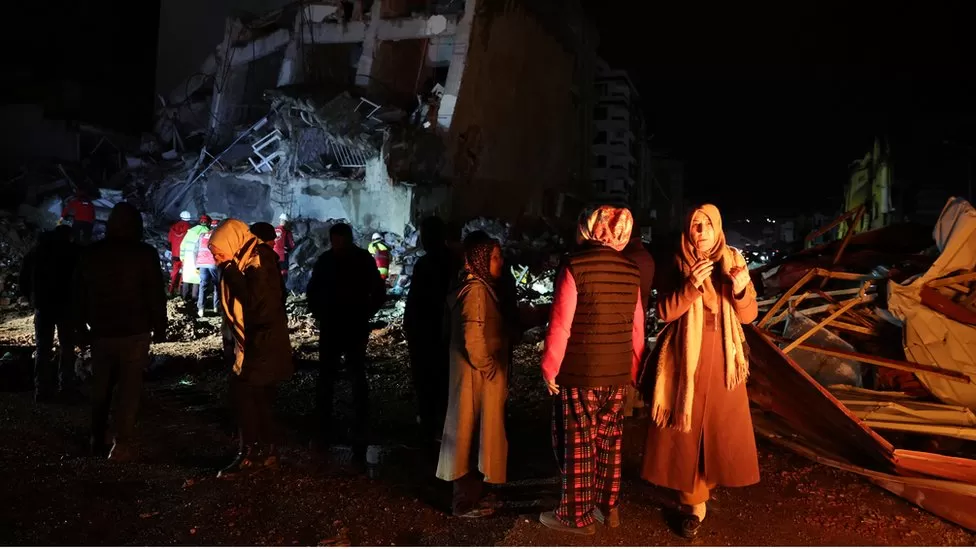
At least 1,400 people are now known to have been killed in Syria where millions of refugees live in camps on the Turkish border.
British-born doctor Shajul Islam has worked in al-Shifa's hospital in Idlib, in northern Syria, for the past seven years. He told BBC Radio 4's The World Tonight programme that the carnage in the hospital was the worst had ever seen.
"Our hospital is full. We have about 300-400 patients in the hospital right now... we literally have two to three patients per bed," he said.
He said he was caring for 40-45 critically ill patients in the ICU: "I'm taking patients off ventilators to give them to other patients that might have more of a chance of surviving. We're literally at the entrance of the hospital deciding which patients we are going to try to save."
Following an international appeal for help, Turkey's President Recep Tayyip Erdogan said 45 countries had offered support.
UN Secretary General António Guterres called for an international response, saying that many of the families hit by the disaster were "already in dire need of humanitarian aid in areas where access is a challenge".
The European Union is sending search and rescue teams to Turkey, while rescuers from the Netherlands and Romania are already on their way. The UK has said it will send 76 specialists, equipment and rescue dogs.
France, Germany, Israel, and the US have also pledged to help. Russian President Vladimir Putin has offered help to both Turkey and Syria, as has Iran.
Turkey lies in one of the world's most active earthquake zones.
In 1999 a quake killed more than 17,000 in the north-west while in 1939, 33,000 people died in the eastern province of Erzincan.
This earthquake was powerful enough to be felt as far away as Cyprus, Lebanon and Israel.
Latest Stories
-
Gov’t considers exploring local raw materials to stabilise production costs of sachet water prices
20 minutes -
Mahama in Paris: Turning Diplomacy into Delivery
23 minutes -
Middle East crisis shows Ghana needs to diversify energy sources – Energy expert
50 minutes -
Government of Ghana Internal Revenue Generation cannot fund Big Push in Four Years
58 minutes -
EPCG Moderator urges leaders to serve with courage and humility in Easter message
1 hour -
The Cobra at the gate: When good intentions overrun the system
2 hours -
Easter service disrupted in Nyanyano as suspected land guards storm church event
2 hours -
Price surge exposing NDC gov’ts dishonesty -Titus Glover
2 hours -
Afigya Kwabre North MP urges Finance and Energy Ministers to submit energy sector report
2 hours -
Deliver quality or face sanctions — GETFund administrator cautions contractors
2 hours -
Kwahu Easter festivities trigger condom shortages; Health teams boost awareness
3 hours -
Victims of a legend: The women Daddy Lumba left behind
3 hours -
Mahama vows to prioritise roads, social amenities in Savannah region
3 hours -
Mahama sets up 18-member panel to advance Africa-led global health reforms
3 hours -
Ghana Medical Trust Fund Administrator urges hope and compassion in Easter message
3 hours