

Audio By Carbonatix
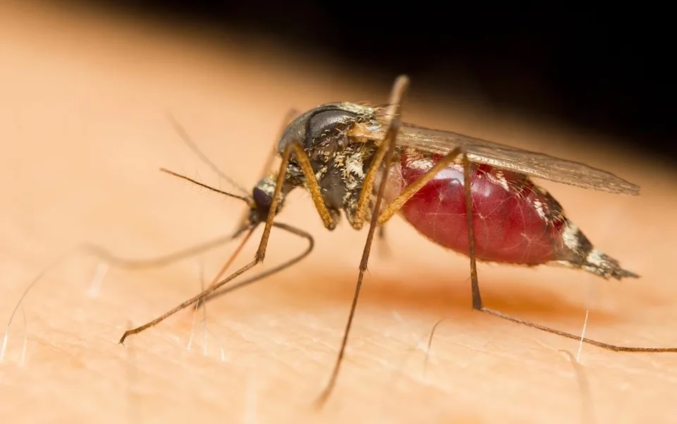
There has been a significant increase in the number of UK cases of a mosquito-borne virus that can cause sudden fever and joint pain, and is normally only found in Africa and southern Asia.
The UK Health Security Agency (UKHSA) says more than 70 cases of the chikungunya virus were reported in the first six months of this year, more than double than in the same period last year – all of them linked to travel.
Chikungunya, while rarely fatal, can leave people experiencing joint pain for years.
The UKHSA is warning travellers to take precautions against mosquito bites.
In most cases, people recover fully within a couple of weeks, but for some, pain can persist for months or even years.
In very rare cases it can be fatal.
While the 73 infections seen in the UK in the first six months of this year is not a huge number, it is more than double the 27 cases over the same period last year.
An outbreak of the virus is under way in the Indian Ocean region, and almost all of the infections were linked to travel in India, Sri Lanka and Mauritius.
Chikungunya is spread by two types of mosquito, neither of which are present in the UK, so there is no risk on onward infection.
But Dr Philip Veal, Consultant in Public Health at UKHSA, says it is a warning to travellers to make sure they take precautions against mosquito bites.
"Chikungunya can be a nasty disease and we're seeing a worrying increase in cases among travellers returning to the UK.
"It is essential to take precautions against mosquito bites when travelling.
"Simple steps, such as using insect repellent, covering up your skin and sleeping under insecticide-treated bed nets can greatly reduce the risk.
"Before you travel, check the Travel Health Pro Website for the latest advice on your destination.
"A chikungunya vaccine may also be considered for those travelling to higher-risk regions."
The same report also says the first-ever UK cases of Oropouche virus, normally only found in Central and South America and the Caribbean, have also been detected in travellers returning from Brazil.
This virus is predominantly spread by midge bites rather than mosquitoes, with the main type of midge involved in transmission not found in Europe or the UK.
Symptoms include high fever, chills, headache, joint pain and muscle aches.
The UKHSA warns of a rise in Oropouche virus infections globally since 2024, and says pregnant travellers should take particular care following some concerns about the impact the virus can cause during pregnancy.
Latest Stories
-
Why diaspora investors are using Accra real estate to hedge against global uncertainty in 2026
8 minutes -
GWL urges public support to stem water thefts
10 minutes -
Fire guts 2-storey apartment at Ashaley Botwe
11 minutes -
Come down and account, it’s a constitutional requirement – Martin Kpebu to Ofori-Atta
20 minutes -
The power of the private courtyard: How regalia is redefining resort-style living in Accra
31 minutes -
Beyond roads and bridges: Understanding the true role of your MP
32 minutes -
UK says Russia ran submarine operation over cables and pipelines
34 minutes -
NPRA recovers GH¢27m in 2025, 30% of defaulted pension contributions
36 minutes -
Power fluctuations slash Ashanti region water production by 959,000 cubic metres in March
42 minutes -
Beyond the festivities: Gomoa must turn visibility into development
50 minutes -
DVLA clarifies it is not responsible for Toyota Voxy commercial operations
52 minutes -
Calls for Ofori-Atta’s return a non-issue if trial proceeds in absentia – Pius Hadzide
54 minutes -
France names Ghana first beneficiary of newly established National Health Compact
1 hour -
US Immigration, extradition outcomes likely to influence each other in Ofori-Atta case – Amanda Clinton
1 hour -
29-year-old woman rescued after hiding in drain to escape attackers
1 hour