


Audio By Carbonatix
Anna Tymchenko was scared. She had been in labour for hours but her hometown was being bombed and her apartment was shaking.
She and her husband were trapped with no electricity, running water or doctor.
The small town of Bucha, 30km (18.5 miles) from the capital Kyiv, had come under relentless bombardment since the start of the war.
Twenty-one-year-old Anna, along with her husband and brother, had previously taken refuge in the basement of their block of flats. But when the electricity was cut off and the heating stopped working, the basement was plunged into darkness, and it was bitterly cold.
Anna's husband Volodymyr was torn between remaining in Bucha or trying to flee. When they did finally try to escape by car, they had had to turn back when they heard that a column of Russian military vehicles was heading their way.
"We then decided to stay in the apartment," Anna told the BBC. "I preferred to give birth at home and not in a dusty basement. I had difficulty breathing, my lungs hurt."
When she went into labour late on 7 March, she called her neighbours for help. They agreed to come, but none of them had experience delivering babies.
Viktoria Zabrodskaya, Anna's 49-year-old neighbour, told the BBC they worried that if something went wrong, they wouldn't know what to do.
The room was lit with candles and the only available water was freezing cold from bottles.

"I never imagined that I would give birth in such conditions," Anna says. "It was surreal. It was my first child and I didn't know anything."
In desperation, Anna's neighbours tried to contact medical staff, but the phone signal was poor. They were eventually able to make contact with a gynaecologist in Bucha after getting a signal from the balcony. He agreed to come but never appeared.
Later that day, he messaged with an apology and explained that he had been stopped by a Russian patrol who had broken his phone.
Anna's neighbours would have to deliver the baby themselves. Only one of them - Irina Yazova - had any medical expertise.
"When the baby's head came out, we got scared," Viktoria says. "She was blue and we didn't know what to do. Then Irina gently turned the baby's head and she came out. She didn't cry at first - we started hitting her, and then she cried and we all cheered."
Husband Volodymyr cried tears of relief for baby Alisa, who was born on 8 March - International Women's Day.
Two days later, it was announced that Bucha was one of the evacuation corridors agreed by the Ukrainian government and the Russian defence ministry.
"We spent the whole night discussing whether to go or not," Anna says.
She and her husband finally decided to leave with their new-born child. They tried to contact people to ask if the route was safe, and downloaded maps on to their phones.
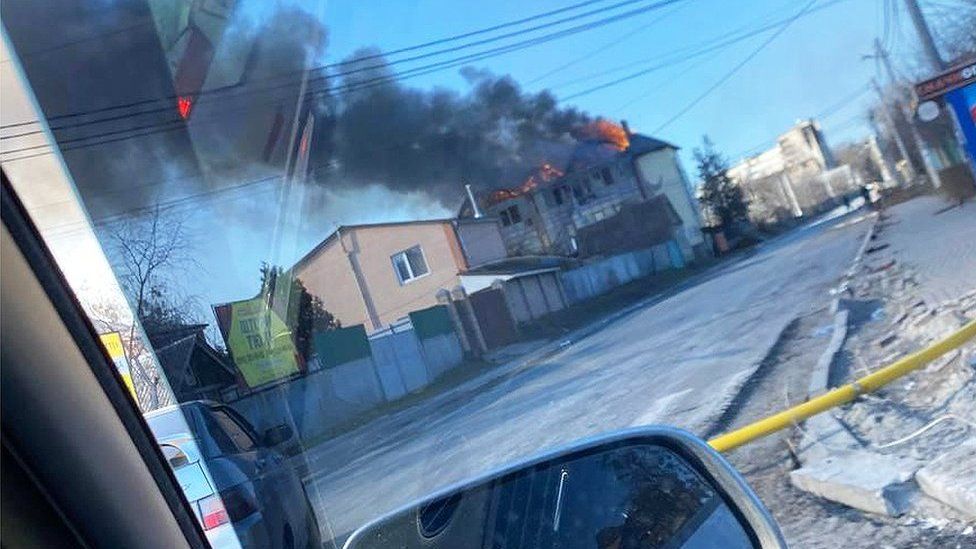
The following day, 21 cars left the town heading towards Kyiv. Viktoria, who had helped deliver Anna's baby, drove at the front of the convoy, a white flag wrapped around a mop attached to her car and a sign saying "Children".
"On the way we saw horrible scenes," Anna says. "I never thought that I would see such things in real life - only in movies. There were dead bodies lying on the road. The houses were destroyed. Russian tanks parked, pointing their barrels at the road. We were so scared that they could fire when we passed by."
After several hours the evacuees had safely passed all the Russian checkpoints and arrived in Kyiv - and from there went their separate ways.
"When we got out, I couldn't stop smiling," Anna says. "I couldn't believe that we managed to flee."
Anna is enjoying motherhood and is looking forward to introducing her parents to their new granddaughter. But while many of her relatives have now left the country, she and her husband cannot leave - and Anna says that she still doesn't feel completely safe.
"All my thoughts are with what's happening [in Bucha] and in the rest of the country," she says. "It's just unbelievable but we hope that we can return home soon."
Latest Stories
-
Gov’t orders deployment of Metro Mass buses to cushion commuters amid fuel price hike
36 minutes -
Key Indian state polls begin in test for Modi’s party
43 minutes -
Playback: Gomoa Easter Carnival in photos
49 minutes -
Gov’t orders removal of fuel taxes to ease pump price hikes
55 minutes -
“Whatever the decision of CAS, we will respect it” – CAF President Motsepe after AFCON final meetings in Morocco
1 hour -
Emma Ankrah: When waiting becomes part of treatment – Reflections on hospital care
1 hour -
Ghana urges travellers to prepare for new EU border system roll-out
1 hour -
Mahama enforces fuel coupon ban for ministers as cabinet moves to slash fuel taxes
1 hour -
Task force probes strange fish deaths in Tema
2 hours -
Neglected traffic lights turn Awoshie–Anyaa highway into deadly hotspot
2 hours -
EOCO declares Dr Gabriel Tanko Kwamigah-Atokple a fugitive over alleged gold fraud
2 hours -
GSE records GH¢1.09bn trade in equity market; 10 stocks register gains
2 hours -
Fuel prices: Ghana places 15th in Africa
2 hours -
Africa must look inward: Reframing resilience in a shifting global economy
3 hours -
9 dead, 2 missing after boat capsizes on Volta Lake
3 hours