

Audio By Carbonatix
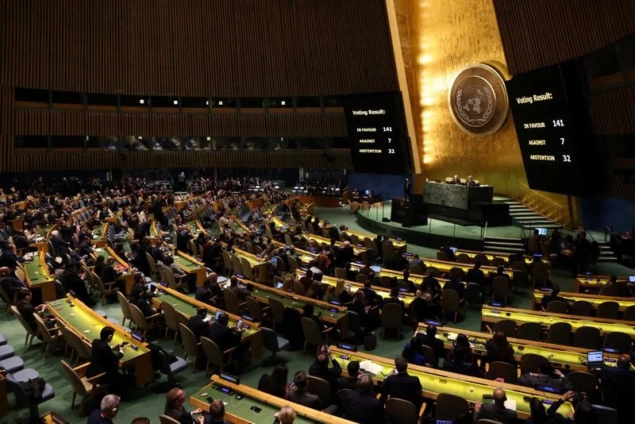
The United Nations General Assembly (UNGA) has voted overwhelmingly in favour of a resolution demanding Moscow withdraw its troops from Ukraine and end the fighting, a year after Russia launched its invasion.
The resolution (PDF) urged a “comprehensive, just and lasting peace” that it said “would constitute a significant contribution to strengthening international peace and security” and reaffirmed Ukraine’s independence and territorial integrity.
One hundred forty-one countries voted in favour of the resolution, with 32 abstaining.
Seven countries, including Russia, voted against it.
Ukraine’s Foreign Minister Dmytro Kuleba welcomed the adoption of the resolution.
“The impact is very clear. It sets the perception,” Kuleba told reporters at the UN in New York City after the vote.
“It shows who stands where. If resolutions had no impact, Russia would not be fiercely fighting against them. This is politics. This is how it is being made.”
Writing on social media, Ukraine President Volodymyr Zelenskyy said the resolution was a “powerful signal of unflagging global support for Ukraine”.
The #UNGA 11th ESS (resumed) just adopted draft resolution A/ES-11/L.7 on Principles of the Charter of the #UN underlying a comprehensive, just & lasting peace in #Ukraine (by recorded vote: 141 in favour-7 against-32 abstentions)
- FULL TEXT 🔗 https://t.co/cY7MpDcTt5 @UN_PGA pic.twitter.com/wCtq8719t5— UN Media Liaison (@UNMediaLiaison) February 23, 2023
The vote shows that a year after the war began, most countries around the world remain deeply disturbed by Russia’s invasion, which President Vladimir Putin has styled as a “special military operation”.
The war has killed thousands of people, forced millions from their homes and fuelled a global food and energy crisis.
At the last UNGA vote about the war in October last year, 143 countries backed the resolution condemning Russia for annexing four regions of Ukraine. On that occasion, 35 countries abstained and five, including Russia, voted against it.
Russia managed to secure support from Eritrea and Mali – two countries that had abstained in the October vote.
But Honduras, Lesotho, Thailand and South Sudan all decided to back the resolution after abstaining last time around.
Some of the General Assembly’s 193 members were absent for Thursday’s vote, which followed a lengthy debate during which Russia called the resolution “unbalanced and anti-Russian” and its ally Belarus tried to put through text amendments including the “prevention of further escalation of the conflict through feeding the parties with lethal weapons.”
That is a view being echoed by China, which abstained in the vote and whose officials have spent much of this week criticising the mostly Western countries that have provided military support and weaponry for Ukraine.
On Thursday, China’s UN Deputy Ambassador Dai Bing told the UN General Assembly that the “brutal facts offer an ample proof that sending weapons will not bring peace”, and repeated earlier comments from senior Chinese officials that weapons transfers to Ukraine would only add “fuel to the fire”.
China is attempting a difficult diplomatic balancing act over the war that has deepened geopolitical rivalries particularly between Russia and western liberal democracies.
Beijing has stressed that the sovereignty and territorial integrity of all countries must be respected, but believes all security concerns should be addressed and shares Russian unease over the NATO alliance. The warmth of the two countries’ relationship was on display in Moscow on Wednesday when top diplomat Wang Yi met Russian Foreign Minister Sergey Lavrov and held talks with Putin.
Other countries that abstained also expressed concern that the intense international division was a major obstacle towards bringing an end to the conflict.
“While we support the present resolution’s focus on the principles of the charter and international law, it certainly brings us no closer to laying the foundations for a durable peace and bringing and end to devastation and destruction,” said South Africa’s United Nations Ambassador Mathu Joyini.
The votes in the General Assembly have become a barometer of the global mood with action in the 15-member Security Council hampered by the veto held by each of its five permanent members: China, Russia, the US, UK and France.
The Council is due to hold a meeting on Ukraine later on Friday.
Latest Stories
-
Kwahu Business Forum 2026: Corporate citizenship, sustaining African businesses take centre stage with KGL as the case study
4 minutes -
Trump seeks $152m to reopen notorious Alcatraz prison
2 hours -
Ex-Chelsea player Oscar retires with heart issue
2 hours -
CA Foundation drives constitutional literacy in Kpone Katamanso municipality
2 hours -
GPRTU to hold talks with Transport Ministry over rising fuel costs
3 hours -
CUTS International urges gov’t to halt sachet water price hike pending cost review
3 hours -
Chief Justice: Efficient Judiciary essential to reducing business costs
3 hours -
Bayern grabs 99th-minute winner to cap superb fightback
3 hours -
Ahmed Ibrahim urges Ghanaians to reflect Easter values in nation-building
3 hours -
ECG inefficiencies undermining power supply -Mahama outlines reforms
3 hours -
Lewandowski scores as Barca fight back to defeat Atletico
3 hours -
Lack of private sector consultation undermining economic growth – Jerry Ahmed Shaib
3 hours -
Real Madrid seven points adrift after Muriqi’s late Mallorca winner
3 hours -
Ghana must lead AfCFTA implementation by example – Trade Minister Ofosu-Adjare
3 hours -
Strong Judiciary key to business confidence – Chief Justice Baffoe-Bonnie
3 hours