


Audio By Carbonatix
The UN Security Council has unanimously agreed to lift sanctions against Eritrea after nine years.
An arms embargo, asset freeze, and travel ban were imposed in 2009 amid claims Eritrea supported al-Shabab militants in Somalia.
The resolution, drafted by the UK, was backed by the US and its Western allies.
The UN vote comes amid a thaw in relations between Eritrea and its neighbours following years of conflict.
Eritrea agreed a peace deal with Ethiopia in June, while the leader of Eritrea and the UN-backed government in Somalia have also met three times this year.
Why were sanctions imposed?
The resolution, backed by 13 votes in favour, was passed after the UN Security Council accused Eritrea of arming, training and equipping armed groups including al-Shabab.
The UN had frequently expressed concern about the flow of weapons into Somalia, where Islamist militants were battling government forces for control of the capital Mogadishu.
Eritrea has also been criticised for human rights abuses and mandatory national service conscription, which has led to tens of thousands of young Eritreans fleeing the country for Europe.
The asset freezes and travel ban affected individuals and businesses, as well as the Eritrean leadership.
However, the AFP news agency says that the UN monitors had said they had "not found conclusive evidence that Eritrea supports Al-Shabaab".
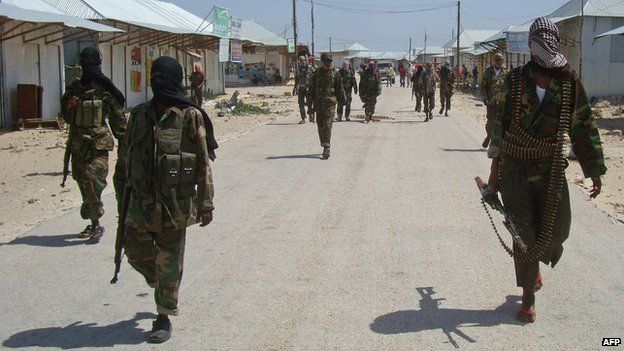
Eritrea has faced accusations of arming and training al-Shabab militants
What does Eritrea say?
The Eritrean government has always denied supporting al-Shabab militants, calling the claim a "fabrication" created by US intelligence officials. Ethiopia is a close ally of the US, especially in the fight against al-Shabab.
When they were imposed, Araya Desta, Eritrea's ambassador to the UN, dismissed the sanctions as "ludicrous punitive measures".
Eritrea occupies a strategic location on the Red Sea, which connects Europe, Africa and the East. However, its economy has suffered after years of sanctions.
The Eritrean government now says it wants compensation for the sanctions, which it insists were politically motivated.

How peace has broken out in the Horn of Africa
By Emmanuel Igunza, BBC News, Addis Ababa
Since the sanctions were imposed, Eritrea has lobbied and fought hard against them. But three times over that period, the UN Security Council has always voted to maintain them, claiming the country was a destabilising factor in the Horn of Africa region.
But all that seems to have changed after Eritrea signed a landmark agreement with Ethiopia in June, committing to end a bitter two-decade dispute.
Since then, diplomatic ties have resumed and both air and land transport between the two countries have re-opened.
The bromance between Ethiopian's new reformist leader Abiy Ahmed and Eritrea's President Isaias Aferweki seems to have rubbed on neighbouring leaders.
Eritrea, Ethiopia and Somalia have now signed a joint agreement of cooperation, and leaders of the three countries have met personally on three different occasions this year - something that hadn't happened in years.
Relations between Eritrea and Djibouti are also thawing after years of a border dispute. There is now even an ambitious talk of the Horn of Africa countries forming an economic bloc of sorts.
Many analysts believe that there are still many issues like the border disputes to resolve before that can be achieved, but so far leaders of the region are daring to believe.
Latest Stories
-
Gov’t cuts fuel taxes, deploys buses to curb impact of rising fuel prices
31 minutes -
Interior Minister calls for intelligence-driven strategy as Ghana strengthens counter-terrorism efforts
31 minutes -
Adenta Circuit Court remands Pastor William Gyimah over viral threats against Vice President
1 hour -
“We’ve implemented changes to prevent a repeat of the AFCON final” – CAF President Motsepe
1 hour -
Gov’t orders deployment of Metro Mass buses to cushion commuters amid fuel price hike
2 hours -
Key Indian state polls begin in test for Modi’s party
2 hours -
Playback: Gomoa Easter Carnival in photos
3 hours -
Gov’t orders removal of fuel taxes to ease pump price hikes
3 hours -
“Whatever the decision of CAS, we will respect it” – CAF President Motsepe after AFCON final meetings in Morocco
3 hours -
Emma Ankrah: When waiting becomes part of treatment – Reflections on hospital care
3 hours -
Ghana urges travellers to prepare for new EU border system roll-out
3 hours -
Mahama enforces fuel coupon ban for ministers as cabinet moves to slash fuel taxes
3 hours -
Task force probes strange fish deaths in Tema
3 hours -
Neglected traffic lights turn Awoshie–Anyaa highway into deadly hotspot
4 hours -
EOCO declares Dr Gabriel Tanko Kwamigah-Atokple a fugitive over alleged gold fraud
4 hours