

Audio By Carbonatix
Senior US and Iranian officials are in Oman for talks amid a crisis that has raised fears of a military confrontation between the two countries.
The discussions come after a US military build-up in the Middle East in response to Iran's violent repression of nationwide anti-government protests last month, that human rights groups say killed many thousands of people.
But the scope of the talks, which are believed to be indirect, remained unclear, with both countries far apart in their positions amid mutual mistrust.
The hope was that, if successful, the discussions could lead to a framework for negotiations.
The US, which is demanding Iran freezes its nuclear programme and discards its stockpile of enriched uranium, had said the talks in Oman should also involve Iran's ballistic missiles, the country's support for regional armed groups and its treatment of its citizens.
Iran, however, has said the discussions will be limited to its nuclear programme, and it is unclear if these differences have been resolved.
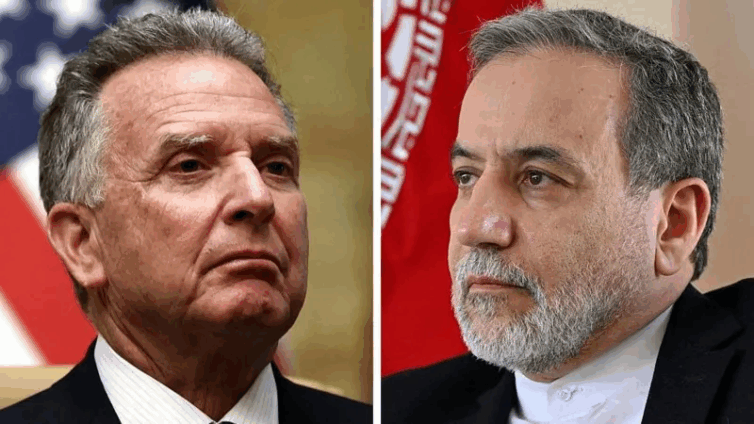
Oman said its foreign minister had held separate discussions with Iranian Foreign Minister Abbas Araghchi and US special envoy Steve Witkoff and President Trump's son-in-law and emissary Jared Kushner on Friday morning.
It said the "consultations focused on preparing the appropriate conditions for resuming diplomatic and technical negotiations". The last round of talks between the US and Iran, over its nuclear programme, had been scheduled for June 2025 but collapsed after Israel's surprise attack on Iran.
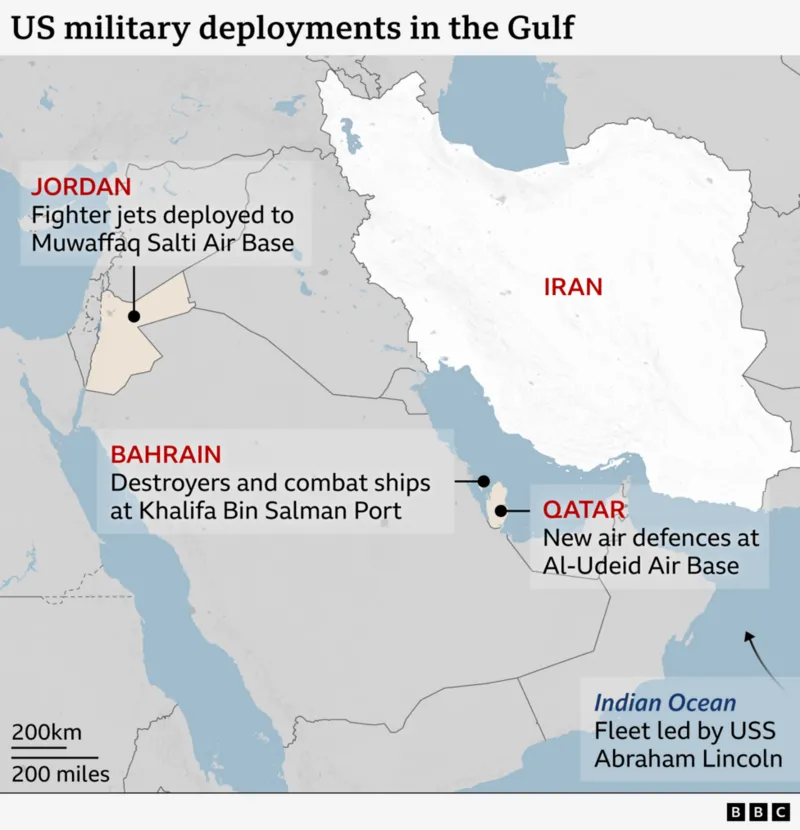
In recent weeks, Trump has threatened to bomb Iran if it does not reach a deal. The US has sent thousands of troops and what Trump has described as an "armada" to the region, including an aircraft carrier along with other warships as well as fighter jets.
Iran has vowed to respond to an attack with force, threatening to strike American military assets in the Middle East and Israel.
For Iran's embattled leaders, the talks could be the last chance to avert US military action that could further destabilise the regime, which analysts say is in its weakest position since it came to power following the 1979 Islamic Revolution.
Trump's threats came as Iran's security forces brutally repressed large-scale demonstrations, which were triggered by a deepening economic crisis, and saw protesters calling for the end of the Islamic Republic.
The Human Rights Activists News Agency, a Washington-based group, said it had confirmed at least 6,883 deaths, warning that the number could be much higher, and that more than 50,000 people had been arrested.
The current crisis has brought back to discussions the issue of Iran's nuclear programme, which has been at the centre of a long-running dispute with the West.
For decades, Iran has said its programme is for peaceful purposes, while the US and Israel have accused it of being part of an effort to develop a weapon.
Iran says it has the right to enrich uranium in its own territory and has rejected calls for its stockpile of highly enriched uranium - 400kg (880lb) - to be transferred to a third country.
It says its uranium enrichment activity stopped after the US attacks last year.
Officials have indicated being open to concessions, which could include the creation of a regional consortium for uranium enrichment, as proposed during talks with the US that collapsed when Israel launched its surprise war last year.
At the same time, Iran says demands to limit the country's ballistic missile programme and to end the support for proxies in the region - an alliance Tehran calls the "Axis of Resistance" that includes Hamas in Gaza, militias in Iraq, Hezbollah in Lebanon and the Houthis in Yemen - are unacceptable and a breach of its sovereignty.
On Tuesday, Iranian President Masoud Pezeshkian said he had instructed Araghchi to "pursue fair and equitable negotiations" with the US, "provided that a suitable environment exists".
In any case, Iran is expected to demand the lifting of sanctions that have crippled its economy. Opponents of the regime say any relief would give the clerical rulers a lifeline.
For the US, the meeting, depending on its outcome, could offer an off-ramp for Trump from his military threats.
Regional countries are concerned that a US strike could lead to a wider conflict or long-term chaos in Iran, and have warned that air power alone will not be able to topple the Iranian leadership.
Asked if Iran's Supreme Leader Ayatollah Ali Khamenei should be worried, Trump told NBC News on Wednesday: "I would say he should be very worried. Yeah, he should be".
US Secretary of State Marco Rubio said the discussions would have to go beyond the nuclear issue for "something meaningful" to be achieved.
"I'm not sure you can reach a deal with these guys, but we're going to try to find out. We don't see there's any harm in trying to figure out if there's something that can be done," he said.
The talks, initially planned to be held in Istanbul, are an effort led by Egypt, Turkey and Qatar to defuse tensions.
Iran, however, asked at the last minute for the location of the meeting to be changed to Oman, which hosted discussions last year, and for it to be limited to Iranian and American officials.
Latest Stories
-
We can tackle multiple priorities – Sam George defends Anti-LGBTQ Bill push
23 minutes -
Statement: Ghana Chamber of Mines’ Response to Claims in Joe Jackson’s “Ananse Stories about the Economy of Ghana”
25 minutes -
GES opens 2026 teacher recruitment for licensed B.Ed graduates
27 minutes -
Ghana must value skilled trades, build resilient learners — Ibn Chambas
35 minutes -
Ghana must rethink education around relevance, resilience and responsibility — Ibn Chambas
38 minutes -
Prince Harry faces defamation lawsuit from charity he co-founded
40 minutes -
South Korea deploys thermal cameras to track escaped zoo wolf
42 minutes -
Calls for royal meeting with Epstein survivors grow ahead of US visit
45 minutes -
Ibn Chambas advocates blend of technology and human values in education
47 minutes -
UMA improves healthcare access in Asutifi North with GH₵700k ‘Kim Taylor Legacy’ Walkway
51 minutes -
Scholarships Authority and Fanaka University offer sponsorship for procurement and supply chain studies
55 minutes -
Bisa Kdei drops new single ‘Go N Look’ featuring Medikal
1 hour -
Benin facing rising terrorism in north as French military presence faces growing criticism
1 hour -
UEW Public Lecture Series 2026: Education debate ‘about the soul of Ghana’s future’ — Dr Ibn Chambas
1 hour -
EU fingerprint and photo travel rules come into force from today
1 hour