

Audio By Carbonatix
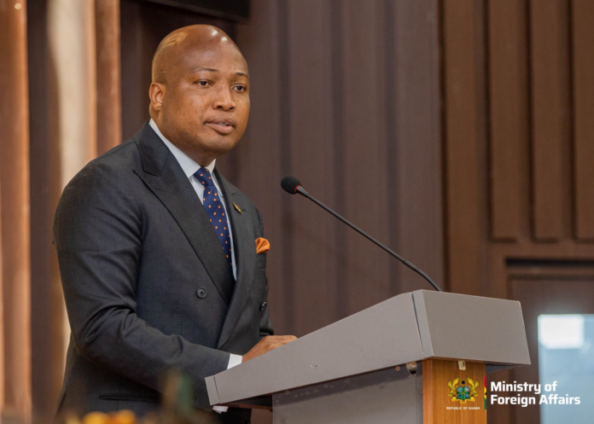
Foreign Affairs Minister Samuel Okudzeto Ablakwa has disclosed that the United States has formally indicated its willingness to work with Ghana on the country’s reparatory justice agenda despite voting against a UN resolution on the issue.
According to Mr Ablakwa, Washington has communicated its readiness to collaborate with Ghana in pursuing what he described as a fair and just world.
He made the disclosure during the High-Level Side Event on the Next Steps, hosted by President John Dramani Mahama in New York on Wednesday, September 23.
“We have received formal notice from the United States of America that even though they voted against this resolution, they are willing to begin to work with us towards that fair and just world we all seek,” he said.
The United States was among three countries that voted against the Ghana-led UN resolution adopted in March 2026, while 123 countries voted in favour and 52 abstained.
Mr Ablakwa said the US decision to engage Ghana demonstrated that the reparatory justice initiative was not intended to divide countries but to promote healing and reconciliation.
“The Ghana-led effort is not about dividing the world. It is rather about bringing us together. It is rather about healing. It is rather about genuine reconciliation.”
He said President Mahama, in his role as Chair of the Global Advisory Panel on Reparatory Justice, was committed to advancing the agenda in good faith.
“There are no hidden agendas. There is no secret motive. All we seek is to build a new world, a fair and just world, a world without racism, a world without discrimination.”
Mr Ablakwa also highlighted the return of African cultural artefacts as an important first step in translating the reparatory justice commitments into action.
He said Ghana was seeking the return of African artefacts held in museums and private collections in Europe and the United States, arguing that the objects were integral to Africa’s identity, culture and heritage.
“They represent our soul. They represent our spirit, our humanity, our culture, our heritage.”
The Minister commended France, Germany and the Netherlands for publicly pledging their willingness to return African artefacts and urged other countries to follow their example.
Ghana's reparatory justice agenda has, since the UN resolution, focused on moving from international recognition towards concrete action, including restitution of cultural heritage and the development of legal and policy frameworks.
Latest Stories
-
Anthropic seeks rehearing of case over Pentagon’s security risk branding
8 minutes -
NDC Deputy National Organizer Aspirant Hamza Umar targets grassroots mobilisation
52 minutes -
Partisan appointments won’t help restore trust in EC – Osae-Kwapong
3 hours -
Villarreal fight back to beat Napoli and end losing run
3 hours -
Tresoldi nets hat-trick as Club Brugge win Inter thriller
3 hours -
PSG’s Luis Enrique hopes Man City avoid sanctions
3 hours -
Lisandro Martinez issues scathing attack on Man Utd board – has he made things worse?
3 hours -
Saka responds to Arteta’s challenge with ‘huge impact’
4 hours -
Viking hold Bayern in thriller as Kane breaks Messi record
4 hours -
Gordon scores as Barcelona beats Galatasaray
4 hours -
Bumble bought for $1.3bn in ‘bet on the future of humanity’
4 hours -
Imagination Africa, Mentors Chess Academy to host second African Genius Chess Championship at Ghud Park
4 hours -
Paradigm Initiative steps up calls over digital rights, internet freedom in Africa
4 hours -
Saudi man charged with planting ‘sophisticated’ recording device in OpenAI office
4 hours -
Ghana wins UN Human Rights Council seat as calls grow for action against atrocities
4 hours