

Audio By Carbonatix
The U.S. National Highway Traffic Safety Administration (NHTSA) has contacted Tesla after footage shared on social media appeared to show its newly-launched driverless cars breaking traffic laws.
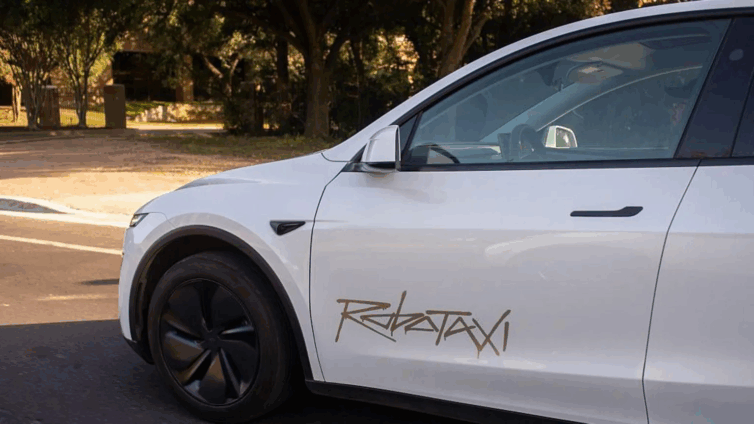
The firm's long-awaited robotaxis, which boss Elon Musk says are central to Tesla's future, were tried out on public roads for the first time in Austin, Texas, on Sunday.
Videos posted online seem to show instances where the vehicles, which had a safety driver in the passenger seat, drive erratically.
In a statement, the NHTSA said it was "aware of the referenced incidents and is in contact with the manufacturer to gather additional information."
The BBC has contacted Tesla for comment.
Despite the importance Musk places on his robotaxi project, Sunday's launch was low key.
A small group of invited analysts, influencers and shareholders participated in paid rides.
Musk congratulated Tesla's artificial intelligence and chip design teams on the launch in a post on X, writing that it was "culmination of a decade of hard work".
However, social media footage seems to show the vehicles struggled with real world driving scenarios.
One video seems to show a robotaxi stopping abruptly as it passes a parked police car.
Tech news outlet TechCrunch said cars were also seen speeding and swerving into the wrong lane.
The rollout is limited to 12 taxis and Tesla says they won't operate in bad weather, attempt difficult intersections or carry customers below the age of 18.
Analysts had already said the small-scale launch showed how far Tesla has to go to catch up with rivals.
Waymo, owned by Google parent Alphabet, along with Amazon's Zoox, already offer self-driving taxi rides in Austin, as well as in San Francisco, California, and Phoenix, Arizona.
Fully driverless cars have done millions of miles on public roads in other countries too, including China, UAE and Singapore, but whether they are more or less safe than human-driven ones is still being investigated.
Tesla is using a different technology to its rivals, relying on in-car cameras rather than the radar and sensors employed by the current market leaders.
It is betting that its approach will be cheaper and therefore ultimately more attractive to consumers.
However, questions have been asked about its safety.
The NHTSA has highlighted that under the law, it "does not pre-approve new technologies or vehicle systems – rather, manufacturers certify that each vehicle meets NHTSA's rigorous safety standards, and the agency investigates incidents involving potential safety defects."
Latest Stories
-
GMet warns of incoming rainstorm, flood risk across parts of Ghana
26 minutes -
Mahama, NDC have abandoned anti-LGBTQ Bill after weaponising it to win power – Ntim Fordjour
27 minutes -
Police arrest suspect over murder at Soronko Farms
31 minutes -
The attack on Ghanaian traders in Burkina Faso and the blame game: Why Hybrid Security Governance holds the key (I)
46 minutes -
TaxForGalamey: Stop taxing galamsey immediately or face sanctions – Gov’t cautions MMDCEs
49 minutes -
FNB Ghana strengthens balance sheet with higher earnings and improved asset quality
1 hour -
Stakeholders call for stronger action to advance women’s economic empowerment at UKGCC–British High Commission IWD Event
1 hour -
Global Network of Export-Import Banks holds 6th exchange programme in Accra
1 hour -
Prudential Bank Ladies celebrate IWD with candid talk on Love, Life, and Livelihood
1 hour -
Kejetia Market now a ‘death trap’ – Federation of Kumasi Traders warns
1 hour -
NDPC DG urges shift to resilient, shock-responsive social protection systems
1 hour -
New Town building collapse: Enforce existing laws — Architecture Alliance
1 hour -
Kudus to play under new coach as Tottenham appoint De Zerbi
1 hour -
Gov’t may review fuel taxes amid rising oil prices – Kwakye Ofosu
1 hour -
Iran–US conflict pushes fertilizer prices higher, raising food security risks in 2026
2 hours