

Audio By Carbonatix
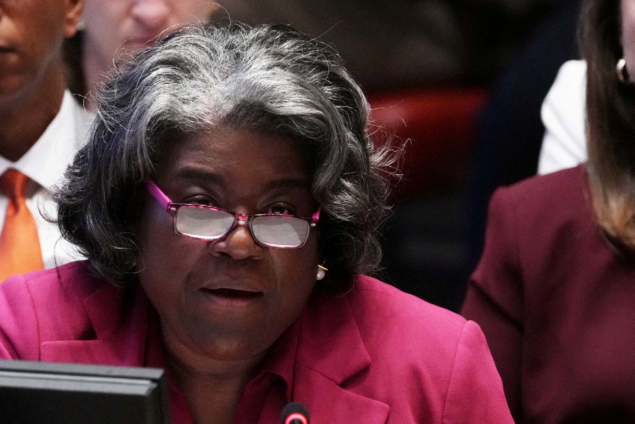
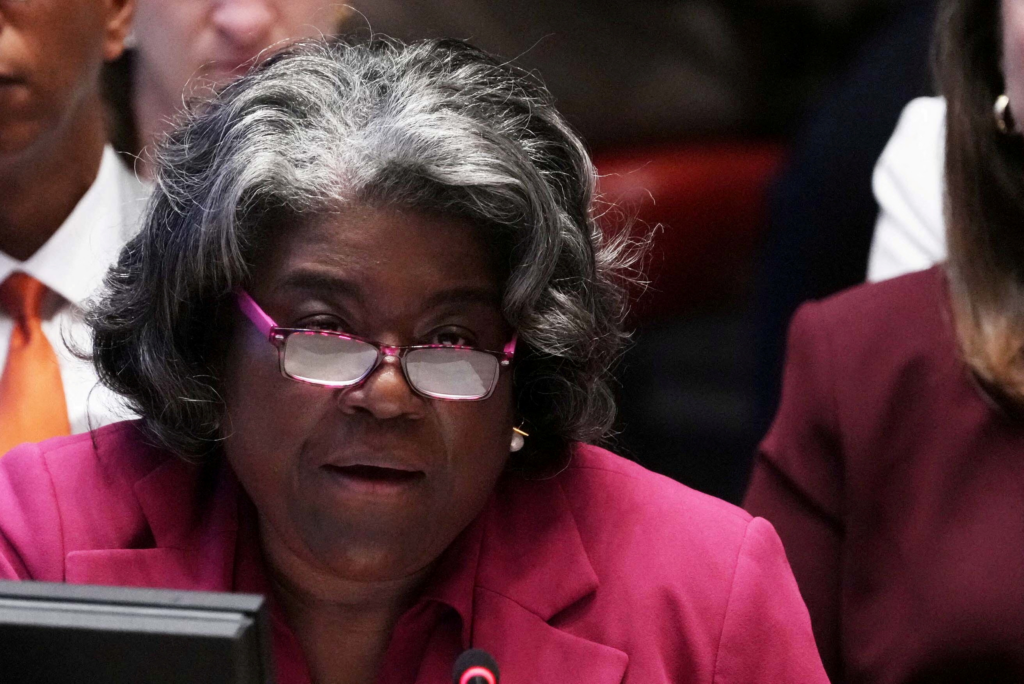
The United States supports creating two permanent United Nations Security Council seats for African states and one seat to be rotated among small island developing states, U.S. Ambassador to the U.N. Linda Thomas-Greenfield announced on Thursday.
The move comes as the U.S. seeks to repair ties with Africa, where many are unhappy about Washington's support for Israel's war in Gaza, and deepen relations with Pacific Island nations important to countering Chinese influence in the region.
"For years, countries have been calling for a more inclusive and a more representative council, one that reflects the demographics of today's world and better respond to the challenges that we face today," Thomas-Greenfield told the Council on Foreign Relations.
The push for two permanent African seats and a rotating seat for small island developing states is in addition to Washington's long-held support for India, Japan and Germany to get permanent seats on the council.
The U.S. also supports permanent council representation for countries from Latin America and the Caribbean but has not specified details.
Developing nations have long demanded permanent seats on the Security Council, the most powerful body in the United Nations. But years of talks on reform have proved fruitless and it is unclear whether U.S. support could lead to action.
The United States does not support expanding veto power beyond the five countries that hold it, Thomas-Greenfield said.
"None of the permanent members want to give up their veto power, including us," she said. "...We think if we expand that veto power across the board, it will make the council more dysfunctional."
The Security Council is charged with maintaining international peace and security and has the power to impose sanctions and arms embargos and authorize the use of force.
When the U.N. was founded in 1945, the Security Council had 11 members. This increased in 1965 to 15 members, made up of 10 elected states serving two-year terms and five permanent veto-wielding nations: Russia, China, France, the U.S. and Britain.
LEGITIMACY PROBLEM
U.N. Secretary-General Antonio Guterres backs Security Council reform.
"You have a Security Council that corresponds exactly to the situation after the Second World War ... That has a problem of legitimacy, and that has a problem of effectiveness, and it needs to be reformed," Guterres told Reuters on Wednesday.
Any changes to the Security Council membership is done by amending the founding U.N. Charter. This needs approval and ratification by two-thirds of the General Assembly, including the Security Council's current five veto powers.
The 193-member U.N. General Assembly has annually discussed reform of the Security Council for more than a decade. But momentum has grown in recent years as geopolitical rivalries have deadlocked the council on several issues, particularly after permanent veto-wielding member Russia invaded Ukraine.
"Much of the conversation around Security Council reform has been just that: a conversation," Thomas-Greenfield said as she also announced Washington's support for negotiations on a draft resolution to amend the U.N. Charter to reform the council.
Thomas-Greenfield told Reuters she could not say how long it might take to get the General Assembly to vote on such a resolution.
Each year the General Assembly elects five new members from different geographical groups for two-year terms on the Security Council. The 15-member council has three seats that are rotated among African states.
"The problem is these elected seats don't enable African countries to deliver the full benefit of their knowledge and voices to the work of the council, to consistently lead on the challenges that affect all of us - and disproportionately affect Africa," Thomas-Greenfield said.
It would be up to African states to decide which country would fill the two permanent council seats, she said.
She said that small island developing states deserve a rotating elected seat because they offer "critical insights on a range of international peace and security issues: including, notably, the impact of climate change."
Latest Stories
-
After more than 14 years at Atletico Madrid, what next for Simeone?
2 hours -
Conquering the World – Building on the foundations laid by Otto Addo
2 hours -
[Watch Live] Kwaw Kese, Kwami Eugene, Tinny, Keche and others thrill fans at Gomoa Easter Carnival
2 hours -
Gomoa Easter Carnival: Experts charge indigenes to own festival to ensure sustainability
3 hours -
Gomoa Easter Carnival: Edem Agbana and Joy Prime fans shower festival with huge endorsements
5 hours -
Gov’t to overhaul free zones into manufacturing hubs for local production – Trade Minister
6 hours -
Ghana losing $2.5bn yearly from raw exports – Trade Minister reveals
6 hours -
Mahama unveils plans for Kwahu Airport, Convention Centre
6 hours -
World’s oldest leader, Paul Biya to get a deputy for first time in 43-year rule
6 hours -
Search for missing US airman continues as Trump threatens ‘hell’ if Iran does not reach deal
6 hours -
US says it has arrested relatives of late Iranian general Qasem Soleimani
6 hours -
La Liga: Real Madrid’s title hopes hang in the balance as Mallorca snatch stoppage-time winner
6 hours -
FA Cup: Haaland hat-trick powers Man City past Liverpool into semi-finals
6 hours -
FA Cup: Chelsea thrash Port Vale to reach Wembley semi-final
7 hours -
Gov’t to boost tourism in coastal communities through infrastructure, sanitation – Vice President
7 hours