

Audio By Carbonatix
For nearly three hours on Thursday, the Supreme Court weighed whether former presidents are immune from prosecution and what exactly it means if they are.
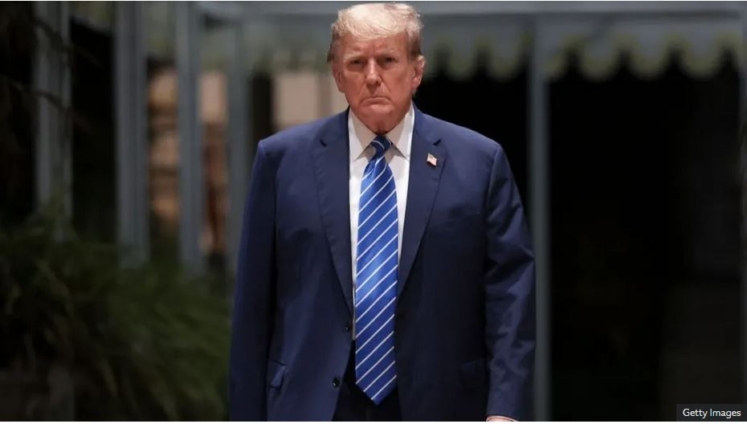
Its answer will determine whether former President Donald Trump can be tried on charges of trying to subvert the 2020 election.
Whatever the decision, each justice indicated that it would shape US democracy for years to come.
"We're writing a rule for the ages," Justice Neil Gorsuch said.
The case, heard in a special session one day after the court's last scheduled argument of this term, hinges on Mr Trump's claim that he is entitled to absolute immunity from criminal charges for actions committed while in office.
According to Mr Trump, this immunity shields him from criminal charges brought by US Special Counsel Jack Smith that he allegedly attempted to overturn the results of the 2020 election.
That trial will remain on hold until the court issues its decision, expected in June.
The justices' pointed questions, levelled at both sides, indicated division within the bench, and suggested a split decision may be likely. That division could also lead to a more complicated decision that would significantly delay any restart of the trial.
Their questions, along with tense exchanges and high-stakes hypothetical scenarios, also showed that both the conservative majority and liberal minority are making the decision with an eye to history. Would total immunity mean a future president was free to use the US military to kill his or her rivals? Or, without it, would presidents leaving office be subject to the whims of individual prosecutors and thrown in jail as part of political vendettas?
They also brought up the pardoning of another former president, Richard Nixon, for his involvement in the Watergate coverup, and Operation Mongoose from the 1960s - where then-President John F. Kennedy had the Central Intelligence Agency carry out covert operations against Fidel Castro.
Getty Images Demonstrators participate in a protest outside the U.S. Supreme Court on April 25, 2024 in Washington, DCGetty Images
While the conservative side seemed open to the idea that all former US presidents should have some degree of immunity, all the justices sounded sceptical of arguments made by Mr Trump's lawyer, Dean John Sauer, that a former president has near-total protection from prosecution.
Answering questions first, Mr Sauer was grilled by the nine justices on the breadth of that protection.
"How about if the president orders the military to stage a coup?" asked Justice Elena Kagan, one of the court's three liberal justices.
Mr Sauer appeared hesitant to respond before saying it would "depend on the circumstances".
Justice Kagan, sounding incredulous, replied: "That sounds pretty bad, doesn't it?"
Later, following this same thread, Justice Ketanji Brown Jackson, also a liberal justice, expressed concern that if past presidents were shielded entirely from criminal prosecution, they would be untethered from the law.
"I'm trying to understand what the disincentive is from turning the Oval Office into the seat of criminality," she said.
The conservative justices, too, pressed Mr Sauer on the distinction between "official acts" - those done as part of presidential duties - and private acts.
"My question is whether the very robust form of immunity you're advocating is necessary," asked Samuel Alito, one of the court's most conservative justices.
But Michael Dreeben, representing the US government, faced the same sharp interrogation as the justices walked through the consequences of leaving US presidents without some level of criminal protection.
What if a president directed a violent attack on foreign soil, Justice Clarence Thomas asked, could that president later be prosecuted?
Mr Dreeben responded that there are "layers of protection" already in place to protect presidents from criminal liability for doing their job, including actions taken overseas.
Justice Alito in particular sounded concerned about another possible consequence: that presidents may be subject to partisan attacks, perhaps by their successors, once they leave office.
"This could destroy the presidency as we know it," said Justice Alito, who dominated the second half of the hearing.
But the conservative justices did not present a united front.
Justice Amy Coney Barrett, appointed by Mr Trump, seemed dubious of the notion that presidents deserve blanket immunity.
When Mr Dreeben said there was "no perfect system" for handling a president's culpability, but that the current system would not be improved by Mr Trump's "radical proposal" Justice Barrett replied: "I agree."
A fractured ruling - one that does not side entirely with either Mr Trump's lawyer or the special counsel - may instead send the question or a part of it to lower courts to decide. This would surely add further delay and be subject to appeal, meaning this legal battle will continue for months, if not years, to come.
Latest Stories
-
Prudential Life settles GH¢100,000 medical bills under its PRUCares Valentine Experience Initiative
2 hours -
Wa West Picnic: Peter Lanchene Toobu champions peace, health and unity in landmark celebration
2 hours -
Dr Mensah Market flooded after downpour in Kumasi
2 hours -
Armed men reportedly storm Adjen Kotoku Onion Market amid tensions
3 hours -
Tecco Mensah writes: Why football fans must look beyond statistics
4 hours -
Police recover stolen Honda CR-V in Kumasi within 48 hours
4 hours -
Apetorku Gbodzi 2026 Festival opens in Dagbamete with development focus
4 hours -
President Mahama arrives in Lyon to co-chair One Health Summit
5 hours -
Beverly View Plus Hotel draws crowds amid coastal Easter rush in Volta
5 hours -
Maiden Zongo Festival held in Wa amid calls to tackle drug abuse among the youth
5 hours -
FDA warns of fake HIV test kits on Ghanaian market
5 hours -
Africa urged to build resilient health systems as donor support tightens
5 hours -
Easter gesture: Ablakwa settles medical bills for 85 North Tongu constituents
7 hours -
Africa must harness its population strength—Titus-Glover
7 hours -
Visa-free access doesn’t mean unlimited stay – Lom Ahlijah
7 hours