

Audio By Carbonatix
The Head of the Legal Department of the West African Examinations Council, Rev. Victor Brew, has clarified the grading system used for the Basic Education Certificate Examination (BECE).
According to him, the performance of students at various schools determine their grades. The grades awarded to students from various schools are dependent on their performance.
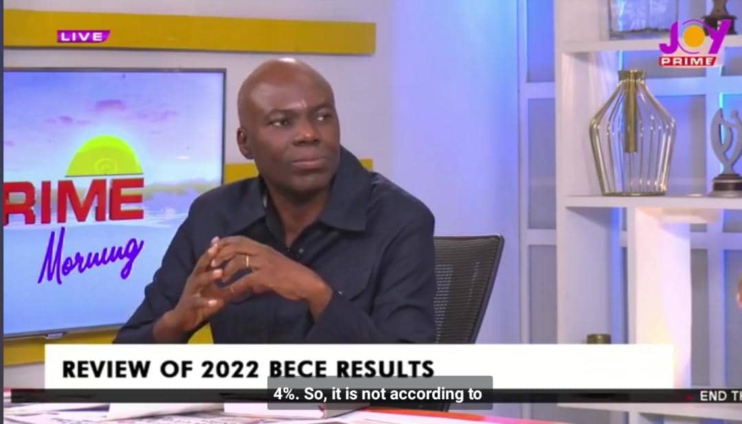
Speaking to Roselyn Felli on Prime Morning, Monday, Rev. Victor Brew explained that students who may be the best in their schools may not meet the first 4% range targeted by the WAEC grading system as it is a nationwide competition.
"...it's the grading system and also the performance of their candidates, because mind you, if you're a local champion where you keep getting 80s, know that if someone else has been getting 99, then you pray that your 80 falls within the 4% otherwise, you're going to get a grade 2, and that doesn't mean you're not good. You’re good, but others are better," he explained.
For the purpose of the variation of the grading system, he urged school managers to avoid comparing cohorts of their institutions, as the "Norm-Referenced Grading System" used by WAEC varies yearly.
Rev. Victor Brew further revealed that the implementation of the grading system is done in collaboration with the government, thus making grade 9 the lowest and not a failure in the BECE system.
Explaining how the grading system is done, he said, "If the first 4% are to get grade 1, what it means is that if you took mathematics, unlike English, someone can get 100% in mathematics. So, what happens is that your candidate or the champion of your school in math gets 80% during your mock trials or 89%, but then when you join forces with the candidates across the country, the question is whether your champion in math in your school can beat all the champions across the country such that your champion falls within the first 4%."
For this reason, he said WAEC is not to be blamed for the failure of candidates, as a particular batch may not fall within the range of the national grading system for the year.
Meanwhile, he thinks a coalition of a total number of candidates acquiring a grade in each subject across the country within a year will inform policy-making so as to help improve the system.
Addressing the issue of the cancellation of the exams for some candidates, he said it is done based on the rules and regulations provided for the year groups before and during the exams.
He has also notified parents whose children’s papers have been cancelled that they are permitted to appeal for remarking.
Latest Stories
-
AU Chair hails UN resolution recognising transatlantic slave trade as crime against humanity
6 minutes -
A crippled security recruitment process: A threat to national security architecture
13 minutes -
Ghana’s new procurement rules are more than a technical fix
14 minutes -
IGP meets Ibrahim Mahama, pledges full investigation into alleged assault
15 minutes -
Eight Schools advance to semifinal stage of 2026 Luv FM VitaMilk Primary Schools Quiz
26 minutes -
GIS 2026 – Lack of bankable businesses threatens to stall US$75 million fund’s impact
36 minutes -
IGP Special Operations team nab 19 persons over alleged drug peddling
39 minutes -
GEXIM@10: Experts discuss AfCFTA and strategies for export growth
41 minutes -
NPP must aim for decisive 2028 parliamentary Majority — Minority Leader
1 hour -
Ghana not afraid of Germany like a few years ago – Kurt Okraku
1 hour -
UNESCO-Ghana, Manhyia Palace Museum seal partnership as 2026 Otumfuo Art Awards launched
2 hours -
Ibrahim Mahama faces Police board as assault probe continues
2 hours -
UK–Ghana study tour strengthens partnership on roads and future transport systems
2 hours -
Renting out your Accra apartment: Should you short-let or long-let in 2026?
2 hours -
Government communication alone won’t fix tomato shortage – Dr Charles Nyaaba
2 hours