

Audio By Carbonatix
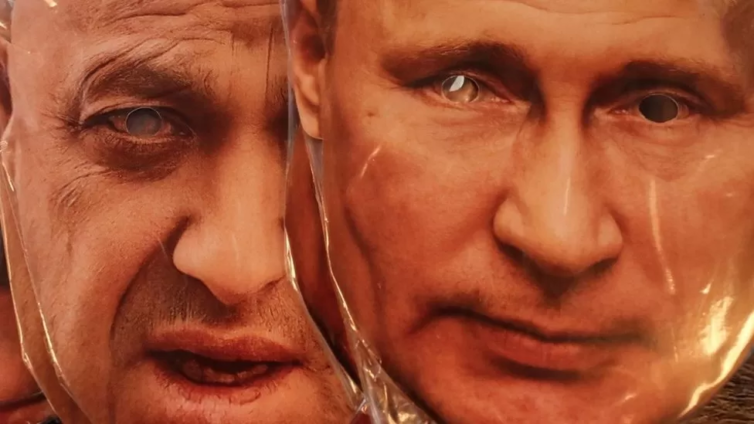
Wagner mercenary group head Yevgeniy Prigozhin has rejected an offer to his fighters to serve as a unit in Russia's army, President Vladimir Putin says.
He told Kommersant newspaper that many group commanders had backed the plan to be led by a senior Wagner figure during recent talks in Moscow.
He said Prigozhin's reply was "the guys do not agree with this decision".
The talks were held just days after Wagner's aborted mutiny on 23-24 June that challenged Mr Putin's authority.
Under the deal that ended the short-lived rebellion, the mercenaries were told they could join the regular Russian army or head to Belarus, a close ally of Russia.
Wagner has fought some of the bloodiest battles since Russia launched its full-scale invasion of Ukraine in February 2022.
However, the US military now assesses that the group is no longer "participating in any significant capacity in support of combat operations in Ukraine".
The comments were made on Thursday by Pentagon spokesman Pat Ryder, who also said that "the majority" of Wagner fighters were believed to still be in areas of Russian-occupied Ukraine.
In his Thursday's interview with Kommersant business daily, President Putin said that 35 Wagner commanders, including Prigozhin, had been present at the Kremlin meeting on 29 June.
Mr Putin said he had offered them several "employment options", including continued service under the command of a senior Wagner commander known by his nom de guerre Sedoi - Grey Hair.
"Many [Wagner fighters] were nodding when I was saying this," Mr Putin said.
"And Prigozhin, who was sitting in front and didn't see all this, said after listening: 'No, the guys do not agree with this decision,'" the president added.
He also said that "Wagner does not exist" when asked whether the group would be preserved as a fighting unit. "There is no law on private military organisations. It just doesn't exist."
This "difficult issue" of how to legalise Wagner fighters should be discussed in parliament, Mr Putin suggested.
The Kremlin appears to want to differentiate between the Wagner chief and regular Wagner fighters, driving a wedge between them, says the BBC's Russia editor Steve Rosenberg in Moscow.
He adds that this would explain the attempts in Russia's state media to discredit Prigozhin.
The current whereabouts of Prigozhin, a former Putin loyalist, are unknown.
Also on Thursday, US President Joe Biden said Prighozin should be careful of poisoning following the mutiny.
"God only knows what he's likely to do. We're not even sure where he is and what relationship he has [with Mr Putin]. If I were he, I'd be careful what I ate. I'd keep my eye on my menu," Mr Biden said.
Speaking after a summit with Nordic leaders in Helsinki, he also said there was no possibility of Mr Putin winning the war in Ukraine.
"He's already lost that war," the president said.
Mr Biden suggested that the Russian president would eventually "decide it's not in the interest of Russia, economically, politically or otherwise to continue this war. But I can't predict exactly how that happens."
He also expressed the "hope and expectation" that Ukraine would make enough progress in its current counter-offensive for there to be a negotiated peace settlement.
But more than a month into the long-planned Ukrainian counter-offensive, some Ukrainians and their allies are expressing concerns over the slow progress of Kyiv's troops.
Others believe that Russia's defences will eventually shatter, allowing Ukraine to seize strategically significant territory and to advance towards Crimea, Ukraine's southern peninsula annexed by Russia in 2014.
Ukraine has long asked Western allies to provide more military assistance to help it fight back against the Russian invasion.
Although it did not get a solid timeframe for Nato membership at this week's summit in Lithuania, it did receive from G7 members a long-term security framework to help guard against Russian aggression.
On Thursday, Ukrainian army commander Oleksandr Tarnavskyi told US broadcaster CNN that the military had received the first consignment of cluster munitions promised by the US in a controversial move.
He stressed that they would make a difference to Ukraine's fortunes on the front line. "We just got them, we haven't used them yet, but they can radically change [the battlefield]," Mr Tarnavskyi said.
Latest Stories
-
Prince Harry faces defamation lawsuit from charity he co-founded
41 seconds -
South Korea deploys thermal cameras to track escaped zoo wolf
2 minutes -
Calls for royal meeting with Epstein survivors grow ahead of US visit
6 minutes -
Ibn Chambas advocates blend of technology and human values in education
7 minutes -
UMA improves healthcare access in Asutifi North with GH₵700k ‘Kim Taylor Legacy’ Walkway
12 minutes -
Scholarships Authority and Fanaka University offer sponsorship for procurement and supply chain studies
15 minutes -
Bisa Kdei drops new single ‘Go N Look’ featuring Medikal
21 minutes -
Benin facing rising terrorism in north as French military presence faces growing criticism
23 minutes -
UEW Public Lecture Series 2026: Education debate ‘about the soul of Ghana’s future’ — Dr Ibn Chambas
24 minutes -
EU fingerprint and photo travel rules come into force from today
51 minutes -
Anti-LGBTQ+ Bill: Ghanaians demand expedited passage, not dialogue – Ntim Fordjour to Mahama
59 minutes -
EU airline industry warns of fuel shortages if Strait of Hormuz stays closed
1 hour -
White House staff told not to place bets on prediction markets
1 hour -
Auctioneers petition Prez Mahama over ‘interference’ in public auctions
1 hour -
GEA, Mastercard Foundation drive market access for MSMEs at Kwahu Business Forum
1 hour