

Audio By Carbonatix
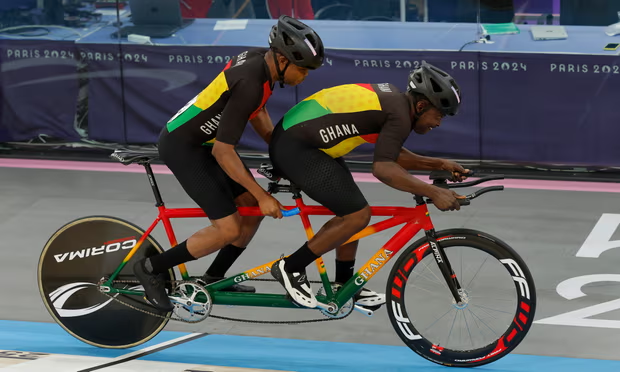
There are no velodromes in Ghana. But there is a Paralympic track cyclist. His name is Frederick Assor and at the Paris velodrome he and his pilot, Rudolf Mensah, loop the track on a brightly-coloured tandem with spoked wheels and a Heath Robinson air.
Assor and Mensah finished last in the men’s B 4,000m individual pursuit on the first day at the track, their time of 6min 30.071sec, a Ghanaian and African record, 2min 35sec slower than the winner Tristan Bangma of the Netherlands, who broke the world record with an average speed of over 61km/h. Assor and Mensah’s average was 36.9km/h. They returned on Sunday, whooped along by the crowd, this time in the B 1,000m time trial, where they also finished last.
The huge gap isn’t much of a surprise: the bike Assor rides compared to the bikes of other nations is the difference between a pawing thoroughbred and a weary donkey.
“It’s nice riding on a big platform like the Paralympics,” says Assor. “But the issue is that we are using a very, very old bike. You can see that we are riding with all our energy, our strength, because you pedal, you pedal a lot. But you see the other countries, they pedal slowly because their crank is very, very big. They have a 144 crank, but we are using a 50 crank so if they go once, we have to go three times.”
Assor loved sport as a child, playing football, volleyball and athletics. But he became blind at 14. “We were writing exams and then I couldn’t see again. Just like that.” There was a huge period of adjustment as he learned braille. When he went to university he was introduced to cycling and fell in love with it.
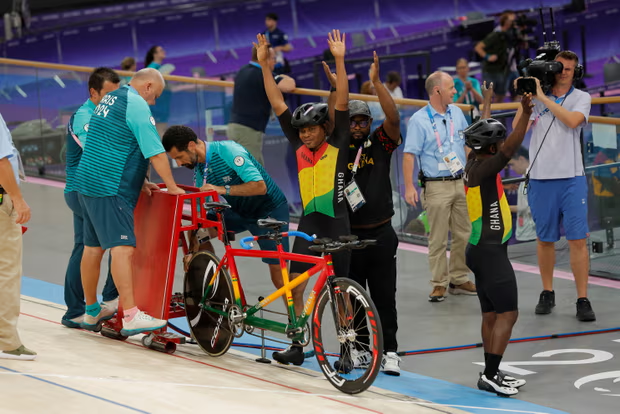
“It has given me more confidence and boldness. It means I don’t fear when I’m walking, because when you are riding you can’t see anything but you are moving fast.”
He is Ghana’s first blind Paralympic cyclist and this is his and Mensah’s second Games after Tokyo – where their bike was lost in transit and they had to borrow one from the Japanese federation. This time they have also had bike problems, the French team later lending them some wheels, which they have now returned.
Mensah isn’t only the eyes of the bike, he also is the coach and the (volunteer) team mechanic. He and Assor both live in Accra, where Assor does some odd jobs and Mensah works as a mechanic. He spends his spare time repurposing bikes and trying to put together improvised tandems that other blind people can ride.
There are only a handful of velodromes in Africa, including one in Egypt and a concrete one in Lagos, and when Mensah first saw one he wasn’t convinced.
“I was afraid. I asked myself, can I ride on that? I saw two ladies from Britain, the way they rode on the velodrome, their speed and skills, then I saw that I can do it. And I told him [Assor], it’s easy, we can do it. He tried before and he fell down, but I was good to him, I said to him, let me ride you, let’s do it.”
When the two go out training on the road, the sight of them on the tandem causes some surprise. “When people see us, they think we are having leisure,” says Assor, “because they have not seen two people sitting on one bike before. Sometimes when we tell them, it amazes them that a blind man is riding.”
Ghana has sent one of the smaller Paralympic teams to Paris, just four athletes: Assor, Zinabu Issah, who got through qualifying in the wheelchair discus and will compete in the shot put on Wednesday, Patricia Kyeremaa, who lost the last 16 of the women’s K44 +65kg taekwondo, and the powerlifter Tahiru Haruna, who will compete in the +107kg final on Sunday. Resources are scarce.
How are people with disabilities treated in Ghana? “Not good,” says Assor. “We are far behind. We have a lot of abilities in people with disabilities. There are people who would be interested in doing sports. There are people who would be interested in doing other things, like sewing, shoe making. But with all these things, it boils down to the resources and the facility for doing this
“I hope someone will read this and say: ‘Have some wheels.’ And then we could get a lot of people who could qualify for a competition like this. But with just one person all the time and no equipment, it’s not healthy.”
Latest Stories
-
AGI commends government’s move to resolve the power crisis in Volta and Oti Regions
19 minutes -
IBAG president alleges political interference driving kickbacks in insurance sector
53 minutes -
Trump agrees to two-week ceasefire, Iran says safe passage through Hormuz possible
1 hour -
Dozens killed as Angola flood death toll rises
1 hour -
Russia confirms deaths of 16 Cameroonians fighting in Ukraine war, Yaounde says
2 hours -
Plan to scrap presidential elections puts Zimbabweans at loggerheads
2 hours -
Guinea-Bissau transporters strike over higher fuel prices
2 hours -
Iran ceasefire deal a partial win for Trump – but at a high cost
2 hours -
Oil slides below $100 after Trump announces two-week ceasefire
2 hours -
Madagascar declares state of emergency over energy situation due to Iran war
2 hours -
Ex-Meta worker investigated for downloading 30,000 private Facebook photos
3 hours -
World Bank says Nigerian economy to grow in 2026 but Iran war lifts inflation
3 hours -
Ringleader of suspected human trafficking network arrested in Ethiopia
3 hours -
Alexander-Arnold fails to ease Tuchel concerns as Kane stars
3 hours -
Amad backs Carrick for Manchester United job
3 hours